Digital Audio
To take advantage of the T 737’s high performance surround and digital
audio circuitry, it is advisable that its Digital Audio inputs are selected.
There are four Digital Audio inputs selectable for the T 737 - Optical 1,
Optical 2, Optical Front and Coaxial IN.
Another option is “O” whereby no incoming digital audio signal is selected
by the particular Source.
NOTE
An incoming digital signal present at the assigned digital input will always
take precedence over the assigned analog audio input, even if both are
present. To maintain the analog audio input for the particular Source, select
“O” at the “Digital Audio” setting of the same “Source” menu.
Video
A specic video input can be assigned a particular Source. The following are
the assignable Video inputs:
• HDMI 1, HDMI 2
• Component 1, Component 2, Component 3
• S-Video 1, S-Video 2, S-Video 3, S-Video 4, S-Video Front
• Video 1, Video 2, Video 3, Video 4, Video Front
Another option is “O” wherein the particular Source is prompted not to
select any Video input.
ABOUT VIDEO FORMATS
For many years, there was only one type of video format used. Composite
video signals include the Luminance (black & White) and Chroma (color)
signals combined on one wire. S-Video uses separate wires in a single cable
for Luminance and Chroma signals. Component Video goes a step further
with separate cables for Luminance and the two elements of Chroma. For
NTSC (America, Japan) as well as PAL signals(Europe, Asia) these are labeled
Y, Cr, Cb. Television studios use the Component Video format to keep these
signals separate in order to maintain the best quality. As consumer video
equipment has improved this higher quality format has been included.
VIDEO FORMAT CONVERSION
The T 737 is equipped with a Video Format Converter. This allows for a
simplied video connection between the T 737 and your TV Monitor when
using multiple video formats such as Composite (CVBS), S-Video, and
Component (YUV). This format change is accomplished by encoding the
analog video signal intoa digital signal using a very high quality digital encoder
to maintain the best possible picture quality. Once in a digital format, it can be
decoded into any of the three standard analog video formats.
It is suggested that you select the highest quality video format available
on your TV Monitor and utilize this for your Monitor OUT connection from
the T 737 to the TV Monitor. In most cases this will be Component Video,
but on some older TV’s S-Video may be the best quality connection. See
also the item “COMPONENT VIDEO 1-3, COMPONENT VIDEO OUT” under
“Identication of Controls – Rear Panel” discussions.
NOTES
Video signals are converted between all three formats:
· Video (Composite), S-video and Component Video.
· All three monitor outputs will always be active no mater what the source
format is.
· OSD menu is always available on all three output formats - Video
(Composite), S-Video and Component Video.
A/V Preset
A particular Source can be assigned a stored Preset. The parameters set up
in the selected Preset number will be adopted into the particular Source
it is assigned (Please refer to the separate item below about “AV PRESETS
SETUP” for a better understanding of A/V Preset settings).
Scrolling to “A/V Preset” and by pressing [ ] and then [ ] keys, a
Source could be assigned a Preset number ranging from Preset 1 to 5.
If it is desired not to assign the particular Source a Preset setting, select
“None”.
Trigger Out
The Trigger Out for a particular Source is dependent on the congurations
done in a separate menu on Trigger Setup (See “TRIGGER SETUP” below).
If Trigger output is assigned to “Src Setup” in the separate “Trigger Setup”
menu window, +12V will be available at +12V TRIGGER OUT port whenever
a Source with “Trigger Out” set to “Yes” is recalled.
Another option is “None” whereby the particular Source is not assigned any
Trigger Out.
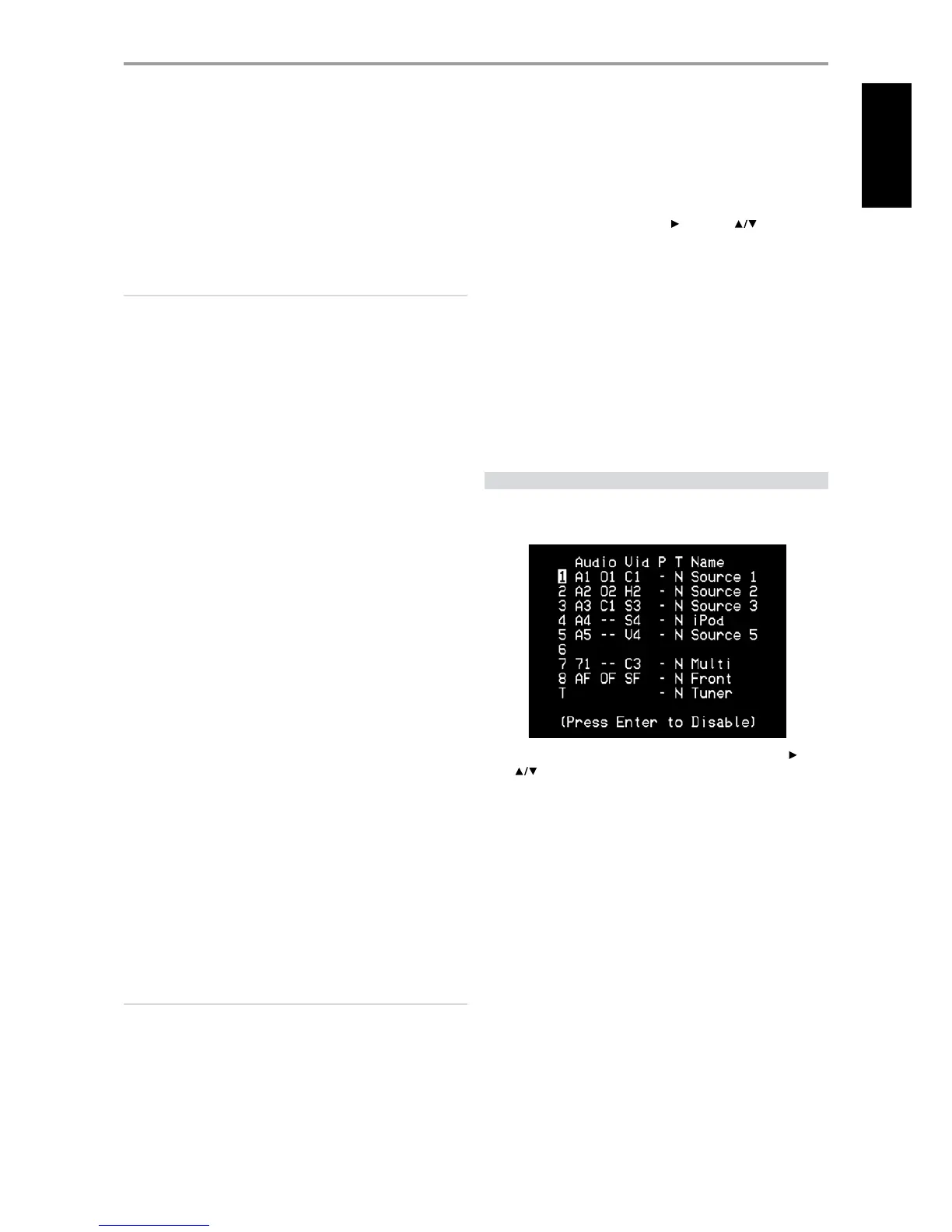
SOURCE SETUP (TABLE VIEW)
The Source Setup (Table View) reects the settings made in the Source
Setup (Normal View) menu. All the Source settings are summarized and
displayed in tabulated form in the Source Setup (Table View).
Navigating through the Source Setup (Table View) via a combination of [ ] and
then [ ] keys, one will have the benet of directly changing the settings for
“Audio, Video, Preset, Trigger and Name” without going back to the Source Setup
(Normal View) menu. Toggle [ENTER] also to enable or disable a Source.
OPERATION
USING THE T 737 SETUP MENU
19
ENGLISHFRANÇAISESPAÑOLITALIANODEUTSCHNEDERLANDSSVENSKAРУССКИЙ


 To Next Page