2.4 Electric assistance:
2.4.1 Operation:
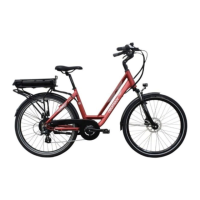
Your bicycle is an electric bicycle (e-bike): it is equipped with an electric motor, located in the rear wheel.
This motor activates automatically (if switched on and the battery is charged) when you pedal, and only when
you pedal.
The electric assistance is activated by an electromagnetic sensor, which cuts power to the motor when the
pedals stop turning.
The motor is also cut:
• When you pull either of the two brake levers;
• When you reach the upper speed limit of 20 or 25 km/h (depending on configuration).
This principle enables the motor to give you its full power when you need it, and to make “energy savings”
when you are riding downhill or riding on flat ground.
This energy control increases the e-bike’s battery life. These functions and energy control are achieved using
an electronic unit or “controller”.
WE
WOULD
LIKE
TO
POINT
OUT
THAT
THE
ACTIVATION
OR
DEACTIVATION
OF
THE
ELECTRIC
ASSISTANCE
MAY
LEAD
TO
ABRUPT
ACCELERATION
OR
DECELERATION.
2.4.2 Performance values:
The electric assistance on your bike is limited up to 25 km/h (according to configuration).
At this speed, the power supply to the motor will be automatically cut.
Your bicycle’s battery life depends on numerous parameters:
Weight transported:
Your bicycle’s performance values refer to an average load of 75 kg.
Exterior temperature:
The performance values refer to an exterior temperature of around 20°C. Below this temperature,
performance values decrease; however, this drop in performance is not particularly significant unless
temperatures fall below 5°C.
Battery wearing:
Your battery is designed to provide you with stable performance values over 750 charging cycles (or
an average service life of 3 years). After these 750 cycles, the battery will still be operational, but its
performance values will fall proportionally, and its battery life will decrease along with it.
But most of all, the battery’s run time depends on the terrain you ride on:
The theoretical battery life ranges from 30 to 50 kilometers, based on a near-continuous demand on
flat ground or with gentle inclines (10 to 20% of the total). If your route is flat and includes a portion
of declines (even gentle declines), your battery’s run life will increase. If you climb inclines steeper
than 5% (the motor “struggles” on inclines of above 8%), your battery life may decrease
proportionally.
Manual PLIMOA
17


 To Next Page