The Odstock Dropped Foot Stimulator (ODFS® Pace and ODFS® Pace XL) is a Functional Electrical Stimulation (FES) device designed to improve walking for individuals with dropped foot or other gait problems resulting from nerve damage in the spine or brain. This includes conditions such as stroke, multiple sclerosis, spinal cord injury (T12 and above), head injury, cerebral palsy, Parkinson's disease, and hereditary spastic paraparesis. The device is controlled by a footswitch placed in the shoe, which triggers stimulation at the appropriate time during walking. It also features an exercise function for muscle strengthening while resting.
Function Description:
The ODFS® Pace (XL) produces foot lift (dorsiflexion) and ankle stabilization (eversion) as the foot leaves the ground, allowing for sufficient time for push-off using voluntary calf muscle activity. This helps the foot clear the ground, preventing the toe from catching, and enables a natural heel strike with controlled ankle lowering, preventing foot slap. The device can also strengthen muscles, reduce spasticity, increase range of movement, reduce oedema, increase local blood flow, and modulate the central nervous system to promote neuroplasticity. It is intended for use as a long-term orthotic aid for both adult and paediatric individuals.
Important Technical Specifications:
- Medical Device Classification: Class IIa, internally powered, continuous operation. Type BF applied part(s).
- Ingress Protection Rating: IP22 (Protected against solid foreign objects of 12.5mm and greater diameter; vertically falling water drops have no harmful effect when tilted up to 15°).
- Stimulator Size: 72 x 62 x 26 mm.
- Stimulator Weight: ODFS® Pace: 68g without battery; ODFS® Pace XL: 75g without battery.
- Battery: PP3, 9V.
- Battery Life (average use):
- Alkaline battery: 3 to 6 weeks (ODFS® Pace), 1 to 2 days (ODFS® Pace XL).
- NiCad or NiMH rechargeable battery: 4 to 8 days (ODFS® Pace), use not recommended (ODFS® Pace XL).
- Lithium polymer rechargeable battery: 3 to 6 weeks (ODFS® Pace), 1 to 2 days (ODFS® Pace XL).
- Operating Temperature: Electrodes: 5 to 27°C; Alkaline Battery: -20 to 54°C; Lithium Battery: -10 to 40°C; System (excluding above items): 5 to 40°C.
- Storage & Transport Temperature: Electrodes: 5 to 27°C (>1 month), 0 to 40°C (<1 month); Alkaline Battery: 5 to 30°C; Lithium Battery: 0 to 35°C; System (excluding above items): -20 to 70°C.
- Relative Humidity: Electrodes: 35 to 50%; System & Batteries: 15 to 90%.
- Atmospheric Pressure: 700 to 1060hPa.
- Wireless Information (ODFS® Pace XL only): Industry standard ZigBee PRO compliant RF telemetry module, ETRX3. Contains RF transmitter S4GEM35XA. Frequency band: 2.4 to 2.483 GHz (2.4GHz ISM band). Radiated power: +8dBm.
Usage Features:
- Control Knob: Used to turn the device on/off, adjust output level (pulse width), navigate menus, and select options. It features a control lock that enables after 4 seconds of inactivity to prevent accidental adjustments.
- Test Button: Delivers a single burst of stimulation when pressed in pause mode, assisting in finding the correct electrode position and testing the output level.
- Pause Button: Cycles between active and pause modes. In walk mode, a long beep indicates active mode, and a shorter, higher-pitched beep indicates pause mode. When paused, the battery condition is briefly displayed.
- Stimulation Modes:
- Walk Mode: Functional stimulation triggered by a wired or wireless footswitch.
- Exercise Mode: Stimulation controlled by an internal timer, not intended for walking. Enabled by a clinician. For ODFS® Pace, entered by removing the footswitch lead plug. For ODFS® Pace XL, entered via the user accessible menu.
- User Accessible Menu: Accessed by clicking and holding the control knob for 2 seconds (or just holding if control lock is disabled). Allows users to:
- Change between walk and exercise modes.
- Access "Options" for "BEEPS" (audio beep feedback) and "SOUNDER" (stimulation audio feedback) settings (ON/OFF).
- Access "Wireless Options" (ODFS® Pace XL only) to join wireless footswitch or remote control accessories.
- Activate "Airplane Mode" (ODFS® Pace XL only) to disable wireless communication, requiring a wired footswitch for walking.
- View "My Steps" (total steps taken with stimulated leg) and "Total" steps (since last clinician reset). Users can reset "My Steps."
- Auto Turn Off: The device automatically turns off after 4 hours of inactivity in pause mode to save battery power.
- Electrode Placement: Clinician-guided placement of active (black pin) and indifferent (red pin) electrodes, typically on the fibula head and 2cm below/forward, respectively, to achieve optimal foot lift and ankle stabilization. Specific adjustments can be made to reduce eversion or inversion.
- Footswitch Placement: Placed on the underside of a cork or solid foam insole, typically midline of the foot and under the heel, to detect foot contact and trigger stimulation.
- Wireless Joining (ODFS® Pace XL only): Allows joining of wireless footswitch or remote control accessories via the user accessible menu. Remote control must be joined before a wireless footswitch if both are used.
- Create Network (ODFS® Pace XL only): An advanced wireless option to reset the network and select a quieter channel in case of interference, requiring re-joining of all wireless accessories.
Maintenance Features:
- Cleaning:
- Stimulator: Wipe with a damp cloth or anti-bacterial wipes. Do not immerse in water or clean with solvents. Remove battery before cleaning.
- Electrodes: Dampen with water and wipe. Do not use cloth to clean gel, immerse in water, or use soap.
- Leads and Footswitches: Clean with anti-bacterial wipes or a damp cloth soaked in water.
- Battery Care: Remove battery if not used for an extended period. For LiPo rechargeable batteries, fully charge every 3 months if not used regularly. Only use recommended batteries, chargers, and power supplies. Do not use or recharge damaged/swollen batteries.
- Electrode Replacement: Replace electrodes if they become worn, pitted, damaged, contaminated, or lose stickiness after 3-4 weeks of daily use.
- Consumables: Electrodes, elasticated tubular stockings, and insoles are single-patient use only.
- Servicing: No regular servicing required. Faulty devices should be returned to Odstock Medical Limited.
- Calibration: The device and its consumables/accessories do not require calibration by the clinician or end user.
- Expected Service Life:
- Stimulator: 5 years.
- Electrode/Footswitch sockets: 2 years.
- Footswitch/Footswitch lead/Electrode lead: 6-12 months.
- Neurostimulation electrodes: 3-4 weeks.
- Elasticated tubular bandage: 3 months.
- ODFS® Pace (XL) pouch: 2 years.
- Cork insoles: 3 months.
- Foam insoles: 1 year.
- PP3 Battery (9V) (non-rechargeable): 3-6 weeks.
- PP3 rechargeable battery LiPo: 100 charge cycles (>65% capacity).
- Battery charger 4 bay LiPo: 5 years.

 Need help?
 General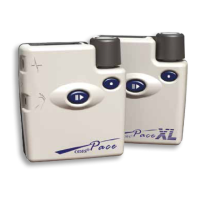

 To Next Page