To Next Page
D
David MartinezSep 6, 2025
How to fix overexposed pictures on Nikon Coolpix S230?
- JJason PayneSep 6, 2025
If your Nikon Digital Camera pictures are too bright (overexposed), adjust the exposure compensation.

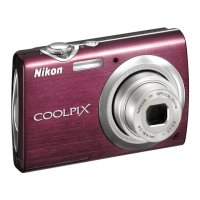
How to fix overexposed pictures on Nikon Coolpix S230?
If your Nikon Digital Camera pictures are too bright (overexposed), adjust the exposure compensation.
How to fix blurred pictures on Nikon Digital Camera?
If your Nikon Digital Camera pictures appear blurred, consider the following: * Use flash. * Increase ISO sensitivity using the High ISO auto setting in the shooting menu. * Enable electronic vibration reduction or motion detection. * Use BSS (Best Shot Selector). * Stabilize the camera with a tripod and use the self-timer.
Why Nikon Transfer does not start when my Nikon Digital Camera is connected?
To resolve the issue of Nikon Transfer not starting when your Nikon Digital Camera is connected, consider the following: * Ensure the camera is turned on. * Verify the battery is not exhausted. * Check that the USB cable is correctly connected. * Confirm the camera is recognized by the computer. * Ensure your computer is set to automatically start Nikon Transfer.
Why are my Nikon Digital Camera pictures too dark?
If your Nikon Digital Camera pictures are too dark (underexposed): * Check if the flash is off and turn it on if needed. * Ensure the flash window is not blocked. * Make sure the subject is within the flash range. * Adjust exposure compensation. * Select High ISO auto for ISO sensitivity in the shooting menu, or raise the ISO sensitivity. * If the subject is backlit, select o (Backlight scene mode) or use fill flash.
Why does my Nikon Coolpix S230 turn off without warning?
If your Nikon Digital Camera turns off unexpectedly, it could be due to the following reasons: * The battery is low, so replace or recharge it. * The camera has turned off automatically to save power. * The battery is cold.
What to do if my Nikon Coolpix S230 is not taking pictures?
If your Nikon Digital Camera is not taking pictures when you press the shutter-release button: * Ensure the camera is not in playback mode by pressing the A button or the shutter-release button. * If menus are displayed, tap H. * Check if the battery is exhausted and replace if necessary. * If the flash lamp is blinking, wait for the flash to charge before attempting to take a picture.
Why is the monitor blank on my Nikon Coolpix S230?
If your Nikon Digital Camera monitor is blank, it could be due to several reasons: * The camera might be off, so ensure it is powered on. * The battery could be exhausted, so replace or recharge it. * The camera may be in standby mode to save power; press the power switch, shutter-release button, A button, or c button. * If the flash lamp is blinking red, wait until the flash has finished charging. * The camera might be connected to a computer via USB or to a TV via AV cable; disconnect these to view the monitor. * Interval timer photography might be in progress.
Why my Nikon Digital Camera settings reset?
If your Nikon Digital Camera settings have been reset, the backup battery is exhausted, and all settings were restored to their default values.
Why date is not appearing on Nikon Coolpix S230 pictures?
The date will not appear on Nikon Digital Camera pictures in the following situations: * Movies. * Pictures taken using d (Sports scene mode), l (Museum scene mode), or p (Panorama assist scene mode). * When Blink proof is set to On in smile mode. * When the Continuous setting is set to Continuous or BSS. * When Electronic VR is set to Auto.
How to correct date and time on Nikon Coolpix S230 Digital Camera?
To correct the date and time on your Nikon Digital Camera recordings: * Set the correct time and date from the Date option in the setup menu. * Check the camera clock regularly against more accurate timepieces and reset as required.
 General
| Megapixel | 10 MP |
|---|---|
| Camera type | Compact camera |
| Sensor type | CCD |
| Image stabilizer | Yes |
| Image sensor size | 1/2.33 \ |
| Maximum image resolution | 3648 x 2736 pixels |
| Digital zoom | 4 x |
| Optical zoom | 3 x |
| Focal length range | 6.3 - 18.9 mm |
| Interface | USB |
| Digital SLR | No |
| Camera shutter speed | 1/1000 - 2 s |
| Effective sensor resolution | 10340000 pixels |
| Compatible operating systems | Windows Vista Home Basic / Home Premium / Business / Enterprise / Ultimate Editions Windows XP Home Edition / Professional Mac OS X 10.3.9 / 10.4.11 / 10.5.5 |
| Focal length (35mm film equivalent) | 35 - 105 mm |
| Focus adjustment | Auto |
| Normal focusing range | 0.6 - ∞ m |
| Macro focusing range (wide) | 0.10 - ∞ m |
| ISO sensitivity | 80, 100, 200, 400, 800, 1600, 2000, Auto |
| Internal memory | 44 MB |
| Compatible memory cards | sd, sdhc |
| Video formats supported | AVI |
| Maximum video resolution | 640 x 480 pixels |
| Display diagonal | 3 \ |
| Display resolution (numeric) | 230000 pixels |
| USB version | 2.0 |
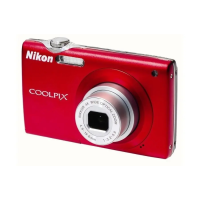
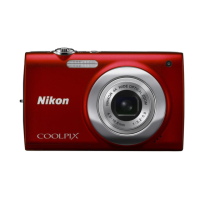
| Product color | Red |
| Battery type | EN-EL10 |
| Battery capacity | 740 mAh |
| Power requirements | DC 3.7V |
| Battery life (CIPA standard) | 160 shots |
| Number of batteries supported | 1 |
| Operating temperature (T-T) | 0 - 40 °C |
| Operating relative humidity (H-H) | 0 - 80 % |
| Flash modes | auto, Red-eye reduction |
| Scene modes | Backlight, beach, Close-up (macro), dusk, Fireworks, Museum, Night landscape, Night portrait, Panorama, party (indoor), Portrait, Sports, Sunset, Landscape (scenery) |
| Image editing | crop, resizing, rotating |
| Photo effects | black&white, Sepia, Vivid |
| White balance | auto, Cloudy, daylight, flash, Fluorescent, Incandescent, manual |
| Camera playback | single image, slide show |
| Camera shutter type | electronic, mechanical |
 Weight and Dimensions
| Depth | 20 mm |
|---|---|
| Width | 91 mm |
| Height | 57 mm |
| Weight | 115 g |
Important safety precautions and warnings for using the camera and its accessories.
Instructions for connecting and charging the camera's rechargeable Li-ion battery.
Procedure for correctly inserting the rechargeable Li-ion battery into the camera.
How to power the camera on and off using the power switch.
Procedure for inserting a Secure Digital (SD) memory card into the camera.
Instructions for charging the camera's battery using the supplied charger.
Procedure for inserting the battery and a memory card into the camera.
How to turn on the camera and select the Auto mode for shooting.
Guidance on positioning the subject and framing the shot for optimal picture taking.
Instructions for viewing and deleting pictures in playback mode.
How to select scene modes like Portrait, Landscape, Sports, or Night portrait.
How to use smile mode to automatically detect and shoot smiling faces.
How the blink proof function works to save shots where eyes are open.
Overview of settings available in the shooting menu for image quality and exposure.
Choosing image size and quality settings, affecting file size and print resolution.
Detailed explanation of white balance settings and their effect on image colors.
How to adjust exposure compensation to control picture brightness.
Settings for continuous shooting modes: Single, Continuous, BSS, Multi-shot 16, and Interval timer.
Adjusting camera sensitivity to light, impacting image noise and brightness.
How to choose the focus area, including Face priority, Auto, and Center.
How the camera detects and focuses on faces, including operation in different shooting modes.
How to select pictures and the number of copies for printing.
How to delete selected or all pictures from the camera.
How to protect selected pictures from accidental deletion.
Detailed explanation of electronic VR settings and their effects on still pictures.
Setting the camera clock and choosing home and travel destination time zones.
How to format the camera's internal memory or a memory card.
Setting whether to detect human subjects with eyes closed during shooting.
Restoring camera settings to their default values.
Troubleshooting common issues related to the monitor, settings, and power supply.
Troubleshooting common problems encountered during shooting operations.
Troubleshooting common issues encountered during picture playback.
How to focus on subjects and take pictures, including flash status.