119118
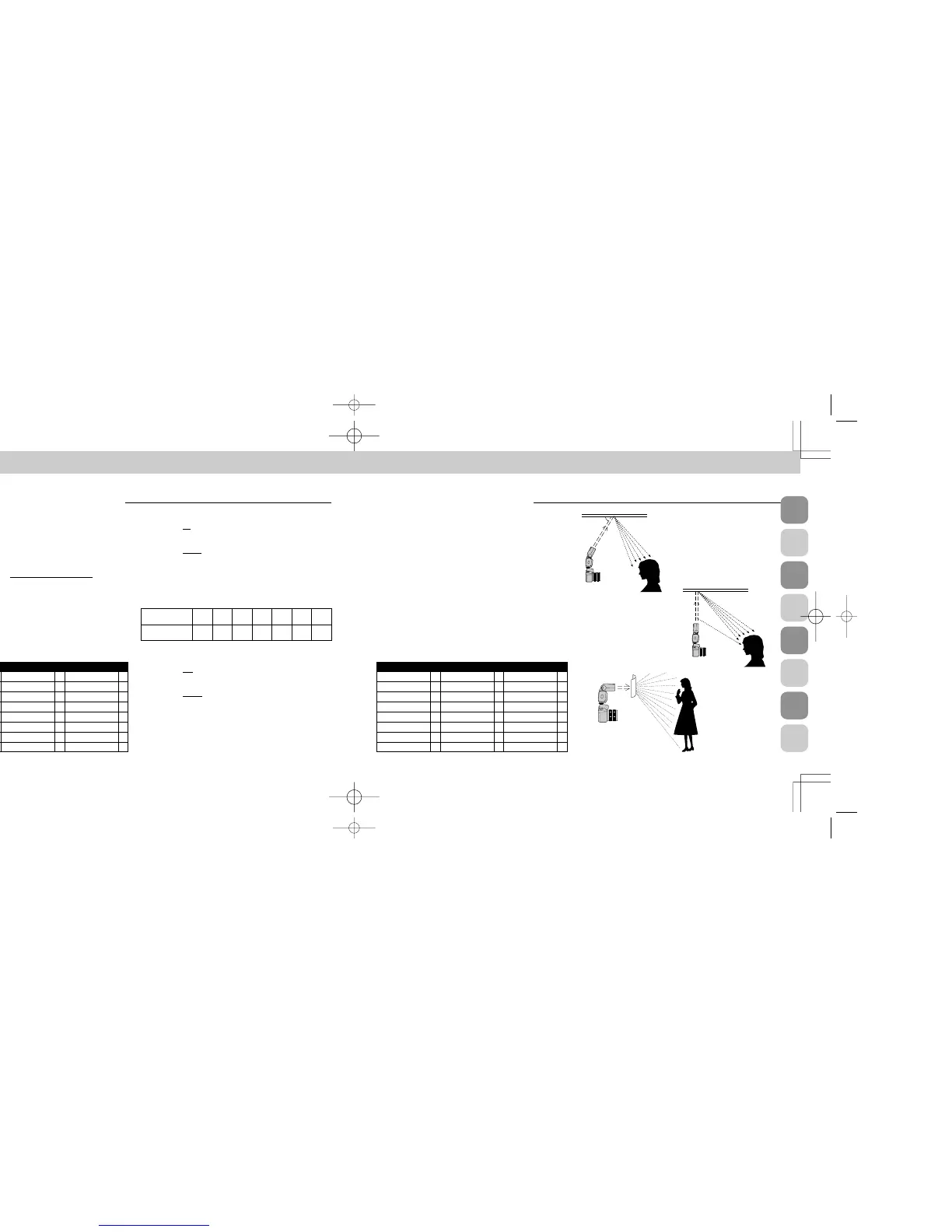
Diffusing Light —
To Soften Harsh Shadows
With a subject in front of a wall, a direct flash causes harsh
and unattractive shadows. By bouncing the light off the ceil-
ing or walls, or by diffusing the light with card(s) or paper,
you can soften harsh shadows and create attractive por-
traits.
The SB-26 comes with a built-in diffuser. You can use it
alone or with a combination of other reflecting surfaces for
advanced application.
There are a few ways to diffuse light:
1. Bounce light off a broad reflective surface such as
the ceiling.
2. Use both the ceiling and the built-in diffuser card to
create a catchlight for subject's eyes.
3. Use a diffuser between the flash and the subject.
1. Light can be bounced off the ceiling.
2. Natural-appearing light
with a pleasing catchlight
in the eyes.
3. Use some translucent
material between the
flash unit and subject.
Chapter
4
The “guide number” helps you determine a correct aperture
or f/stop value for using the SB-26’s Manual Flash and
Repeating-Flash mode. (See “Guide number” chart, page
143.)
Use the following equation for your calculations, and
check the following chart for guide numbers at various film
speeds.
[f/stop] =
[guide number]
[flash-to-subject distance]
For example, when shooting a subject located 9 m
(approx. 30 ft.) away at 1/1 (full) light output in i (Manual
Flash) mode, with a zoom-head position of 35mm and a film
speed of ISO 100, you will obtain a guide number of 36 (or
118) from the same chart on page 143.
If the film speed in the above example was ISO 400 rather
than ISO 100:
[f/stop] =
36
x 2 = 4 x 2 = 8
9
Or, if measuring in feet;
[f/stop] =
118
x 2 = 3.93 x 2 = 7.86 ≈ 8
30
You should then choose f/8 as the proper aperture.
Adjustment factors for other ISO film speeds
ISO film speed
Factor
25 50 100 200 400 500 1600
x 0.5 x 0.71 x 1 x 1.4 x 2 x 2.8 x 4
If measuring in meters;
[f/stop] =
36
= 4
9
Or, if measuring in feet;
[f/stop] =
118
= 3.93 ≈ 4
30
You should then choose f/4 as the proper aperture.
For films other than ISO 100, multiply the above figures
by the factors shown in the following chart:
Guide Number —
To Calculate a Proper Aperture
F5
E F-601M/N6000 E FE2 E
F90X/N90s
E
F50-Series/N50
E FG E
F90-Series/N90
E F-401x/N5005 E Nikonos V E
F70-Series/N70
E F-501/N2020 E F3-Series E
F4-Series E F-301/N2000 E F2-Series E
F-801/N8008 E F-401/N4004 E FM2 E
F-801s/N8008s E F-401s/N4004s E FG-20 E
F-601/N6006 E FA E
APPLICABLE NIKON SLR MODELS
SB-26 (E) 03.1.14 7:16 PM Page 118





 To Next Page