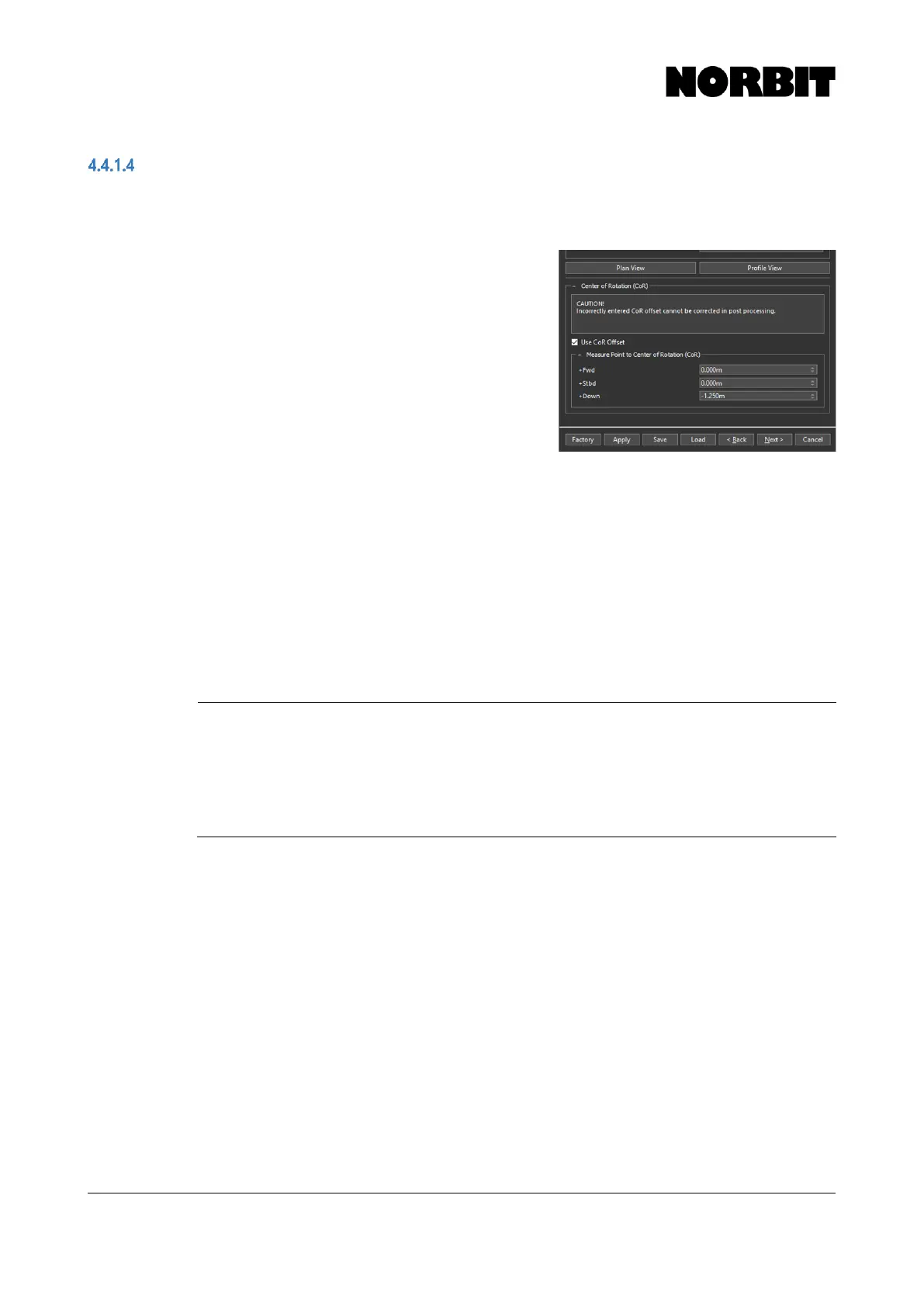
Center of Rotation Offset
The vessel Center of Rotation (CoR) offset should be entered relative to the Measure Point. Note
that the center of rotation is more of an area rather than a well-defined point on the vessel, therefore
an approximation will suffice. Select Use CoR Offset and enter the measured values under
Measure Point to Center of Rotation (CoR).
The vessel center of rotation is a point on the vessel that
experiences only rotations with changes in attitude. Any
heave measured at this point arises entirely from vertical
movements that affect the whole vessel equally. The
multibeam transducer, being some distance from the
vessel’s CoR, will therefore experience a small
component of heave as the vessel moves vertically in the
water, and a much larger component of apparent heave
with changes in vessel attitude.
To separate these effects, the INS can translate the IMU
measurements to the vessel CoR. Having done so, it applies filtering to the measurements of pure
heave and then translates the filtered measurements back to the heave record.
This method for measuring heave avoids the errors that can occur if you filter direct heave
measurements made from a point different from the vessel CoR.
By entering these values in the GUI, the user avoids a possible heave artefact that may occur as
the INS records the heave measurements made from an IMU that is not located at the vessel CoR.
Applanix systems apply a dynamic filter to the heave record to normalize the vertical data back to
zero over time. This can result in a visible heave artefact if the vertical orientation of the sonar is
constant for a period.
NOTE: Artefact Scenario
If the weight on a boat was shifted port or starboard for multiple minutes
during a survey, the sonar would be moved vertically in the water column. At
the beginning of this vertical shift, the heave would be recorded correctly.
However, after a period the heave value would start to settle back to zero
and the location of the multibeam in the water will not be recorded correctly.
The CoR, for most commercial vessels, is documented in the vessel design plans. For other vessels,
this point at which the vessel’s roll and pitch axes intersect must be determined. This location can
be hard to determine, as the vessel CoR may change from day to day and even during the day. For
smaller vessels, the CoR moves depending on fuel stowage and even distribution of personnel body
weight. Generally, choose a CoR location that is about ¾ distance from bow to stern, centered on
the keel, and located at approximately water level. Choose a location and attempt to keep the weight
distribution constant throughout the survey. If in doubt, take the boat to open water and measure its
motion while passing over waves in different directions.
It should be noted that these offsets only impact heave calculations and do not impact positioning.



 To Next Page