
 Need help?
Do you have a question about the Nordyne 4-5 TON SERIES and is the answer not in the manual?
Guidance on familiarizing with unit capabilities, safe operation, and problem resolution.
Critical safety warnings and precautions for users of the air conditioner.
Safety guidelines specifically for installation and servicing personnel.
Warnings regarding R-22 refrigerant, installation, and unqualified personnel.
Checklist for verifying supply voltage, frequency, phase, and wiring integrity.
Information on line voltage supply, disconnect switches, and branch circuits.
Ensuring the unit cabinet is properly grounded to prevent electrical hazards.
Checklist for verifying unit readiness before initial startup.
Step-by-step guide for initiating system operation and safety checks.
Detailed instructions for charging the system with R-22 refrigerant.
This document is a user's manual and installation instructions for a 4-5 ton split system air conditioner, designed for export. It covers single and three-phase units and uses R-22 refrigerant. The manual emphasizes safety, proper operation, installation, and maintenance to ensure the appliance provides safe and dependable comfort for many years.
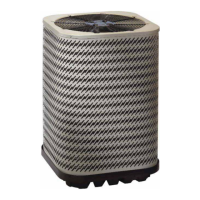
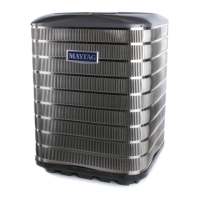
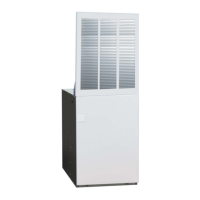
The air conditioner is designed to provide cooling and, with optional equipment, heating for indoor spaces. It operates as a split system, meaning it has an outdoor unit (condenser) and an indoor unit (air handler or furnace). The outdoor unit contains the compressor, outdoor fan motor, and refrigerant coils, while the indoor unit typically houses the indoor blower and evaporator coil. The system works by circulating R-22 refrigerant between the indoor and outdoor units to transfer heat. In cooling mode, heat is absorbed from the indoor air by the refrigerant and then released to the outside air. With optional heating equipment, the system can also provide warmth by generating heat indoors.
The unit is controlled by a thermostat, which allows users to select the system mode (COOL, HEAT, or AUTO), fan mode (AUTO or ON), and desired temperature. In COOL mode, the outdoor fan, compressor, and blower motor cycle on and off to maintain the set indoor temperature. In HEAT mode, the optional heating equipment and indoor blower operate to maintain the desired heating level. The AUTO mode allows the thermostat to automatically switch between cooling and heating to maintain the set temperature. The continuous indoor blower operation (FAN ON mode) circulates indoor air to equalize temperature imbalances, regardless of the system mode.
A key protective feature is a timer circuit that prevents the compressor and outdoor fan from restarting immediately after a temperature adjustment, system reset, or power interruption. This delay, typically around 5 minutes, helps protect the compressor from damage. For three-phase units, an anti-short cycle timer protection is not included.
The manual provides detailed instructions for operating the air conditioner, including setting the thermostat for cooling, heating, and automatic cooling/heating. It explains how to operate the indoor blower continuously and how to turn the air conditioner off. Users are advised to refer to their thermostat manufacturer's user manual for detailed programming instructions, as thermostat styles and features may vary.
For installation, the unit is designed for outdoor rooftop or ground-level installations. Proper placement is crucial, avoiding overhead obstructions, poorly ventilated areas, and locations prone to debris accumulation. Adequate clearance for unobstructed airflow through the outdoor coil must be maintained to achieve rated performance. The manual provides specific clearance requirements and guidelines for mounting pads, emphasizing the need for a level, strong pad for ground installations and structural integrity for rooftop installations.
Connecting the refrigerant tubing between the indoor and outdoor units requires careful attention to minimize length, bends, and vibration. Dry nitrogen should be flowed through joints during brazing to prevent internal oxidation. The system uses R-22 refrigerant with mineral oil, and it is critical not to use any other refrigerant to avoid damaging the unit.
Electrical wiring must comply with all local, state, and national codes. A dedicated branch circuit with the correct fuse or circuit breaker is required. An electrical disconnect switch must be located within sight and readily accessible to the unit. For three-phase units, phase balance is critical, and the manual provides steps to calculate voltage imbalance, advising contact with the electric utility if the imbalance exceeds 2%. Low voltage wiring for thermostat connections must also be correctly installed, with recommended wire gauges and lengths provided.
Startup procedures include a pre-start checklist to ensure all connections are secure, the unit is properly charged, and the thermostat is correctly wired. If the unit has a crankcase heater, a 24-hour warm-up period is required before startup to prevent compressor damage. The manual guides users through verifying blower operation, checking for proper cooling and heating, and monitoring refrigerant pressures.
Regular maintenance is essential for achieving the best performance and extending the life of the air conditioner. The manual recommends performing maintenance frequently, ideally at the beginning of each air conditioning season. Key maintenance tasks include:
The manual emphasizes that installation and servicing should only be performed by qualified, trained personnel familiar with the equipment and safe refrigerant handling procedures. This is due to the presence of liquid and gaseous refrigerant under pressure and the complexity of electrical connections. Owners are strongly advised not to attempt installation or servicing themselves.
For refrigerant charging, the unit leaves the factory with a nitrogen holding charge. Specific charging instructions are provided for maximum unit performance and efficiency, including leak checking and evacuating the indoor section and line connections. The manual includes charging tables for 4-ton and 5-ton units, applicable to matched assemblies of NORDYNE equipment. It also provides guidance on charging units in AC mode when the outdoor temperature is above 55°F, using liquid refrigerant pressure and temperature measurements.
The manual also includes a troubleshooting section, advising users to check thermostat settings, circuit breakers, and the cleanliness of filters and the outdoor unit if problems occur. If these suggestions do not resolve the issue, users are directed to call their servicing contractor.
Finally, the document includes an installation/performance check list for installers to complete, covering electrical system checks (voltage, polarity, connections, thermostat calibration) and refrigeration system checks (warm-up period for crankcase heaters, liquid and suction pressures, final charge). It also lists replacement parts available through Nordyne distributors, emphasizing the need for the complete model and serial number when ordering.
 General
| Refrigerant Type | R-410A |
|---|---|
| Phase | 1 |
| Compressor Type | Scroll |
| Tonnage | 4-5 |
| Cooling Capacity | 48000-60000 BTU |
| Voltage | 208/230V |




 To Next Page