1-4 Introduction
297-2521-106 Standard 23.01 March 2001
•
Layer 4, Transport—Transfers data between sessions transparently.
Layer 4 handles communication between the two end systems and
enhances, where necessary, the quality of services provided by layer 3.
• Layer 5, Session—Responsible for administration services, control of
data exchange, and delimiting and synchronizing data operation dialogue
services. Layer 5 handles the structure of dialogue between devices.
• Layer 6, Presentation—Interprets data and is responsible for format and
code transformation. Handles the representation of information as bit
patterns.
• Layer 7, Application—Contains the protocols specific to the application
or reason for communicating. Layer 7 is concerned with the application
process and management functions.
Note: Layers 4 through 7 govern the transmission of signaling information
between two terminals on an ISDN loop.
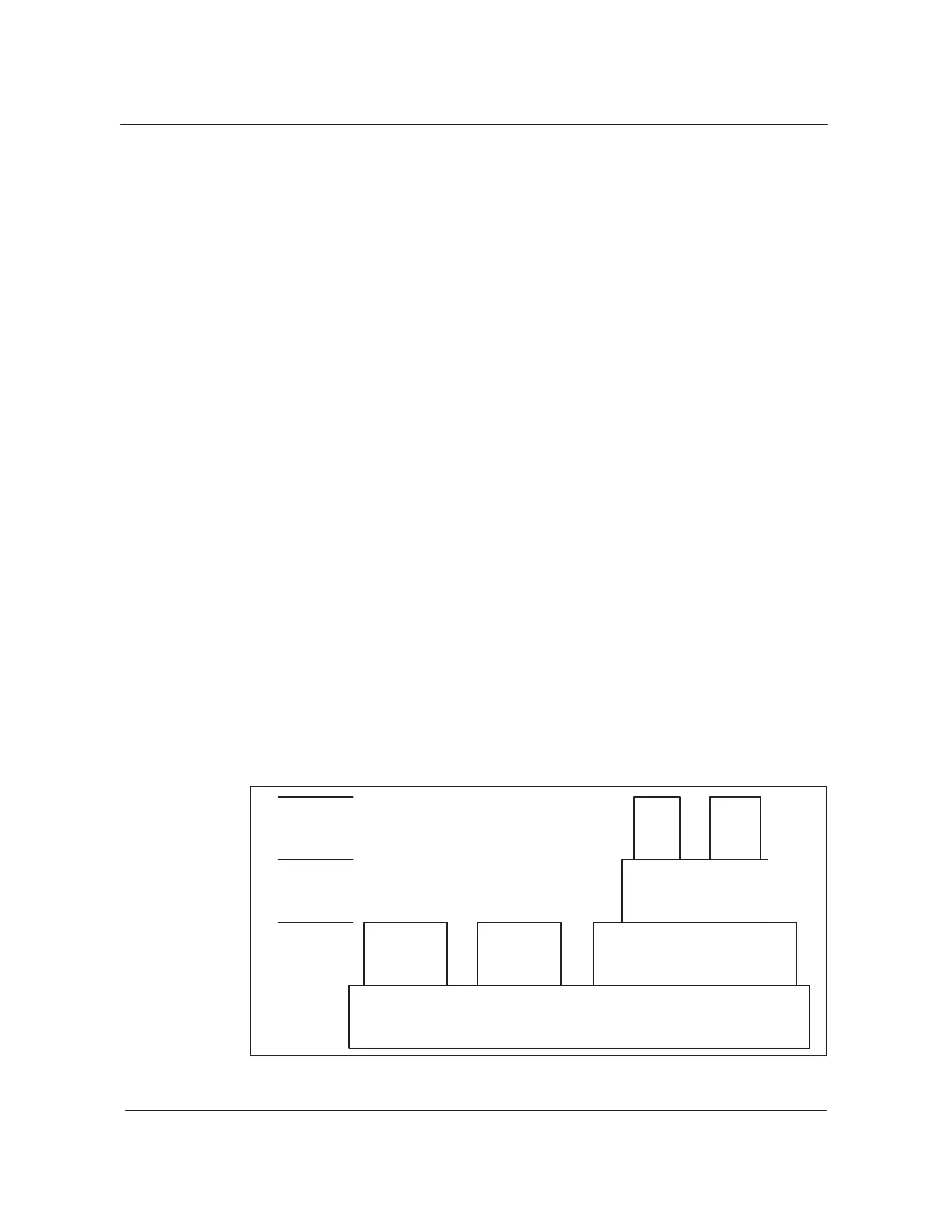
ISDN protocol layers
Layers 1 through 3 govern connection, set up, and transmission of
information between terminals on loops, packet-switched, and
circuit-switched networks. As shown in Figure 1-3, the protocols in layers 1
through 3 can be thought of as a series of pipes. Only message information
intended for that layer or any higher layer can pass through the pipes.
Data transfer on a B-channel between two ISDN terminals involves layer 2
and higher protocols. Layer 2 and higher protocols are transparent to the
telecommunications network. Layer 4 provides transparent transfer of data
between network entities.
Figure 1-3
Layers 1 through 3 of the ISDN protocol
B-channel D-channel
Primary interface
Link 1
Call 1
Call N...
...
Layer 1
Physical
Layer 2
Data link
Layer 3
Network
B-channel





 To Next Page