5-10 Call control procedures
297-2521-106 Standard 23.01 March 2001
Call establishment at the terminating exchange
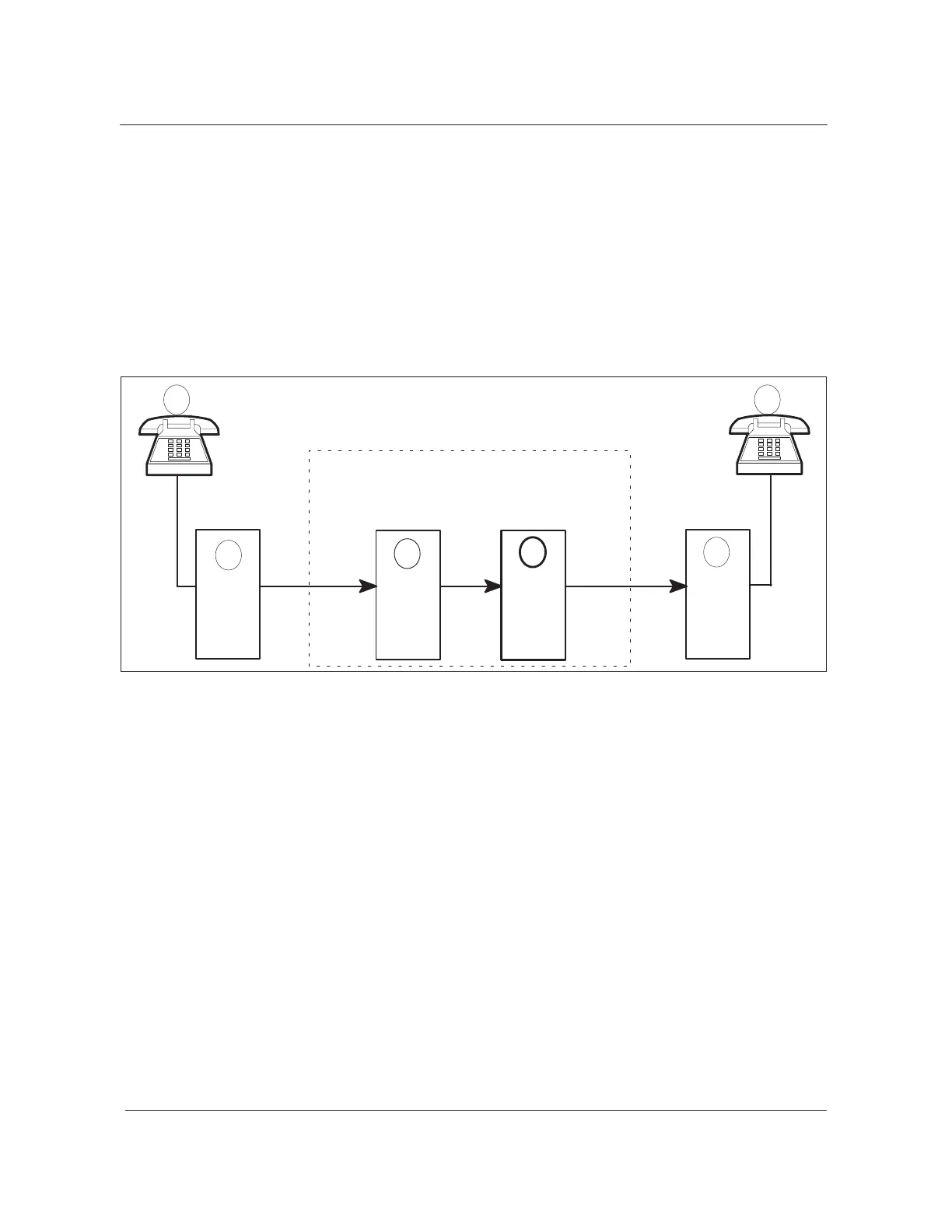
Call establishment at the terminating exchange occurs when a PRI call goes
out from the DMS-250 switch (node 4 in Figure 5-4) when the switch is the
network.
In any PRI connection, one end of the interface functions as the user and the
other functions as the network. The switch can function as the user or
network in a PRI connection, but is ideally configured as the network.
Figure 5-4
Originating exchange
PBX
DMS-250
3
4
IMT
1
25
Basic
PRI
PRI
User Network
UserNetwork
Originating
user user
Terminating
PBX
DMS-250
ISUP
switch
switch
6
(call originates
into switch)
Originating
exchange
(call terminates
out of switch)
rate
interface
Basic
rate
interface
Terminating
exchange
MCI
MCI
Network
Network call request with SETUP message
The network indicates the arrival of a call to a user by sending a SETUP
message across the terminating PRI interface. The SETUP message contains
information about the call regarding where it should be routed.
Selection of PRI B-channel for termination
The DMS-250 switch performs the following to select a PRI B-channel to
make an outgoing call.
PRI B-channel allocated
When a route is determined and the trunk group selected (within the route
verified as a PRI-type), the call is treated as a PRI termination. This is
described as follows.
To select a B-channel, the next idle member in the trunk group is chosen
according to the SELSEQ field in table TRKGRP. The outgoing PRI trunk
member is marked busy and the B-channel is allocated (made unavailable to
other calls). (The selected trunk member is in effect the B-channel.) This





 To Next Page