Introduction 1-5
Digital Switching Systems DMS-250 ISDN Reference Manual MWC14 (CSP14)
The layers function in the following manner:
• Layer 1 (physical) provides the physical pipe for primary access; this
layer contains multiple B-channels and one D-channel.
• Layer 2 (link) provides pipes on the D-channel in the form of logical
data links. These links join terminals on the loop to points that provide
access to packet-switched service or circuit-switched service.
• Layer 3 (network) provides protocols that are used to establish, maintain,
and clear one or more calls in a logical link pipe. For the PRI, one data
link exists between the terminal and the network, and between multiple
calls at layer 3.
• Layer 4 (application) provides protocols for transport, session,
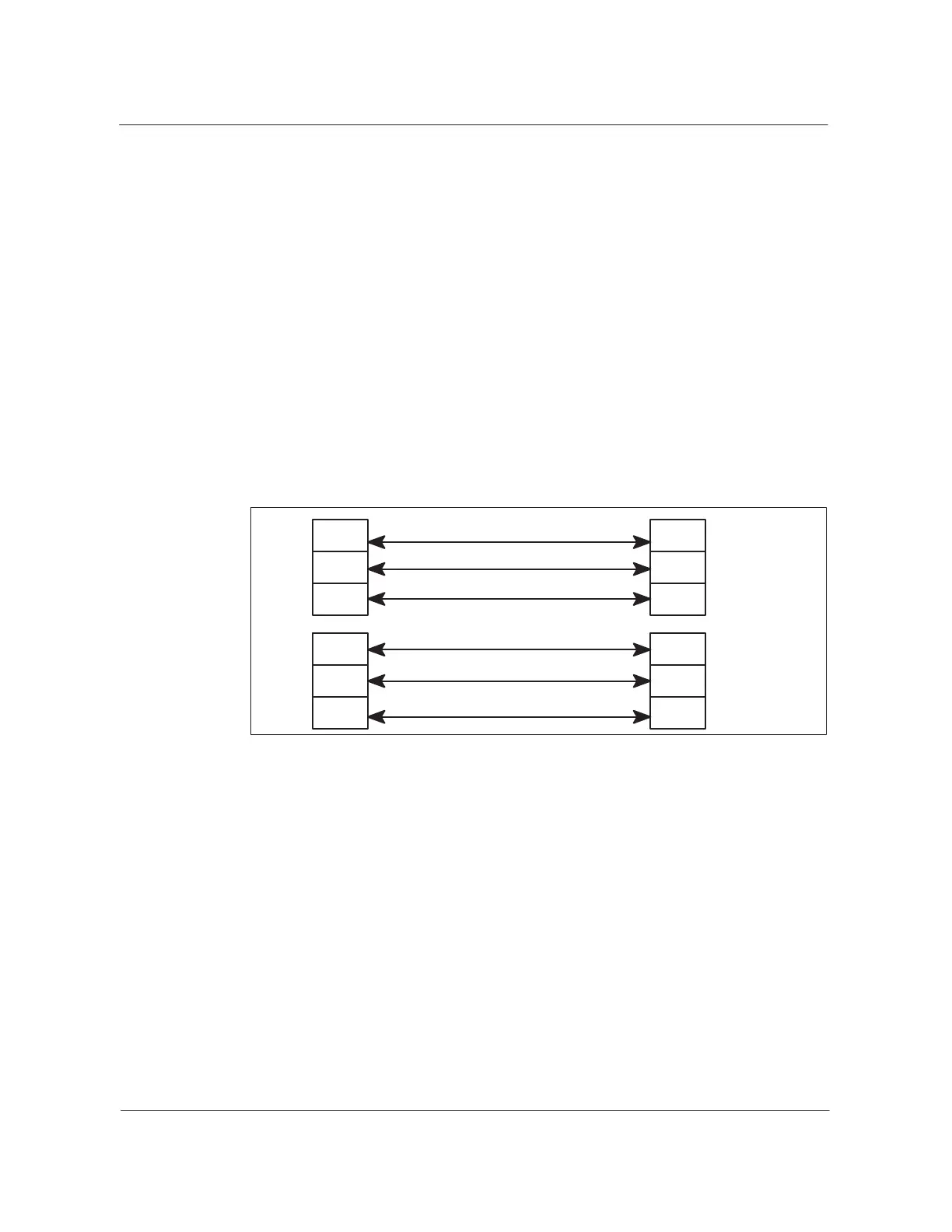
presentation, and application functions. Figure 1-4 shows the ISDN layer
1, 2, and 3 protocols used by the B- and D-channels.
Figure 1-4
B- and D- channel protocols
X.25
LAPB
I.431
B-channel
packet
service
protocol
view
L3
L2
L1
L3
L2
L1
Q.931
LAPD Q.921
I.431
D-channel
signaling
protocol
view
L3
L2
L1
L3
L2
L1
Layer 1 (physical) protocol
The physical layer protocol is described in CCITT recommendation I.431.
Layer 2 (link) protocols
There are two types of link access procedures:
• Link access procedure on the B-channel (LAPB) protocol—used to carry
packet-switched data, speech, and circuit-switched data on B-channels
(defined in CCITT recommendation Q.921)
• Link access procedure on the D-channel (LAPD)/Q.921 protocol—used
to carry multiple signaling and data message streams that interleave on
the same D-channel, each of which forms a logical link (defined in
CCITT recommendations I.440, Q.920, Q.441, and Q.921). There are
two types of logical links:
— broadcast—used for line (not trunk) implementation of ISDN





 To Next Page