and propane weighs 4.2 lbs. per gallon. Limiting your on-
board water until you arrive at your destination will lower
your total weight. You must know the actual load on the axles
and wheels, and there’s no other way to do it other than on a
commercial scale.
In addition to knowing the total weight, it is crucial to know
the weight on each end of each axle. That’s the only way you
can find out if the load is both within the tire capacity, as well
as whether the load is properly distributed.
You should be able to find certified scales by looking in your
Yellow Pages for moving and storage companies, farm
suppliers, gravel pits, recycling companies or commercial
truck stops. Be sure to call in advance to determine whether
the facility offers public weighing services, their hours of
operation and any fees that might be involved.
Failure to properly match camper and truck can result in
undesirable handling characteristics and create a safety hazard.
In addition to knowing the overall weight that can be safely
loaded in or attached to the truck, you should know how to
distribute the weight in the camper so that correct amounts of
weight are placed on each truck axle. Proper weight
distribution is required for driving stability and will assure that
the truck/camper is not rear, front or side heavy. Heavy
weights placed at the rear end of the truck/camper may cause
undesirable handling characteristics.
When loading the camper, store heavy gear first, keeping it on
or close to the camper floor. Place heavy things far enough
forward to keep the loaded camper’s center of gravity within
the zone recommended by the truck manufacturer. Store only
light objects on high shelves. Distribute weight to obtain even
side-to-side balance of the loaded vehicle. Secure loose items
to prevent weight shifts that could affect the balance of your
vehicle.
Attaching Camper to/Removing from Truck
Swing-Out Brackets: (If equipped)
To load or unload campers on dual rear wheel trucks, special
brackets are installed on the front jacks to clear the fender. To
operate, follow the steps below:
1) Lift jack from the travel notch locked position and
swing outward from the camper body.
2) Position jack so when camper jack is lowered, the
notch and raised tab engage to prevent rotation.
3) Repeat the process for the other front mounted jack.
4) Follow the standard camper loading and removal
procedures below.
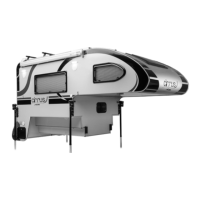
Loading/Removing Camper
Keep children and animals away from the area when raising or
lowering the camper. Avoid putting any part of your body
under the camper during the procedure.
Do not tilt the camper sideways while raising it on the jacks.
The jacks could buckle.
Always raise or lower the camper with the front either level or
higher than the back to avoid weight transfer and damage to
jacks or cargo.
Always load and unload camper on firm level ground.
Use caution when loading and unloading the camper on a
windy day. The amount of wind that is dangerous depends on
your exposure and the weight of the camper, etc.
Always keep
front higher
than rear.
Before loading
the camper
onto the truck,
be sure to
attach the tie-
downs to the
truck.
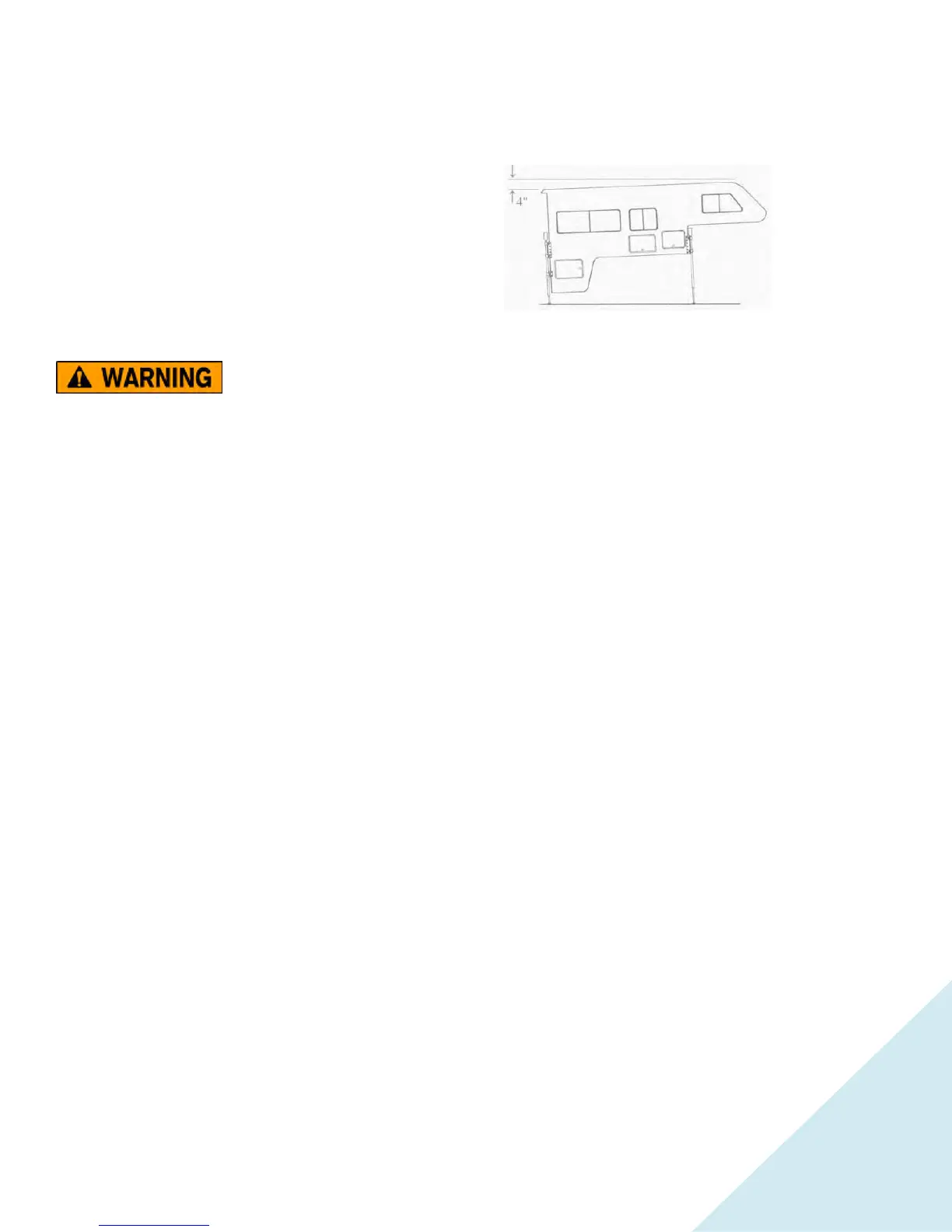
1) Extend each jack no more than 4” at once. Starting
with the front jacks, keeping the camper level always.
Repeat this process until the camper clears the truck
body bed by approximately 4”.
2) Slowly back truck under camper making sure to clear
wheel wells and any structure or plumbing located
below the living area. This may take more than one
try.
3) Continue backing until the truck is within a foot of
loaded position. Stop and connect the 7-way power
cord to the 7-way receptacle in the truck bed.
4) Continue backing under the camper until the bumpers
mounted on the crossbar in the truck bed lightly
touch the front of the camper.
5) Slowly lower both rear jacks, then front jacks until
the camper is resting fully on the truck bed.
6) Raise the jacks and secure in place per the
manufacturer’s instructions.
7) Lift and swing front jacks inward (if equipped with
swing-out brackets).
8) Secure the camper to the truck with turnbuckles. The
front turnbuckles must be spring or shock loaded,
while the rear should use solid turnbuckles. Install
both the front and rear turnbuckles per
manufacturer’s instructions.
Safety Tips:
1) Never allow the camper to be occupied while it is
being loaded or unloaded.
2) Never raise the rear of the camper higher than the
front of the camper.
3) Be sure all tie-down devices and electrical devices
are disconnected from the vehicle.
4) Do not load the camper on a windy day. The amount
of wind that is dangerous depends upon your
exposure and the weight of the camper.
5) Only store your camper on level ground.
To Lower Camper:
Retract the rear jacks first so the camper is 4” lower
in the rear than in the front.
When the rear of the camper is lower than the front,
press and hold the ‘ALL JACKS’ button to retract the
jacks. Release the button when the camper is at the
desired height.


 To Next Page