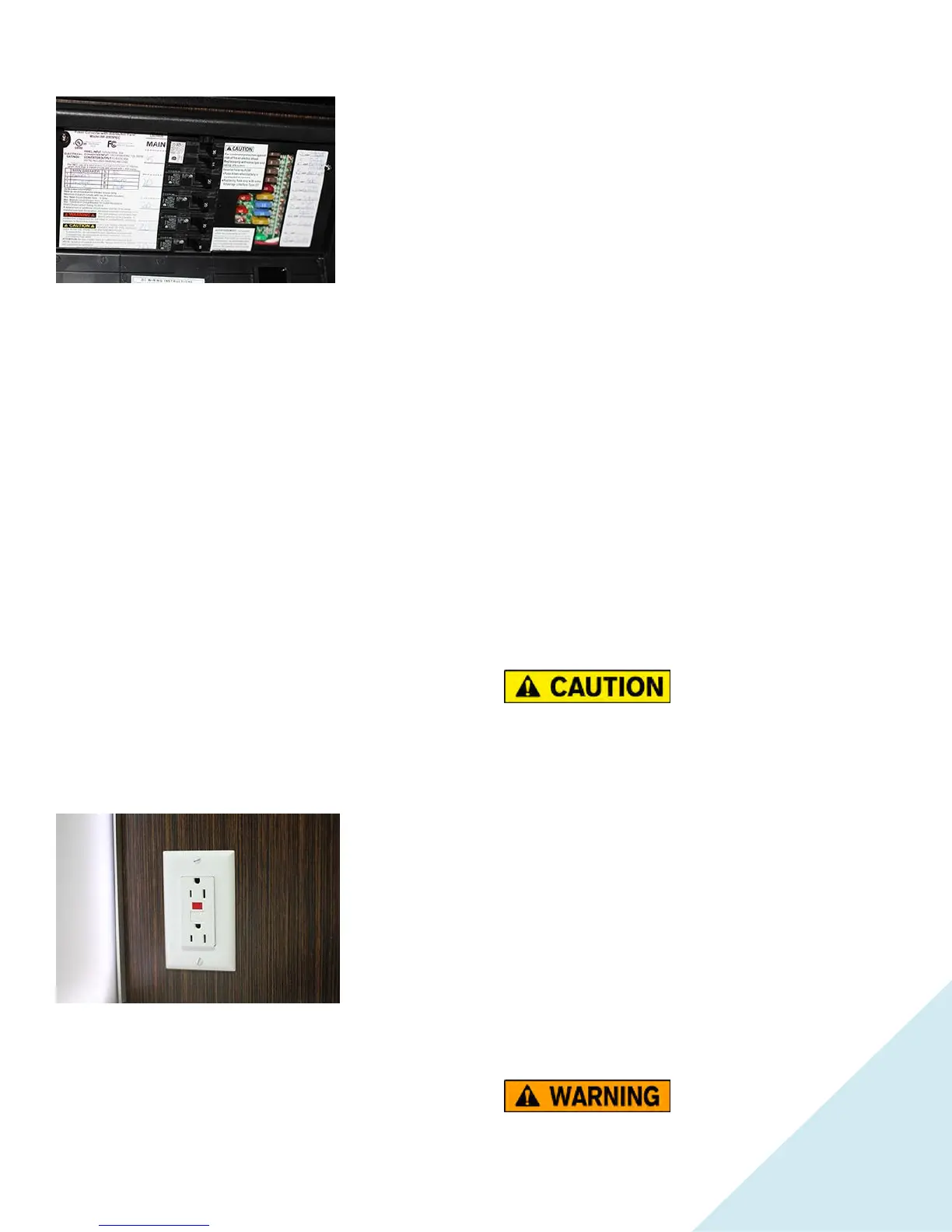
Power Distribution Center
The power
distribution
center consists
of 120-volt
AC, 12-volt
DC and the
power
converter. The
120-volt AC
panel board
containing a 30-amp main breaker and 15 and/or 20-amp
branch circuit breakers. These breakers interrupt the power if
the rated current is exceeded. If a breaker trips repeatedly,
reduce the load on that circuit and have the system checked by
your Nücamp RV Dealer.
Switching from 120-volt AC power to 12-volt DC power is
automatic when the power cord is plugged in or the generator
is on. This powers the 12-volt panel board and the connected
circuits are protected by the installed fuses. Battery charging is
automatic when plugged into 120-volt AC power. The
converter has reverse battery circuitry to prevent damage if the
battery is accidentally connected in reverse. These fuses
protect the power converter from accidental shorting of the
power cables at the battery or reverse polarity caused by
accidental cross connecting the battery. Remember red is
positive (+), white is negative (-). The power converter has a
cooling fan that will run at appropriate times to cool the
converter.
NOTE: Should the converter shutdown during normal
operation, heat may be the cause. The converter has a built-in
automatic-reset thermal breaker that will reset after a cooling
off period. If this occurs frequently, your dealer or qualified
personnel should correct the problem. Be sure not to store
items in front of the vent openings.
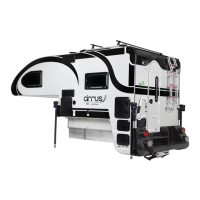
Ground Fault Circuit Interrupter
A Ground
Fault Circuit
Interrupter
(GFCI) This
device is
intended to
protect you
against the
hazards of line
to ground
electrical faults and electrical leakage shocks possible when
using appliances in damp areas.
NOTE: The GFCI device does not prevent electrical shock. It
does not protect a person who comes in contact with both the
“hot” and “neutral” sides of the circuit. It does not protect you
against electrical overload.
TEST the GFCI at least once a month while operating on 120-
volt AC power. To test the GFCI:
Push the TEST button. The RESET button should
pop out, indicating that the protected circuit has been
disconnected.
If the reset button does not pop out when the test
button is pushed, a loss of ground fault protection is
indicated. Do not use the outlet or other outlets on the
same circuit. Have the camper electrical system
checked out at an authorized nüCamp RV Dealer
Service Center. Do not use the system until the
problem has been corrected.
To restore power, push the RESET button.
NOTE: If galley or patio receptacles don’t work, check the
GFCI. Reset the button if necessary. If the GFCI continues to
trip, have the camper electrical system checked at an
authorized nüCamp RV Dealer Service Center or by a
qualified electrician.
Power Generator
Before operating any generator, read, and understand this
section of the manual and the manufacturer’s operating
instructions for your generator. The generator circuit breaker
provides circuit protection while in the “ON” operating mode.
See the Generator Manual for location.
NOTE: Refer to your Generator Owner’s Manual provided in
your Owner’s Information Package for starting, operating,
service and troubleshooting instructions.
Always wait at least three minutes after starting generator
before turning on or plugging in heavy electrical loads, such as
the roof air conditioner and the convection microwave oven.
To stop the generator:
1) Turn off all electrical loads.
2) Let the generator run at no-load for a few minutes, to
stabilize internal engine generator temperatures.
3) Place Start/Stop switch in the Stop position.
Generator Operating Safety Precautions and Warnings
Do not block the generator ventilating air inlets or outlets. The
engine requires a constant supply of cooling air. Restricted
ventilating air inlets or outlets can cause engine failure or fire
from engine overheating.
Do not use generator-ventilating air for heating any interior
living space. Ventilating air can contain high concentrations of
lethal gases.
Exhaust Gas Is Deadly!
Exhaust gases contain carbon monoxide, an odorless and
colorless gas. Carbon monoxide is poisonous and can cause
unconsciousness and death. See the “Carbon Monoxide Safety
Precautions” section in the “Fire and Safety” chapter.
Do not block the tailpipe or situate the camper in a place
where the exhaust gases have any possibility of accumulating


 To Next Page