connected through a power converter. When connected to 120-
volt power, the converter transforms 120-volt AC input into
12-volt DC power output and charges the storage battery(s)
when installed.
Interior Lighting
The interior lighting operates on 12-volt DC power only.
When connected to a 120-volt source or using the generator,
the power converter transforms 120-volts to 12-volts.
However; when not connected to 120-volts, the entire load of
lights, water pump, exhaust fans, etc., is on your 12-volt
battery(s). Use conservatively to minimize battery
discharging.
120-volt AC System
The 120-volt electrical system supplies power to the following
components:
AC to DC Power Converter
120-volt Outlets (interior and exterior)
Refrigerator
Roof Mounted Air Conditioner (optional)
Microwave Oven
Alde System
Never operate the 120-volt electrical system without
a proper ground.
12-volt DC system
The 12-volt system provides power for the following
components:
Electric Jacks
Interior Lighting
Exterior Lighting
Water Pump
Refrigerator
Alde System
Stereo/CD/DVD Player
TV
Systems Panel Monitor
Fantastic Fan
Accessories plugged into 12-volt outlet
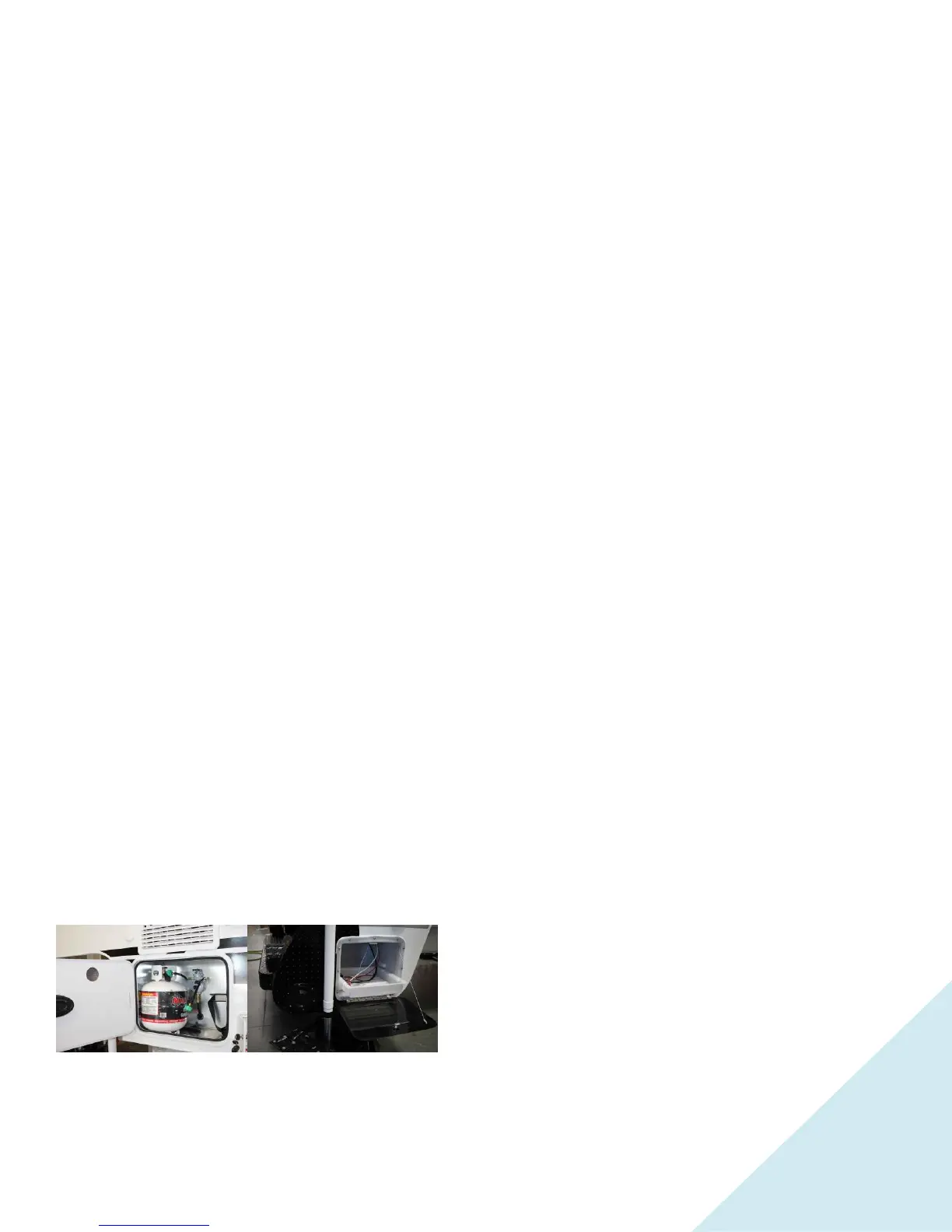
Battery and Compartment
Maintenance of your 12-volt battery(s) is essential for carefree
travel. Be sure to use a heavy-duty, minimum 75 amp/hr.
RV/Marine deep cycle battery. Ensure that they are both the
same size and type battery. Check the battery’s frequently
with the condition meter located on the monitor panel. Also,
check the water level often. The use of a hydrometer is
required to test for the specific gravity of the battery acid.
Hydrometers are available through an auto parts store.
NOTE: The 12-volt battery(s) is not supplied with the camper
by the manufacturer.
Battery Terminology
Deep Cycle Batteries
The term “deep cycle” refers to a battery that has the
capability of deeply discharging hundreds of times.
How it differs from an automotive starting battery is that the
automotive battery is manufactured to specifically provide a
quick burst of energy thousands of times while only being able
to deeply discharge less than 50 cycles during its lifetime. A
Cycle refers to one batter discharge and recharge.
Battery Ratings and Specifications
Marine/RV deep cycle batteries have rating specifications
which include cold cranking amps (CCA), marine cranking
amps (MCA), reserve capacity (RC), and ampere hours (Ah).
RC and approximate Ah ratings may not be listed on the
battery decal. However, they should be available through your
local battery distributor.
Cold Cranking Amps (CCA)
The amount of current (amps) a battery at 0°F (-17.8°C) can
deliver for 30 seconds and maintain at least 1.2 volts per cell
(7.2 volts on a 12-volt battery).
Marine Cranking Amps (MCA)
The amount of discharge current a battery tested at 32°F (0°C)
can deliver for 30 seconds and maintain at least 1.2 per cell
(7.2 volts for a 12-volt battery).
Reserve Capacity (RC)
The amount of time a battery can deliver 25 amps at 80°F
(26.7°C) without falling below 1.75 volts per cell (10.5 volts
on a 12-volt battery). An approximate Ah rating can be
attained by multiplying the battery’s RC rating by 0.6.
Example: 180 RC x 0.6 = 108 Ah.
Ampere hours (Ah)
Tested at 80°F (26.7°C). It is the amount of current (in amps)
a battery can deliver, multiplied by the number of hours,
without falling below 1.75 volts per cell (10.5 volts in a 12-
volt battery). Most marine/RV deep cycle batteries are rated
on a 20-hour discharging rate. Example: a 100 Ah battery can
deliver 5 amps for 20 hours (amps x hours = Ah). The Ah
rating is important when determining the type and amount of
battery(s) required to meet your specific component needs.
Battery Information
The battery(s) must be securely strapped in the compartment
always.
The battery(s) is charged by the truck’s charging system while
the truck is running or when connected to 120-volt power
through the power converter. If equipped, the onboard


 To Next Page