Sample Experiments
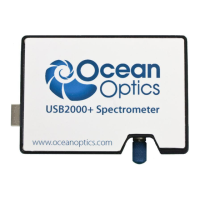
USB2000 Operating Instructions 27
Perform the following steps to take a relative irradiance measurement using OOIBase32:
1. Place OOIBase32 is in scope mode by clicking the Scope Mode icon on the toolbar, or by selecting
Spectrum | Scope Mode from the menu bar.
2. Ensure that the entire signal is on scale. The intensity of the reference signal should peak at about 3500
counts.
Note: The light source must be a blackbody of known color temperature.
3. In the Reference Color Temperature dialog box, enter the color temperature of the light source (in
Kelvin) and click the OK button.
4. Take a reference spectrum using a light source with a black body of a known color temperature, such as
the LS-1.
Click the Store Reference spectrum icon on the toolbar or select Spectrum | Store Reference from the
menu bar to store the reference. This command merely stores a reference spectrum in memory. You
must select File | Save | Reference from the menu bar to permanently save the spectrum to disk.
5. Block the light path to the spectrometer. Then, take a dark spectrum by clicking the Store Dark
Spectrum icon on the toolbar or by selecting Spectrum | Store Dark from the menu bar. This command
merely stores a dark spectrum in memory. You must select File | Save | Dark from the menu to
permanently save the spectrum to disk.
Note: If possible, do not turn off the light source when taking a dark spectrum. If you must turn off your
light source to store a dark spectrum, allow enough time for the lamp to warm up again before
continuing your experiment.
You must take a dark spectrum before measuring relative irradiance.
6. Position the fiber at the light source you wish to measure. Then, choose the Irradiance mode icon on the
toolbar or select Spectrum | Relative Irradiance Mode from the menu bar.
7. Click the Save icon on the toolbar or select File | Save | Processed from the menu bar to save the
spectrum to disk.
Note: If you change any sampling variable (integration time, averaging, smoothing, angle, temperature,
fiber size, etc.), you must store a new dark and reference spectrum.


 To Next Page