23
®
DataMax
PRO
®
N
O
D
E
C
O
M
C
Z
.
.
1
0
F
T
S
T
O
P
2
0
F
T
3
0
5000 40003000
T
I
M
E
T
A
N
K
A
S
C
E
N
T
4
0
#
LOG PLAN
DEPTH
PSI
FT
M
NO DEC
NO DEC
self swimming up current. Constantly updated with new information, the
DataMax Pro gives an accurate prediction of Air Time Remaining within 90
seconds of any change in breathing rate. The Air Time Remaining display
also provides a reserve of 300 psig after reaching the surface. A zero ATR
display shows that the diver must now begin their ascent (assuming a 60 ft./
min. ascent rate) to reach the surface with 300 psig of air.
For example, a diver may have 800 psi of air and still be registering zero
(0:00) Air Time Remaining depending on their breathing rate and depth.
The deeper a diver descends and the heavier their breathing rate, the earlier
the Air Time Remaining display will reach zero. This occurs because the
DataMax Pro takes depth, breathing, and ascent into account.
No-Decompression Time Remaining
No-decompression Time is calculated based on the amount of nitrogen
absorbed by twelve hypothetical “tissue compartments.” The rates each of
these compartments absorb and release nitrogen is mathematically modeled
and compared against a maximum allowable nitrogen level. Whichever one of
the twelve is closest to this maximum level, known as the no-decompression
limit, will be considered the controlling compartment for that depth. Its
resulting value will be displayed in the No decompression Time Remaining
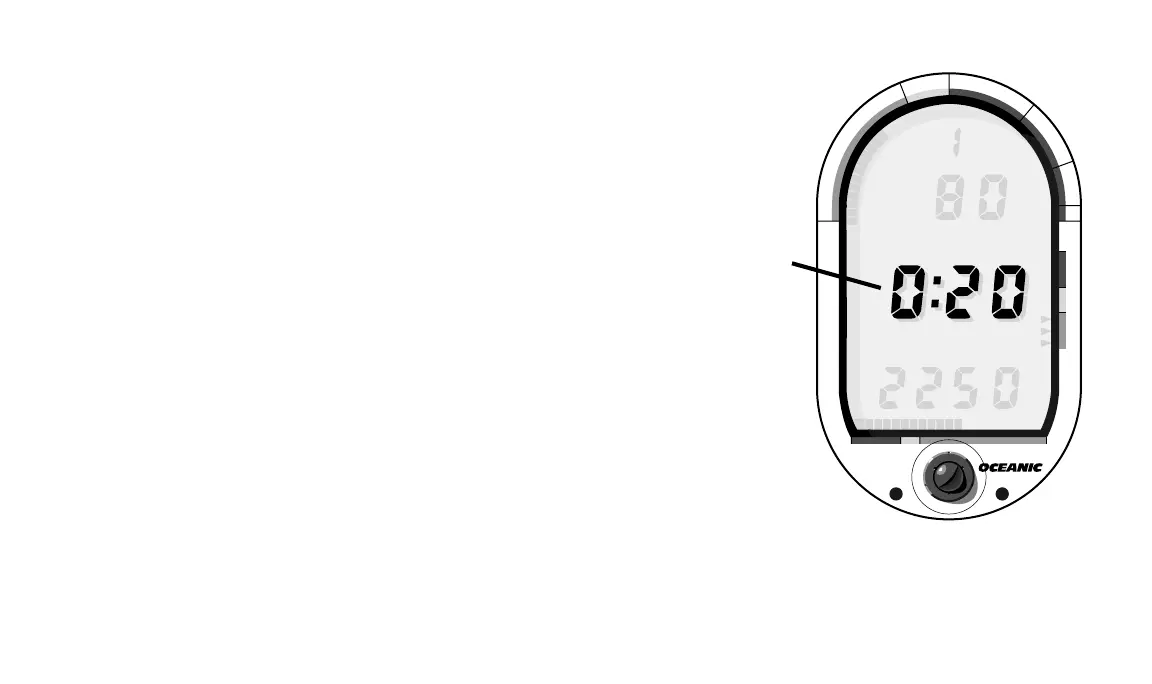
display (Fig. 21a) and the Tissue Loading Bar Graph.
The no-decompression algorithm is based upon Haldane’s theory using
maximum allowable nitrogen levels developed by Merrill Spencer. Repetitive
diving control is based upon experiments designed and conducted by Dr. Ray
Fig. 21 – No-decompression
dive time remaining
a.



 To Next Page