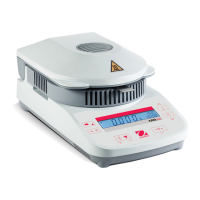
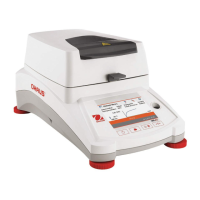
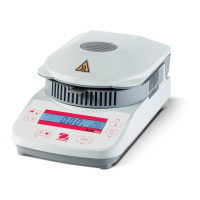
The OHAUS MB23 / MB25 Moisture Analyzer is a precision instrument designed for the accurate determination of moisture content in various samples. Its primary function is to measure the weight loss of a sample as it is heated, thereby calculating the moisture percentage. This process is crucial in many industries for quality control, research, and development.
Function Description
The moisture analyzer operates on the thermogravimetric principle, where a sample is weighed, then heated by a halogen or infrared heating element (depending on the model) to evaporate its moisture. The instrument continuously monitors the sample's weight during the drying process. Once the weight stabilizes, indicating that all moisture has been removed, the analyzer calculates the moisture content based on the initial and final weights. The MB23 and MB25 models offer different levels of readability and capacity, catering to a range of application needs.
The analyzer features a clear display that shows various parameters during operation, including temperature, time, current weight, and calculated moisture or solids percentage. It provides stable indicators to ensure reliable readings. The intuitive control panel with dedicated buttons for functions like "On/Off," "Start/Stop," "Tare," "Temp," "Time," "Set ▲/▼," "Print/Cal," and "%g" allows for easy navigation and operation.
The device supports multiple operating modes:
- Standby Mode: When connected to AC power but with the display off, the unit is in standby. A short press of the "Start" button turns on the display and enters Weigh mode.
- Weigh Mode: In this mode, the display shows the weight of items placed on the pan support. Users can tare the weight, initiate a test, or access temperature and time edit modes.
- Temperature / Time Edit Mode: This mode allows users to set the drying temperature (from 50°C to 160°C in 5° steps) and drying time (from 1 to 99 minutes in various steps, or "AUTO" mode). The "AUTO" mode is particularly useful as the test ends automatically when the analyzer detects that weight loss has ceased.
- Run Mode: Once a test is initiated with a sample greater than 0.5g, the analyzer enters Run mode, displaying the results in progress. Users can change the displayed unit (grams, % Moisture, % Solids) or manually stop the test.
- Result Mode: At the conclusion of a test, the display blinks with the final result. Users can cycle through different result units, print the data, or exit to Weigh mode.
Usage Features
The MB23 / MB25 is designed for user-friendliness and flexibility in various laboratory and industrial settings.
- Sample Preparation: Proper sample preparation is critical for accurate results. Samples should be uniform and evenly distributed on the test pan to ensure consistent drying. The manual provides guidance on handling different types of samples:
- Pasty, fat-containing, and melting substances: Using a glass fiber filter increases the surface area, promoting more uniform moisture distribution and faster, more complete vaporization.
- Liquid substances: Glass fiber filters help distribute liquid samples over a larger area, significantly shortening drying times and preventing drop formation.
- Skin-forming and temperature-sensitive substances: A glass fiber filter can cover the sample, allowing for gentler and more beneficial heating, which improves reproducibility and prevents film formation that could hinder complete moisture determination.
- Sugar-containing substances: These samples tend to caramelize. A thin, uniform layer and moderate temperature settings are recommended. Covering with a glass fiber filter can also enhance reproducibility.
- Volatile substances: Rapid application of the sample to the test pan is advised to minimize moisture escape before the initial weight is recorded. For samples containing solvents or releasing flammable/explosive vapors, low drying temperatures and small sample sizes (max 1g) are crucial to prevent fire or explosion.
- Poisonous/toxic and corrosive substances: These should only be dried in a fume hood and tested in small amounts, respectively, to prevent harm to personnel and corrosion of analyzer parts.
- Test Optimization: The manual emphasizes the importance of optimizing drying temperature, drying time, sample weight, and sample preparation to achieve the best measurement speed and quality. Experimentation is encouraged to find the optimal setup for specific samples.
- Drying Temperature: Influences drying time; selecting a temperature that neither decomposes nor alters the sample's chemical structure is key.
- Drying Time: The analyzer offers manual, automatic, and timed duration methods. "Automatic" mode is highly efficient, ending the process when weight loss falls below a certain threshold.
- Sample Weight: Affects measurement time and result repeatability. Generally, 3g to 20g samples are recommended, with larger samples yielding more consistent results but requiring longer test times. A table is provided to guide users in selecting appropriate sample weights based on desired repeatability.
- Safety Precautions: The analyzer includes important safety guidelines, such as using it exclusively for moisture determination, ensuring proper power supply connection and grounding, maintaining adequate ventilation, and using personal safety equipment. It also warns against placing flammable materials near the hot heating element and advises caution when handling hot samples.
Maintenance Features
The MB23 / MB25 Moisture Analyzer is designed for robust performance, with minimal maintenance requirements.
- Weight Calibration: While rarely needed due to the analyzer's use of relative weight values, weight calibration can be performed using a 50g calibration mass. The process involves placing the mass on the pan support when prompted and removing it when indicated.
- Temperature Calibration: Temperature calibration is also infrequently required but can be performed if heating elements become dirty or if the usual settings no longer produce the same results. This process requires the OHAUS Temperature Calibration Kit (an accessory) and involves setting the analyzer to specific temperatures (100°C and 160°C) and adjusting the displayed value to match the thermometer reading from the kit.
- Cleaning: Regular cleaning is essential to maintain the analyzer's performance and longevity. Users are instructed to disconnect the analyzer from the power supply and ensure it has cooled down before cleaning. Housing surfaces and the temperature sensor can be cleaned with a lint-free cloth dampened with water or a mild cleaning agent. Glass surfaces can be cleaned with a commercial glass cleaner. Harsh chemicals, solvents, ammonia, or abrasive cleaning agents should be avoided.
- Troubleshooting: A comprehensive troubleshooting guide is provided, listing common symptoms or display errors (e.g., "Cannot turn on," "Weight value blinking," "Close Cover" shown, various "Err" codes) along with their possible causes and recommended remedies. This helps users quickly diagnose and resolve minor operational issues.
- RS232 Communication: The analyzer includes an RS232 interface, allowing it to connect to a computer for control and data acquisition. This feature enables users to print results, monitor tests, and integrate the analyzer into larger data management systems. The manual details RS232 pin connections, data settings (baud rate, data bits, parity, stop bits, flow control), and a list of commands for remote operation.
The OHAUS MB23 / MB25 Moisture Analyzer is a reliable and versatile tool, offering precise moisture determination capabilities with user-friendly operation and clear maintenance guidelines, ensuring consistent and accurate results for a wide range of applications.


 To Next Page


 General