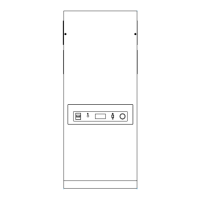
successivamente il tasto per selezionare
la funzione “cooling” .
8) Controllare che la differenza di pressione fra
il valore letto sul manometro (5) con pompa
in moto e il valore letto con pompa ferma sia
superiore alla prevalenza disponibile con
portata massima della pompa.
Se questa differenza è inferiore signica che
la portata d’acqua è superiore al valore
massimo consentito.
Per non danneggiare la pompa è necessario
aumentare la perdita di carico del circuito
idraulico ad esempio, chiudendo parzialmente
un rubinetto in mandata della pompa
(rubinetto sull’uscita acqua a cura
dell’installatore).
9) Se alla prima partenza la temperatura
ambiente è elevata e la temperatura dell’acqua
del circuito idraulico è molto superiore al
valore di lavoro (ad es. 25-30 °C), signica
che l’unità parte sovraccaricata con
conseguente possibile intervento delle
protezioni.
Per ridurre questo sovraccarico si può
chiudere progressivamente (
ma non del tutto!
)
una valvola in ingresso dalla macchina per
ridurre la portata d’acqua che lo attraversa.
Man mano che la temperatura dell’acqua nel
circuito idraulico raggiunge il valore di lavoro
aprire la valvola.
10)
La macchina ora è pronta per lavorare.
Se il carico termico è inferiore a quello
prodotto dalla macchina la temperatura
dell’acqua diminuisce nché raggiunge il
valore di set p
oint (parametro G01) impostato
seguendo le indicazioni del capitolo
CENTRALINA ELETTRONICA.
Raggiunto il valore di G01 il termostato che
controlla la temperatura di ingresso dell’acqua
ferma il compressore. La pompa dell’acqua
rimane, invece, sempre in moto.
5.3 FUNZIONE LAVAGGIO IMPIANTO
Al ne di evitare consistenti formazioni di
calcare, che farebbero diminuire l’efcienza della
macchina, il refrigeratore è dotato di una pompa
che ad intervalli di tempo compresi tra 30 minuti
e 6 ore, a seconda della durezza dell’acqua,
ferma la macchina ed effettua un lavaggio di
scambiatore, vaschetta di raccolta dell’acqua e
tubazioni.
press the key to select the Cooling
function.
8) Check that the pressure difference between
the reading of the gauge (5) when the pump
is moving and the reading when the pump
is still is higher than the head available with
the maximum ow rate of the pump. If this
difference is lower, that means that the water
ow rate is higher than the maximum value
allowed. In order to not damage the pump, it is
necessary to increase the hydraulic circuit
load loss.
This can be achieved, for instance, by
partially closing a tap on the supply line of the
pump (tap on the water outlet is the installer’s
responsibility).
9) If at the rst start-up the ambient temperature
is high and the hydraulic circuit water
temperature is much higher that the working
temperature (ex. 25-30°C), this means that
the unit is already overloaded, and the
protection devices may possibly trip.
To reduce this overload, close progressively
(but not completely!) a valve on the inlet line
to the machine, so as to reduce the water
ow rate of the machine’s circuit.
As the temperature of the water in the
hydraulic circuit reaches the correct working
value, you can re-open the valve.
10)
The machine is now ready to work. If the
thermal load is lower than that produced by
the machine, the water temperature
decreases till the temperature setpoint
value (parameter G01) is reached
(Info on how to set the temperature setpoint
can be found in the chapter entitled
“ELECTRONIC CONTROL UNIT”).
Once the value of G01 is reached, the
thermostat which checks the inlet lin
water temperature stops the compressor.
The pump, however, always keeps working.
5.3 PLANT FLUSHING FUNCTION
In order to avoid formations of scale, which
would decrease the efciency of the machine,
the chiller is equipped with a pump which perio-
dically stops the machine and ushes the heat
exchanger, the water pan and the pipes. The
ushing intervals are between 30 minutes and 6
hours, depending on the hardness of the water.



 To Next Page