Funzionamento
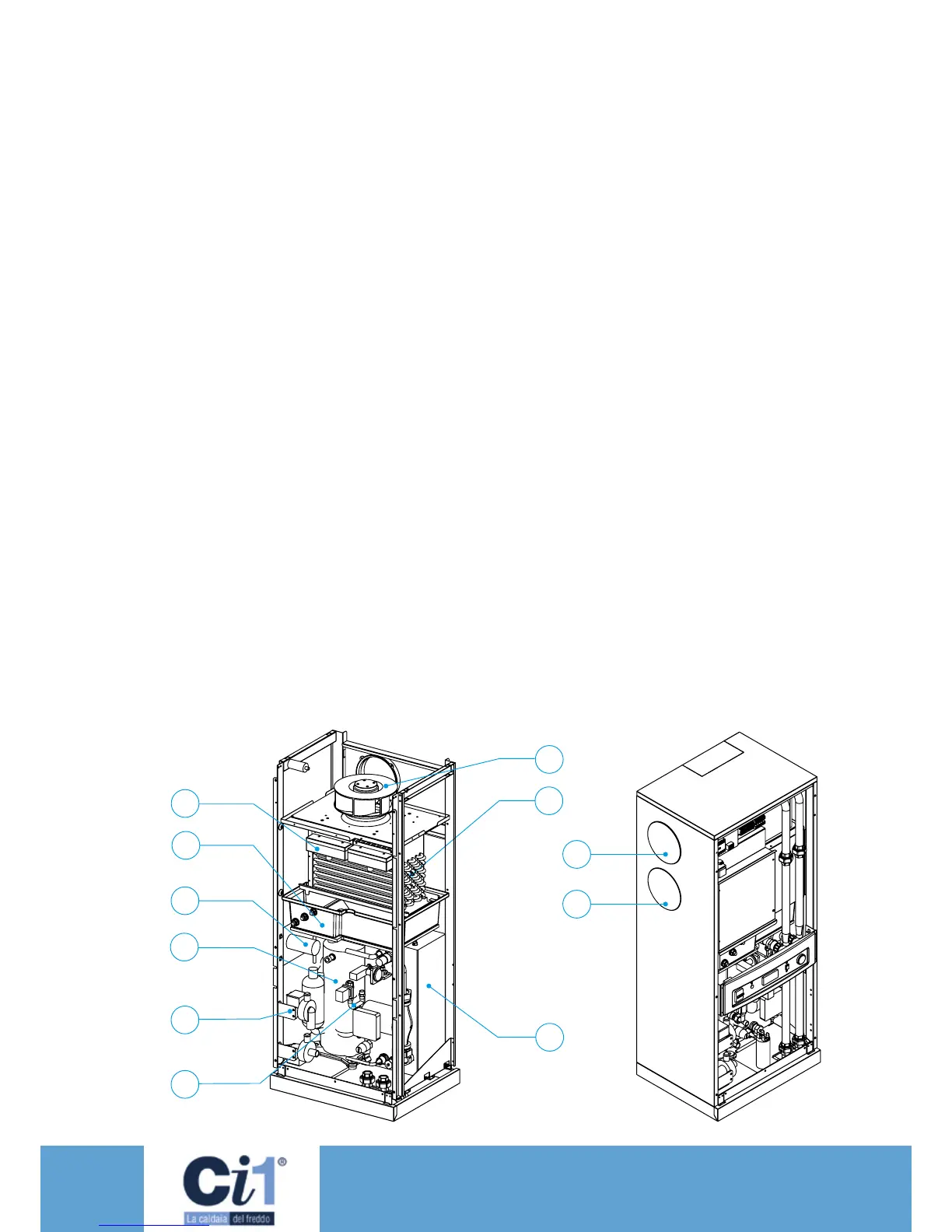
Il compressore frigorifero (1) è ssato al telaio.
Tramite la tubazione di mandata (2) il refrigerante
viene inviato allo scambiatore, o condensatore (3).
L’acqua da evaporare sul condensatore viene pre-
levata da una pompa (4) nella vasca (5) e tramite
la tubazione ed il distributore (6) viene spruzzata
sul condensatore evaporativo (3).
Il refrigerante, condensato, espande nel capillare
o valvola di laminazione.
Nell’evaporatore viene raffreddata l’acqua da
inviare al circuito chiuso di alimentazione del-
le unità terminali di climatizzazione.
Lo stesso
evaporatore è racchiuso nell’accumulo inerziale.
Mediante la tubazione, il refrigerante ritorna al
compressore (1).
Il ventilatore (7) provvede a ventilare il condensa-
tore evaporativo (3). L’aria satura di umidità viene
scaricata all’esterno tramite il condotto (8).
L’aria che attraversa il condensatore evaporativo
viene prelevata dall’esterno tramite il condotto (9).
Per evitare elevate concentrazioni di calcare che
potrebbero incrostare rapidamente le tubazioni,
specie in presenza di acque dure, è stato previsto
un periodico ricambio dell’acqua contenuta nella
vasca (5) posta sotto il condensatore evaporativo
(3). Lo scarico dell’acqua avviene tramite una
pompa (10). Questo sistema evita l’utilizzo di
costose valvole motorizzate o elettromagnetiche
e rende più afdabile il funzionamento.
Il refrigeratore monoblocco senza unità ester-
na offre una essibilità di impiego elevatis-
sima, permettendo di soddisfare pressoché
tutte le esigenze di collocazione all’interno
degli ambienti e di semplicare notevolmente
l’installazione.
Operation
The refrigerating compressor (1) is xed to the
frame. Through the supply pipe (2) the refrigerant
is sent to the exchanger, or condenser (3).
Water to be evaporated on the condenser is
drawn by a pump (4) from the tank (5), conveyed
through the pipe and the distributor (6) and
sprayed on the evaporative condenser (3).
The refrigerant, condensed, expands in the
capillary pipe or throttle valve.
Water is cooled in the evaporator and then
conveyed to the closed circuit which feeds the
air-conditioning terminals. The same evaporator
is contained in the inertial storage tank.
By way of the pipe, the refrigerant goes back to
the compressor (1).
The fan (7) provides ventilation to the evaporative
condenser (3). The air saturated with humidity is
discharged outdoors through the duct (8).
The air which goes through the evaporative
condenser is drawn from the outside through the
duct (9).
The system is provided with a function of periodic
replacement of the water contained in the tank
(5) under the evaporative condenser (3). This
prevents the formation of high concentrations
of scale which, especially in presence of hard
water, could quickly incrust the pipes. The
water drainage is performed by way of a pump
(10). This system avoids the use of expensive
motorised or electromagnetic valves and makes
the operation more reliable.
The monobloc chiller without outdoor unit
offers a very high exibility of use, allowing
to satisfy virtually all needs for indoor
installation, while making the installation
itself considerably easier.



 To Next Page