29
SECTION 10
Installation
!WARNING Install the sensor system so that it is not affected by reflective surfaces. Fail-
ure to do so may hinder detection, resulting in serious injury.
10-1 Reflective Surface Interference
A reflective surface adjacent to the detection zone can deflect the optical
beam and may cause an obstruction in the zone not to be detected. The
reflective surface may be part of the machine, mechanical guard or work-
piece. Therefore, a minimum distance (d) must exist between the reflective
object and the center line of the detection zone. The Test procedure (Appen-
dix B) must be used to test for this condition.
In this picture, the interruption is clearly detected. The reflective object is out-
side of the beam angle.
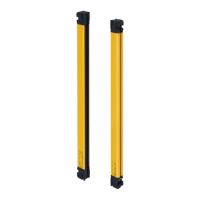
Operating range R: is the effective working distance of the MS4800 system,
from the transmitter to the receiver.
EAA: is the effective aperture angle of the Safety Sensor.
it is ±2,5° for MS4800 system
distance d: is the minimum distance to a reflective surface.
This distance must be bigger than:
d
min
MS4800 system = tan(2,5°)×R
Be aware that reflective surface interference may also appear above and
below the sensing field.
Operating range R
Transmitter Receiver
Interruption
Approach direction
Reflective surface
EAA
d = distance to
reflective surface


 To Next Page