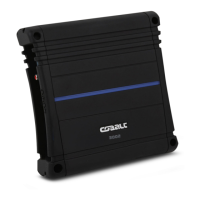
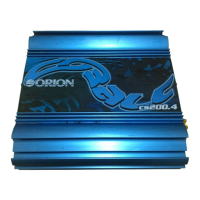
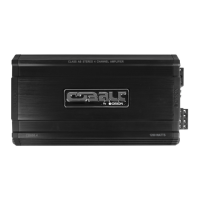
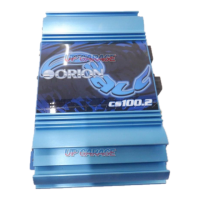
The ORION COBALT power amplifier series, including the CS100.2 and CS150.2 models, is designed to deliver high-performance car audio at an affordable price. These amplifiers are packed with features to enhance your audio system.
Function Description:
The COBALT amplifiers are 2-channel power amplifiers designed to boost the audio signal from a head unit or signal processor to drive speakers. They feature continuously variable high-pass and low-pass crossovers, allowing for flexible system integration and sound shaping. A notable feature is the 0-12dB XTRA BASS CONTROL circuit, which provides adjustable bass boost centered at 40Hz, enhancing low-frequency response. The amplifiers are designed for both stereo and mono bridged configurations, making them versatile for driving midrange speakers, tweeters, or subwoofers.
Important Technical Specifications:
CS100.2:
- Power Output 4 Ohm Stereo: 50 watts per channel
- Power Output 2 Ohm Stereo: 70 watts per channel
- Power Output 4 Ohm Mono: 140 watts
- Distortion (20Hz to 20kHz): <.05% THD
- Frequency Response: 20Hz to 20kHz ±0.5 dB
- Linear Bandwidth: 6Hz to 50 kHz ±3dB
- Signal-to-noise ratio (full bandwidth @ rated output power): >100 dB
- Damping factor (@ output connector full bandwidth): >300
- Slew Rate: >45V/µs
- Input Sensitivity: 150mV to 2.5 Vrms
- Input Impedance: 10kΩ
- Fuse Type: 25A AMP ATC
- Low-pass Crossover: Continuously variable, 30Hz to 250Hz
- High-pass Crossover: Continuously variable, 30Hz to 1kHz
- XBC12 Boost Range: 0dB to 12dB @ 45Hz
- Dimensions (L x W x H): 6.9" x 10.5" x 2.3" (175mm x 266mm x 59mm)
CS150.2:
- Power Output 4 Ohm Stereo: 90 watts per channel
- Power Output 2 Ohm Stereo: 140 watts per channel
- Power Output 4 Ohm Mono: 260 watts
- Distortion (20Hz to 20kHz): <.05% THD
- Frequency Response: 20Hz to 20kHz ±0.5 dB
- Linear Bandwidth: 6Hz to 50 kHz ±3dB
- Signal-to-noise ratio (full bandwidth @ rated output power): >100 dB
- Damping factor (@ output connector full bandwidth): >300
- Slew Rate: >45V/µs
- Input Sensitivity: 150mV to 2.5 Vrms
- Input Impedance: 10kΩ
- Fuse Type: 20A x 2 AMP ATC
- Low-pass Crossover: Continuously variable, 30Hz to 250Hz
- High-pass Crossover: Continuously variable, 30Hz to 1kHz
- XBC12 Boost Range: 0dB to 12dB @ 45Hz
- Dimensions (L x W x H): 8.3" x 10.5" x 2.3" (210mm x 266mm x 59mm)
Usage Features:
- RCA Inputs: Accepts line-level RCA inputs from most aftermarket head units or ORION signal processors.
- Gain Control: Adjustable input gain to match various head unit signal levels, minimizing background noise and preventing overload.
- XBC12 (XTRA BASS CONTROL): Allows boosting bass centered at 40Hz from 0dB to 12dB, dramatically altering bass response. Caution is advised to prevent damage to subwoofers not capable of handling the boost, and it should not be used with mid-range speakers.
- High Pass X-Over Frequency Control: Adjusts the high-pass crossover frequency from 30Hz to 1kHz, useful for preventing lower frequencies from playing through midrange speakers.
- Low Pass X-Over Frequency Control: Adjusts the low-pass crossover frequency from 30Hz to 250Hz, ideal for use with subwoofers.
- X-Over Selection Switch: Determines whether the crossover operates in high-pass, full-range, or low-pass mode. In full-range mode, crossover settings have no effect.
- Fuse Protection: Integrated fuse protects the amplifier from dangerous current levels.
- Power/Ground Connections: Removable plug accepts up to 8-gauge power and ground connections.
- Power LED: Illuminates green when the amplifier is on and turns red in protection mode.
- Speaker Connections: Removable plug accepts up to 12-gauge speaker wire and includes the amplifier's remote 12VDC turn-on lead.
- Stereo Configuration: Recommended for midrange speakers, with a lowest recommended impedance of 2 Ohms stereo. XBC12 should be set to 0dB. High-pass crossover is suggested to increase efficiency, with 100Hz as an average setting.
- Mono Bridged Configuration: Recommended for subwoofers, with a lowest recommended impedance of 4 Ohms mono. Crossover selection should be set to low-pass, with 80Hz as a typical starting point for the low-pass crossover frequency.
- Tri-Mode Configuration: Allows running an entire system (midrange and subwoofer) on one amplifier. Requires capacitors on midrange drivers to block lower frequencies and coils on subwoofers to block higher frequencies. Lowest recommended stereo impedance is 2 Ohms, and subwoofer impedance is 4 Ohms. XBC12 should be set to 0dB. Crossover selection should be set to full range, with frequencies determined by external passive crossover components.
- Installation Tips: Provides guidance on choosing mounting locations (passenger compartment, trunk compartment – avoiding engine compartment), ensuring adequate ventilation (minimum 1" clearance), and securing the amplifier to a stable, flat surface.
Maintenance Features:
- Troubleshooting Tips: A comprehensive section addresses common issues such as no output, audio cycling on and off, distorted output, poor bass response, battery fuse blowing, and amplifier fuse blowing. It provides probable causes and recommended actions, including checking connections, fuse integrity, speaker impedance, gain settings, and ventilation.
- Warranty: ORION Industries Inc. warrants the product to be free from defects in material and workmanship.
- 1-year warranty if purchased and installed by an Authorized ORION Dealer.
- 90-day warranty if purchased from an Authorized ORION Dealer but NOT installed by one.
- 90-day warranty if NOT purchased from an Authorized ORION Dealer.
- Fuse Replacement: If replacing the fuse, use the same size ATC type fuse that came with the amplifier. Using a higher current fuse may void the warranty.
- General Precautions: Emphasizes safety during installation, including disconnecting the battery, avoiding cutting into vehicle lines, securely mounting the amplifier, proper wire routing, and ensuring adequate air circulation around cooling fins.
- System Adjustment: Step-by-step instructions for adjusting the sound, including setting source unit volume, amplifier level controls, and fine-tuning crossovers for optimal front/rear balance and overall sound quality.

 Need help?




 To Next Page

 General