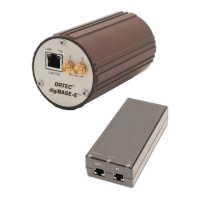
digiBASE-E™ High-Performance Power-over-Ethernet Multichannel Analyzer / PMT Base for Scintillation Detectors
2
In addition to PHA and List modes, an external input allows the digiBASE-E to perform as
a 32-bit counter for low-voltage TTL (LVTTL) pulses. The counter can be read through the
MAESTRO MCA emulation software or user-created software.
1.1.3. Flexible Gating
In measurement systems employing multiple detectors, there is often a need to synchronize data
acquisition (for example in a mobile gamma-ray search system the data from all detectors must
be correlated to correctly map out the activity distribution over an area). DigiBASE-E provides
flexible gating features; events from multiple spectrometers may be correlated to within
<100 milliseconds. This is achieved by the use of a gate input and a gate output. The gate input
can accept multiple signal types, which can be enabled from the supplied MAESTRO MCA
Emulation Software or from a user program. Command syntax is provided in Chapter 5. The
gate input modes are:
Coincidence Gate mode — In this mode, during acquisition, the gate is only open to the
passage of data when this input is “True.”
Trigger mode (“ACQ gate”) — In this mode, application of a “True” pulse to the gate starts
data acquisition.
Routing mode — In PHA mode, the presence of a “True” level results in data being routed
to an alternate spectral memory.
List Mode Event Gate — In this mode the presence of a TRUE level at the gate input
results in the associated list mode event(s) receiving a data tag. The gate output is a bridged
version of the gate input. It provides the “master output” for use with “slave” digiBASE-E
instruments in a multi-detector system. In this mode, the master gate out connects to the slave
gate(s) in.
For more detailed information on the digiBASE-E gate modes, see Section 2.2.
1.1.4. Spectrum Analysis Made Easy
The digiBASE-E is supplied with our MAESTRO
®
MCA Emulation Software (A65-BW).
MAESTRO has all the controls needed to adjust the acquisition parameters, acquire the data, and
save the spectra. As a member of our C
ONNECTIONS family of ORTEC products, it also provides
full networking with other ORTEC MCBs and supporting computers.
For complete quantitative analysis, ORTEC offers the ScintiVision
™
-32 MCA Emulation and
Analysis Software for Scintillation Detector Spectra (A35-B32). In addition, we offer the
A11-B32 C
ONNECTIONS Programmer’s Toolkit for those who wish to integrate the digiBASE-E


 To Next Page