• The audiogram symbol will flash at the specific frequencies where contralateral masking may be recommended
1
.
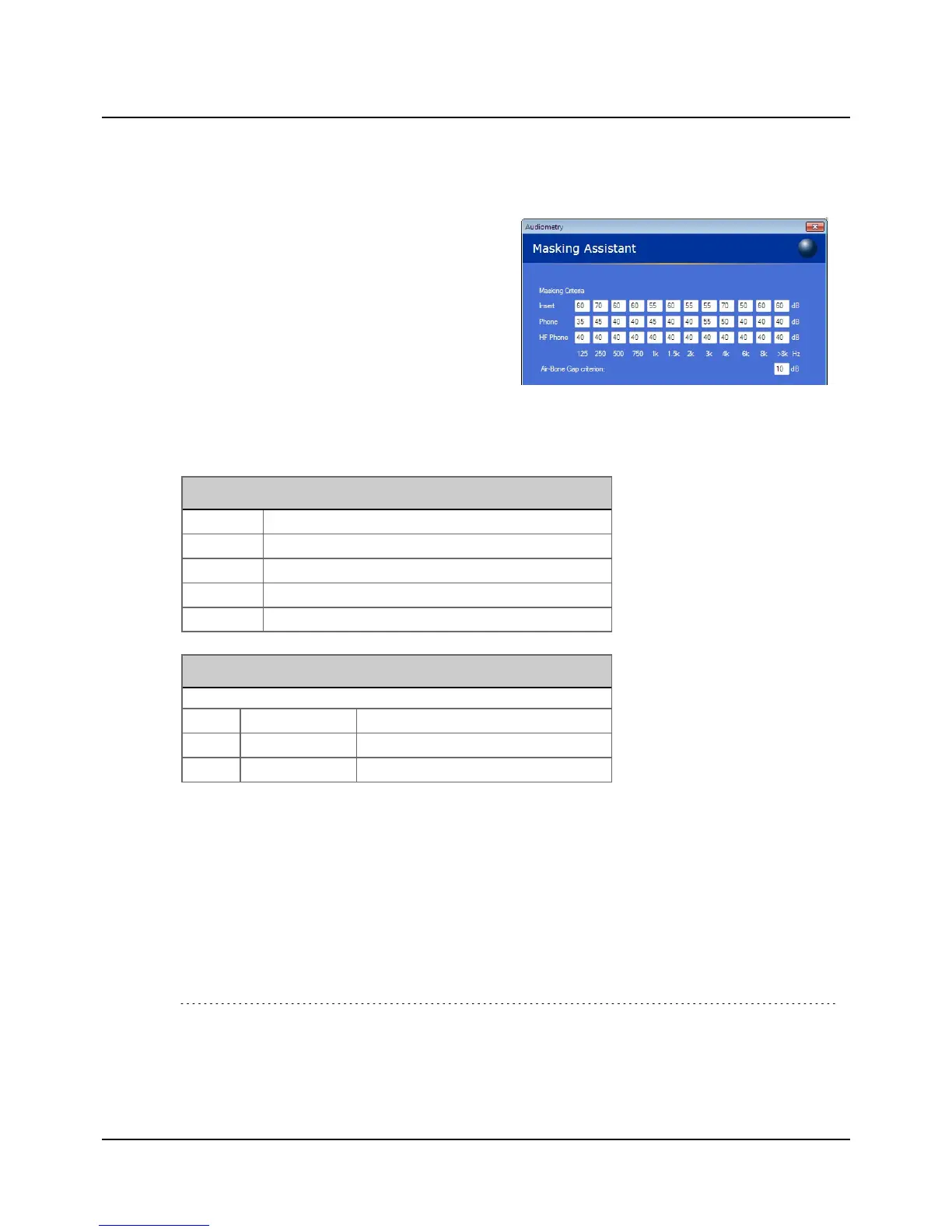
• The masking criteria are configurable so that you can
set them up to match your local recommendations for
masking. You can for instance choose either frequency
specific criteria, which increases the efficacy of your
work, or the traditional "one-level-fits-all" criteria.
Select the Tools> Configuration Wizard> Audi-
ometry - Configure... > Masking Assistant to set up
the masking criteria.
All masking signals are calibrated in effective masking.
How does the Masking Assistant work?
Terminology
AC AC test ear
ACc AC contra
BC BC
BCc BC contra
Min IA Minimum inter-aural attenuation.
When is masking required?
Masking is recommended when the following conditions are met:
AC AC > ACc + Min IA
or AC > BCc + Min IA
BC BC < AC - x* dB
Only stored thresholds measured without masking are checked. Levels which did not evoke a response are excluded from
the check. This means that as soon as a masked threshold has been stored, the flashing stops for that frequency.
* denotes configurable Air/Bone gap criterion (Tools> Configuration Wizard> Audiometry - Configure...> Masking
Assistant).
1
Based on criteria described in Clinical Masking, Essentials of Audiology, Stanley A. Gelfand, Thieme 1997, and Meas-
urement of Pure Tone Hearing Thresholds, Audiologists’ Desk Reference - Vol 1, James W. Hall III, H. Gustav Mueller
III, Singular Publishing Group 1997. and Munro K.J., Agnew N. A comparison of inter-aural attenuation with the Ety-
motic ER-3A insert earphone and the Telephonics TDH-39 supra-aural earphone. Br J Audiol 1999; 33: 259-262.
14 Otometrics - AURICAL Aud
12 The Masking Assistant


 To Next Page