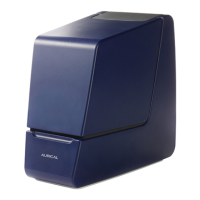
Bone Oscillator
Note • For unmasked bone thresholds, you can store binaural data:
- Selecting Binaural bone in the routing section of the control panel.
Note • If there is a difference of 10dB or greater between the bone conduction threshold and the air conduction
threshold of the same ear, masking is needed. The Masking Assistant can assist you in determining which thresholds
need to be masked.
Note • If the SRT of the test ear and the SRT or PTA of the nontest ear differ by 45dB or more, masking is needed.
If the SRT of the test ear and the bone conduction PTA of the nontest ear differ by 45 dB or more, masking is needed.
Mastoid placement
1. Move any hair covering the mastoid out of the way and place the flat round part of the bone oscillator securely on the
boniest portion of the mastoid without any part of the transducer touching the external ear.
2. Make sure the bone oscillator is tight on the mastoid but still comfortable.
3. If you are going to perform masking with earphones, position the other end of the bone oscillator headband over the
patient's temple on the opposite side of the head so that the headband of the earphones and bone oscillator fit on
the patient's head.
Loudspeaker placement
The environment in which sound-field audiometry is performed may affect the sound field near the patient.
The performance of loudspeakers for AURICAL Aud was tested by Otometrics under free-field conditions in a large
anechoic chamber. Sound pressure level, frequency response and distortion were measured by a microphone placed 1 m
from the front of the speaker.
When speakers are installed in other types of environment, the characteristics of the resulting sound field should eval-
uated by qualified personnel.
12 The Masking Assistant
If the Masking Assistant is enabled, it will at all times check for frequencies that may require testing with
masking. This also applies to old audiograms imported from NOAH or XML as long as a supported transducer
was stored with the data.
The Masking Assistant is a tool provided to help you with an indication that there may be frequencies where testing with
masking
1
is recommended.
1
(Katz, J., Lezynski, J. (2002). Clinical Masking. In J. Katz, ed., Handbook of Clinical Audiology, Williams and Wilkins, Bal-
timore.)
Otometrics - AURICAL Aud
13
12 The Masking Assistant


 To Next Page