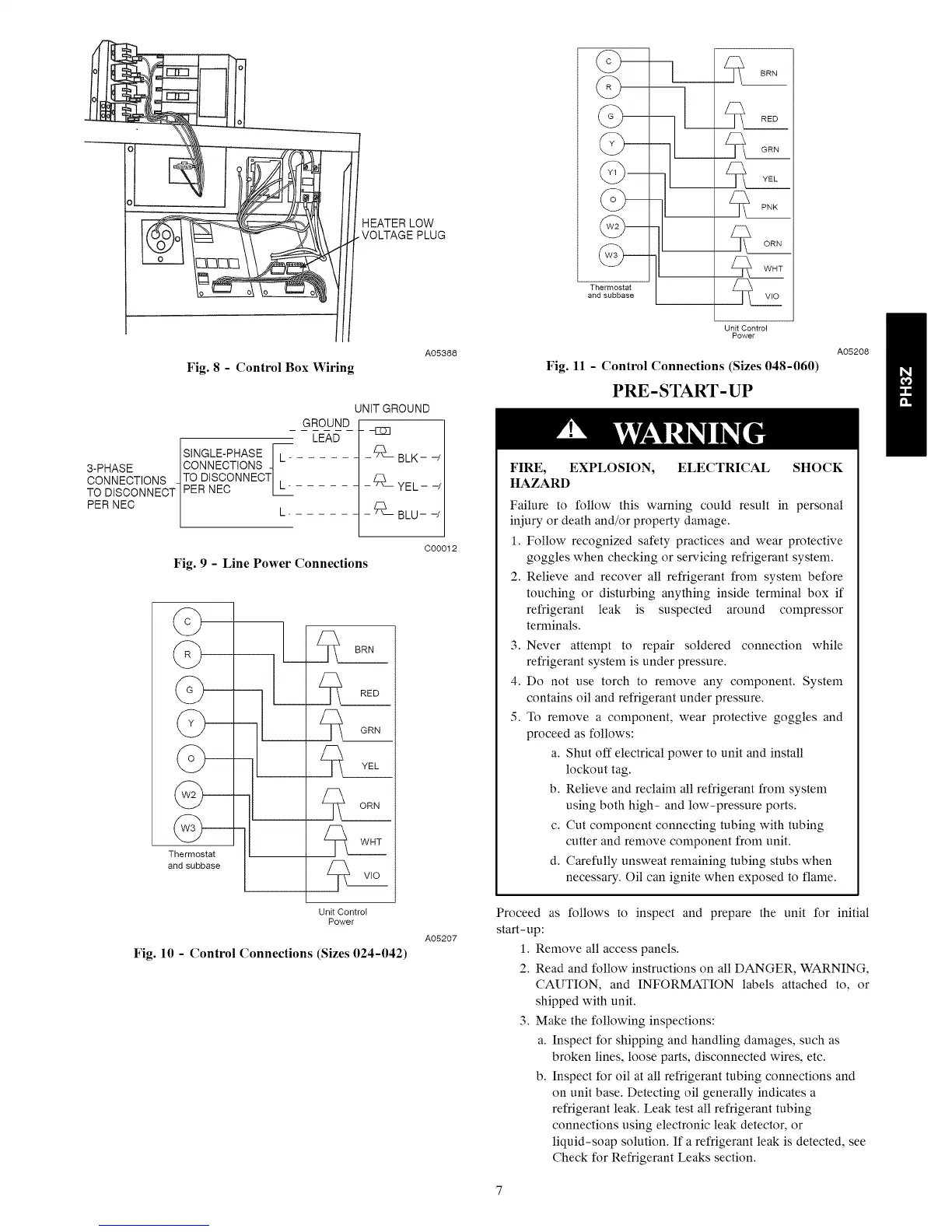
HEATER LOW
. VOLTAGE PLUG
Fig. 8 - Control Box Wiring
A05388
SINGLE-PHASE U
3-PHASE /CONNECTIONS _-
CONNECTIONS /TO DISCONNECTI .
TO DISCONNECT1PER NEO LL_ .....
PER NED / L.
L
UNIT GROUND
GROUND
LEAD
BLK- -/
- _- YEL - -/
_'-- BLU- -/
C00012
Fig. 9 - Line Power Connections
©
@-
@
@-
Thermostat
and subbase
IL--
_ RN
Z_ WHT
Unit Control
Power
Fig. 10 - Control Connections (Sizes 024-042)
A05207
0-
@-
Thermostat
and subbase
ql
11
RED
Unit Control
Power
Fig. 11 - Control Connections (Sizes 048-060)
PRE-START-UP
A05208
FIRE, EXPLOSION, ELECTRICAL SHOCK
HAZARD
Failure to follow this warning could result in personal
injury or death and/or property damage.
1. Follow recognized safety practices and wear protective
goggles when checking or servicing refrigerant system.
2. Relieve and recover all refrigerant from system before
touching or disturbing anything inside terminal box if
refrigerant leak is suspected around compressor
terminals.
3. Never attempt to repair soldered connection while
refrigerant system is under pressure.
4. Do not use torch to remove any component. System
contains oil and refrigerant under pressure.
5. To remove a component, wear protective goggles and
proceed as follows:
a. Shut off electrical power to unit and install
lockout tag.
b. Relieve and reclaim all refrigerant from system
using both high- and low-pressure ports.
c. Cut component connecting tubing with tubing
cutter and remove component from unit.
d. Carefully unsweat remaining tubing stubs when
necessary. Oil can ignite when exposed to flame.
Proceed as follows to inspect and prepare the unit for initial
start-up:
1. Remove all access panels.
2. Read and follow instructions on all DANGER, WARNING,
CAUTION, and INFORMATION labels attached to, or
shipped with unit.
3. Make the following inspections:
a. Inspect for shipping and handling damages, such as
broken lines, loose parts, disconnected wires, etc.
b. Inspect for oil at all refrigerant tubing connections and
on unit base. Detecting oil generally indicates a
refrigerant leak. Leak test all refrigerant tubing
connections using electronic leak detector, or
liquid-soap solution. If a refrigerant leak is detected, see
Check for Refrigerant Leaks section.



 To Next Page