47
k. Mild Weather Point: The mild weather point is
defined by the mild weather outdoor temperature
and the mild weather boiler temperature.
l. Mild Weather Boiler Temperature
: This is the
minimum temperature that the boiler will target to
satisfy a CH demand. In radiant floor design, this
temperature can be set very low. However, avoid
setting the temperature too low in systems with
limited radiator surface and in lower floors with
open stairways that can allow heat to migrate up
to higher floors.
m. Mild Weather Outdoor Temperature
: This
temperature is the highest outdoor temperature at
which the boiler is expected to run. The default
value for this is 70 which equals the default warm
weather shutdown value.
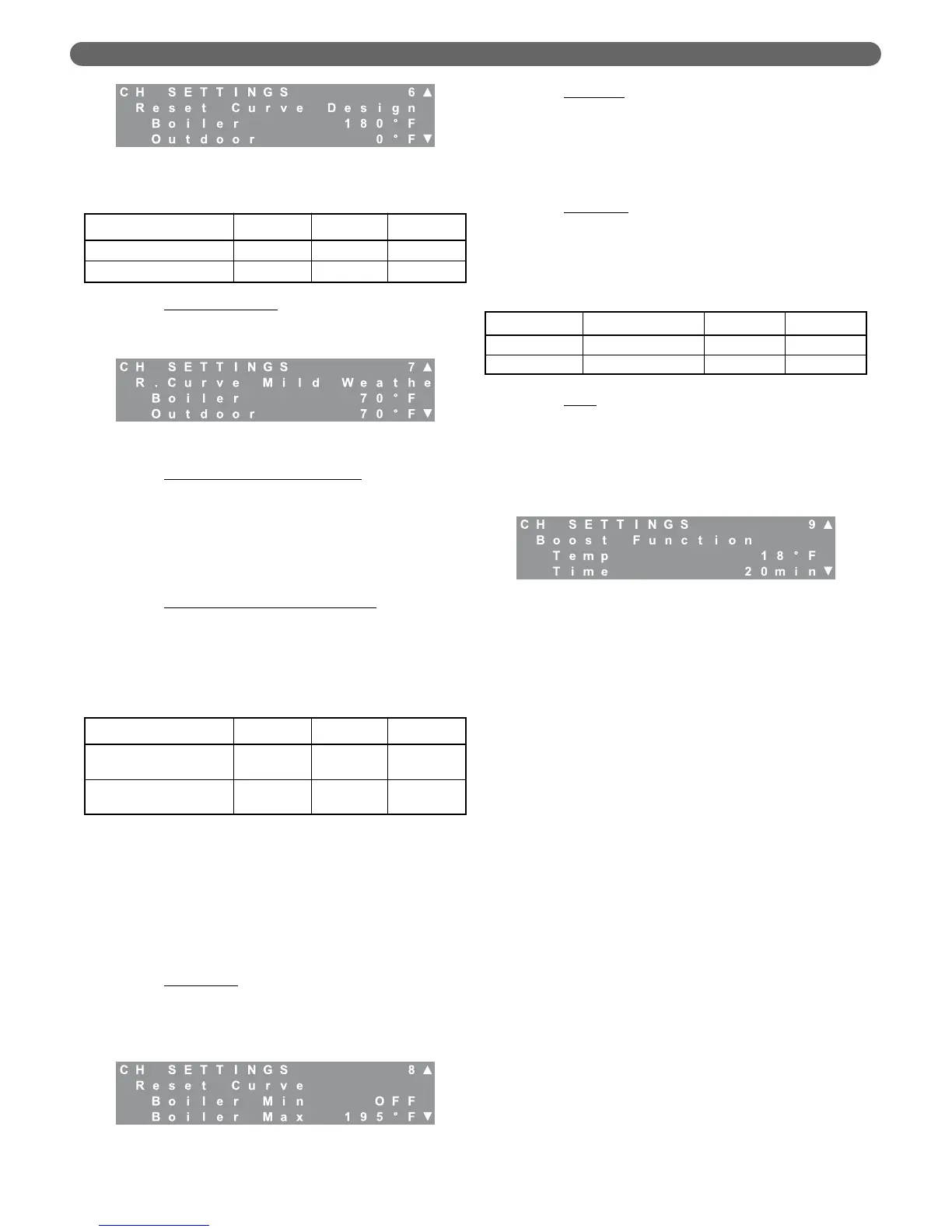
The example in Figure 8.32 shows an outdoor
temperature of 0°F (-18°C) which corresponds to
the value for Springfield, Massachusetts. The boiler
temperature is shown at 160°F (71°C) to meet the
load as determined by the system designers. The
mild weather point is at an outdoor temperature of
70°F (21°C) and a boiler temperature of about
85°F (29°C). When the outdoor temperature is
32°F (0°C), the boiler will target 130°F (54°C).
n. Boiler Limits
: The boiler limits are available to limit
the minimum and maximum temperature that the
boiler can target. Note that these limits will
override the values set in the outdoor reset design
and mild weather outdoor reset parameters.
o. Boiler Min
: The boiler will not target a temperature
lower than what is chosen in this menu screen. The
default for this is, “Off” since low temperatures will
not affect the boiler. However, it may be useful in
installations that require a minimum temperature to
operate (like a fan coil unit that will not allow a fan
to operate below a certain temperature).
p. Boiler Max
: The boiler will not target a
temperature higher than that chosen in this menu.
This can be useful to prevent damage due to high
temperatures in temperature sensitive situations
such as radiant floors.
q. Boost
: The boost function is designed to compensate
for a system that is not meeting the required load. If
there is a constant call for central heat for the length
of time specified, the target temperature will be
increased by the temperature value selected. The
boiler will never target a temperature higher than that
specified by the boiler max. parameter.
There are several reasons why the boost function
may or may not be implemented.
•
In buildings which have many zones, there may
seldom be a period when none of the zones is
calling for heat. In this case, the boiler will very
often be operating at the temperature selected
by the “boiler max.” parameter, and much of
the advantage of a condensing boiler may be
lost. Therefore, it may be better to use CH
Mode 2, “Permanent Demand and Outdoor
Reset” in these situations. In this mode, the
boost function is not applied therefore the
boiler will continue to run at the temperature
calculated by the outdoor reset algorithm.
•
Programmable thermostats can give a building
owner the ability to set back the thermostat
significantly during unoccupied periods. After
an aggressive setback, it may take the boiler a
significant amount of time to recover. However,
this may lead to the boiler frequently operating
at higher temperatures, where it is less efficient.
Before using setback thermostats, the building
owner should be made aware that aggressive
setback s of 10°F (6°C) or more may not have
the desired effect.
•
If the outdoor reset parameters are set for
design conditions at a certain outdoor design
temperature, and the outdoor temperature
drops below that temperature for a significant
amount of time causing cold indoor
temperatures, the boost function can allow the
boiler to target temperatures up to the boiler
maximum to satisfy the load.
Figure 8.33:
CH Settings – Reset Curve Mild Weather
Table 8.22: Reset Curve Mild Weather Ranges &
Defaults
Parameter Minimum Default Maximum
Mild Weather
Boiler Temp.
36°F (2°C) 70°F (21°C) 160°F (71°C)
Mild Weather
Outdoor Temp.
36°F (2°C) 70°F (21°C) 85°F (29°C)
Figure 8.32: CH Settings – Reset Curve Design
Table 8.21: Reset Curve Design Ranges & Defaults
Parameter Minimum Default Maximum
Boiler Design Temp. 61°F (16°C) 180°F (82°C) 195°F (91°C)
Outdoor Design Temp. -40°F (-40°C) 0°F (-18°C) 70°F (21°C)
Figure 8.34: CH Settings – Reset Curve Min/Max
Table 8.23: Reset Curve Min/Max Ranges & Defaults
Parameter Minimum Default Maximum
Boiler Minimum “Off” or 40°F (4°C) OFF 180°F (82°C)
Boiler Maximum 81°F (27°C) 195°F (91°C) 195°F (91°C)
Figure 8.35: CH Settings – Temperature Boost
BOILER CONTROL: OPERATION


 To Next Page