DANGER – HIGH PRESSURE DEVICE
This vessel may cause loss of life, severe bodily harm, or property damage if not correctly
installed, operated and
maintained. Read and understand all guidelines given in this bulleting
before attempting to open, operate or service
this vessel. Failure to follow these guidelines and
observe every precaution will result in malfunction and could result in catastrophic failure.
Misuse, incorrect assembly, or use of damaged or corroded components can result
in high-
velocity release of the end closure. We recommend that only a qualified technician experienced in
servicing
high-pressure hydraulic systems open, close and service this vessel.
Important Safety Precautions
• Read, understand and follow every guide- line
in this bulletin. Failure to take every
precaution may void warranty and could result
in catastrophic failure.
• Install in an area where a vessel or piping
malfunction that result in water leakage would
not damage sensitive or expensive
equipment, such as electronic components.
• Verify that head locking components are
properly placed and secured.
• Inspect end closures regularly, replace
deteriorated components and correct causes
of corrosion.
• Follow membrane element manufacturer’s
recommendations for loading elements into
the vessel (see Replacing Elements).
• The vessel is designed for continuous use at
a pH of 3-11 and for intermittent cleaning
(max. 43.2 hours per year at a pH of 2-12).
• Flush the vessel before system shut down.
Some feed waters may cause corrosion under
static conditions. Flushing with noncorrosive
permeate is recommended.
• Operate the vessel outside the recommended
operating and cleaning pH range.
• Operate vessel at pressures and temperatures
more than their specific rating.
• Service any component until you verify that
pressure is fully relieved from the vessel.
• Use corroded components. Use of such
components may result in catastrophic failure.
• Pressurize vessel until after visually inspecting
to ensure that the spiral retaining rings is
correctly installed and seated in their grooves.
• Tolerate leaks or allow end closures to be
routinely wetted in any way.
• Use excessive silicone lubricant.
• pressurize vessel without element in place
unless permeate ports are plugged internally.
• Use vessel at negative pressure.
• Pressurize vessel with Compressed Air.
• Stand or climb on the pressure vessel, or the
feed/ Concentrate or permeate ports.
• Allow petroleum or silicone based products to
come in contact with membrane elements
during installation or maintenance.
General Information
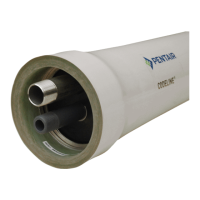
The
40E100
Series of RO Pressure Vessel Housings are
designed to be used in water
desalination systems at
operating pressures
of up to 1000 psi. Each
model
is ava
ilable
in
lengths
to
house
from one to
seven 40-inch-long
elements.
Any make of 4-inch nominal
diameter
spiral-
wound element may
be
used. The 40E100
is
designed
and built-in
accordance
with the
engineering standards
of the
Boiler
and
Pressure Vessel
Code of the
American
Society
of
Mechanical Engineers (ASME Code). The vessels
utilize a
fiberglass reinforced plastic
shell
for
superior
corrosion resistance.
The
information
and
guidelines incorporated
in this
User’s Guide are
intended
only as a
supplement
to
good industrial practice. Full responsibility for
correct
operation and maintenance
of
vessel remains with
the user.
This guide should
be
used
in
conjunction with
drawing
number
518015.
When properly installed and maintained, 40E100
vessels can
be
expected
to
provide safe
operation
over a
long service
life.


 To Next Page
 Loading...