10
self-checking is completed. If the module self-check fails, voice broadcast “xx self-check error”, the
led will continue blink and the buzzer beeps until you restart the receiver. Self-checking procedure
lasts about 1 minute. Please contact your dealer if the self-checking is failed.
If each module led are ON (not blinking) and voice broadcast the self-checking success (for
example “self-check GPS OK”), it means the modules could work normally. Receiver will work
normally after the self-checking finished.
Note: After self-checking, built-in radio frequency will return to factory settings. If necessary,
please contact TI Asahi support to change the frequency to match your usage.
3.4.Power off
When the receiver is in the ON status (power supply light ON), press and hold power key for 3
seconds until all lights blink, then release the power key and there will be a voice broadcast
“power off”. Press the power key to confirm, then receiver will be turned off.
3.5.Measure the antenna height
When we use G7H+ for collecting static data or set
G7H+ on a known point as a base station, the antenna
height should be measured. Antenna height is actually
the vertical height of the phase center to ground
measurement point. But there are some
measurement methods and you should select the
collect measurement method to set the antenna
height.
Base and Static mode antenna height measurement:
You can measure from the ground to the ARP
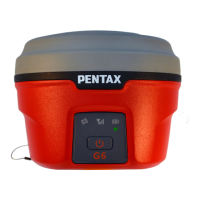
(Antenna Reference Point, that is the bottom of G7H+)
of the receiver to use RTK software or post processing
software.
Figure 3-1 Antenna Height
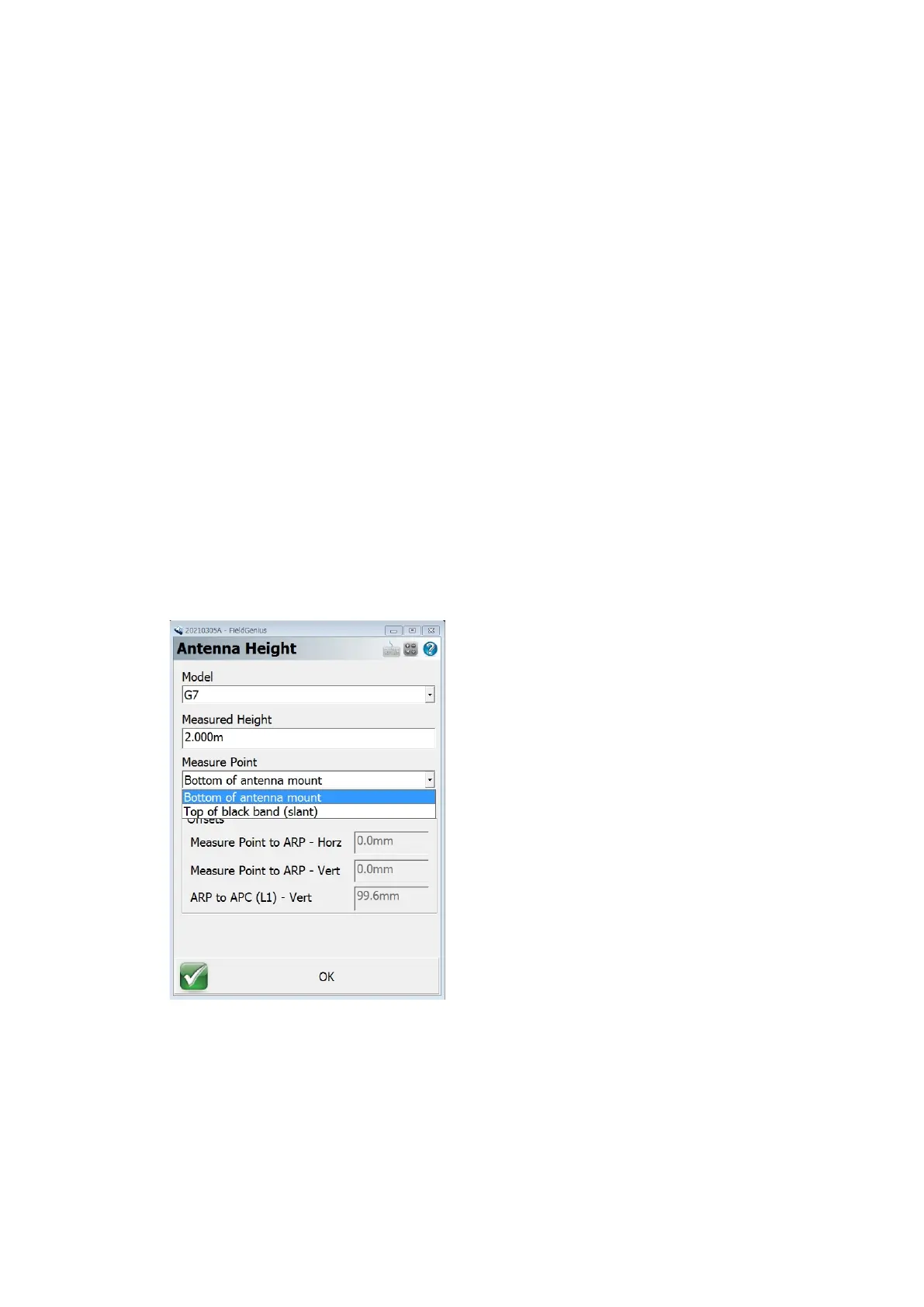
Rover mode antenna height measurement: Antenna vertical height (from bottom), that is the
measured value from measured point on the ground to ARP of G7H+ is adopted the most case
of rover mode. In FieldGenius, it is shown as “Bottom of antenna mount”.



 To Next Page