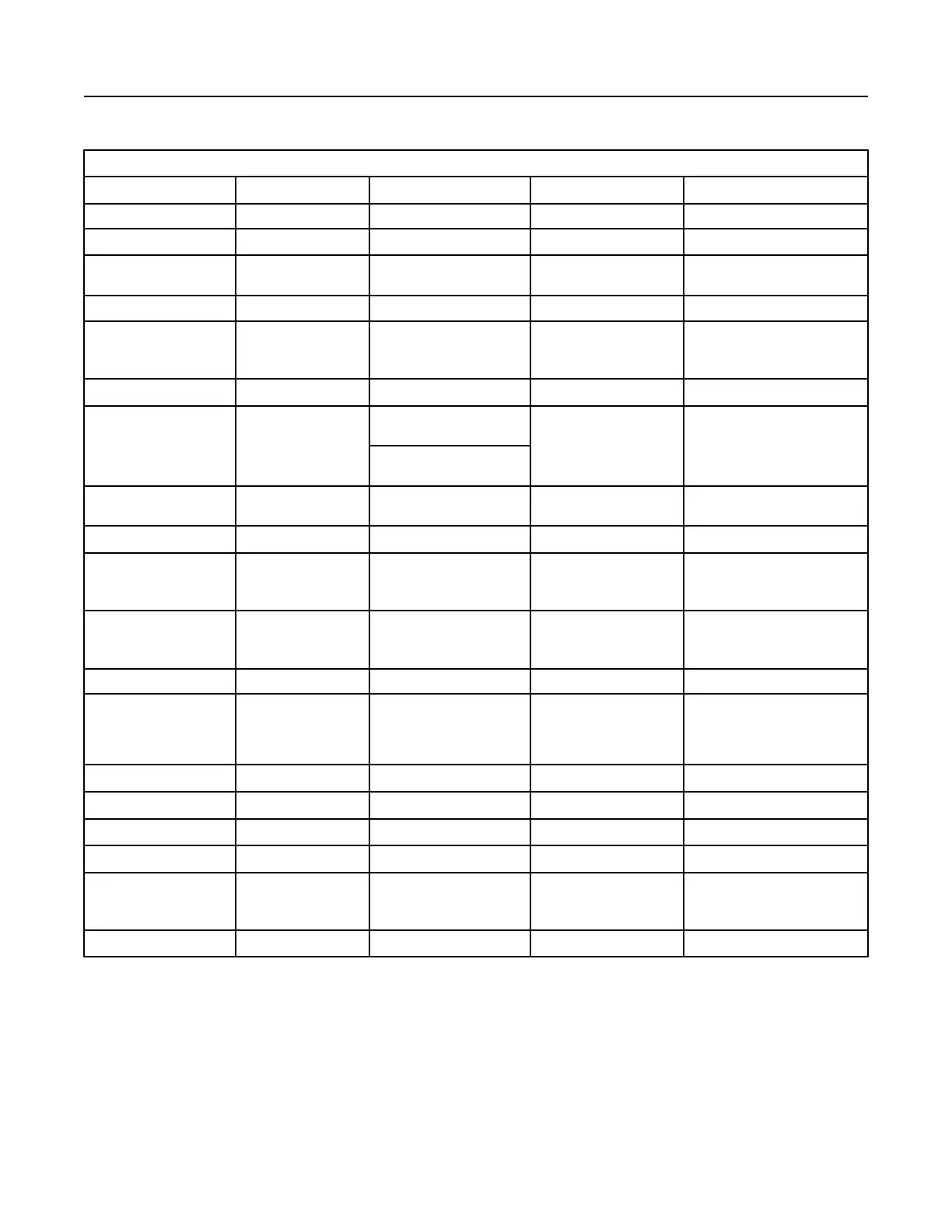
Table 21
Perkins Specification for Distillate Diesel Fuel
Property UNITS Requirements “ASTM Test” “ISO Test”
Aromatics %Volume 35% maximum D1319 “ISO 3837”
Ash %Weight 0.01% maximum D482 “ISO 6245”
Carbon Residue on 10%
Bottoms
%Weight 0.35% maximum D524 “ISO 4262”
Cetane Number
(1)
-
40 minimum D613 or D6890 “ISO 5165”
Cloud Point °C The cloud point must not ex-
ceed the lowest expected
ambient temperature.
D2500 “ISO 3015”
Copper Strip Corrosion
-
No. 3 maximum D130 “ISO 2160”
Distillation °C 10% at 282 °C (539.6 °F)
maximum
D86 “ISO 3405”
90% at 360 °C (680 °F)
maximum
Density at 15 °C (59 °F)
(2)
Kg / M
3
800 minimum and 860
maximum
No equivalent test “ISO 3675” or “ISO 12185”
Flash Point °C legal limit D93 “ISO 2719”
Thermal Stability
-
Minimum of 80% reflectance
after aging for 180 minutes
at 150 °C (302 °F)
D6468 No equivalent test
Pour Point °C 6 °C (10°F)
Minimum below ambient
temperature
D97 “ISO 3016”
Sulfur %mass
(3)
D5453 or /D26222 “ISO 20846” or “ISO 20884”
Kinematic Viscosity
(4)
“MM”
2
“/S (cSt)” The viscosity of the fuel that
is delivered to the fuel injec-
tion pump. “1.4 minimum
and /4.5 maximum”
D445 “ISO 3405”
Water and sediment % weight 0.05% maximum D1796 “ISO 3734”
Water % weight 0.05% maximum D1744 No equivalent test
Sediment % weight 0.05% maximum D473 “ISO 3735”
Gums and Resins
(5)
mg/100mL 10 mg per 100 mL maximum D381 “ISO 6246”
Lubricity corrected wear
scar diameter at 60 °C
(140 °F).
(6)
mm
0.46 maximum D6079 “ISO 12156-1”
Fuel cleanliness
(7)
-
“ISO”18/16/13 7619 “ISO 4406”
(1)
In order to insure minimum cetane number of 40 a distillate diesel fuel should have minimum cetane index of 44 when ASTM D4737 test meth-
od is used. A fuel with a higher cetane number is recommended in order to operate at a higher altitude or in cold weather.
(2)
Density range allowed includes summer and winter diesel fuel grades. Fuel density varies depending on the sulfur level where high sulfur fuels
have higher densities. Some unblended alternative fuels have lower densities which are acceptable, if all the other properties meet this
specification.
(3)
Regional regulations, national regulations, or international regulations can require a fuel with a specific sulfur limit. Consult all applicable regu-
lations before selecting a fuel for a given engine application. Perkins fuel systems and engine components can operate on high sulphur fuels
where allowed by legislation. Fuel sulfur levels affect exhaust emissions. High sulfur fuels also increase the potential for corrosion of internal
components. Fuel sulfur levels above 0.5% may significantly shorten the oil change interval. For additional information, refer to General lubri-
cant Information.
(continued)
SEBU7833
45
Refill Capacities
Fluid Recommendations






 To Next Page