7. Install hose (4) and tighten clip (3) securely . Install
hose (2) and tighten clip (1) securely.
i05970985
Grounding Stud - Inspect/
Clean/Tighten
The connection of battery cables to a battery and
the disconnection of battery cables from a battery
may cause an explosion which may result in in-
jury or death. The connection and the disconnec-
tion of other electrical equipment may also cause
an explosion which may result in injury or death.
The procedures for the connection and the dis-
connection of battery cables and other electrical
equipment should only be performed in a nonex-
plosive atmosphere.
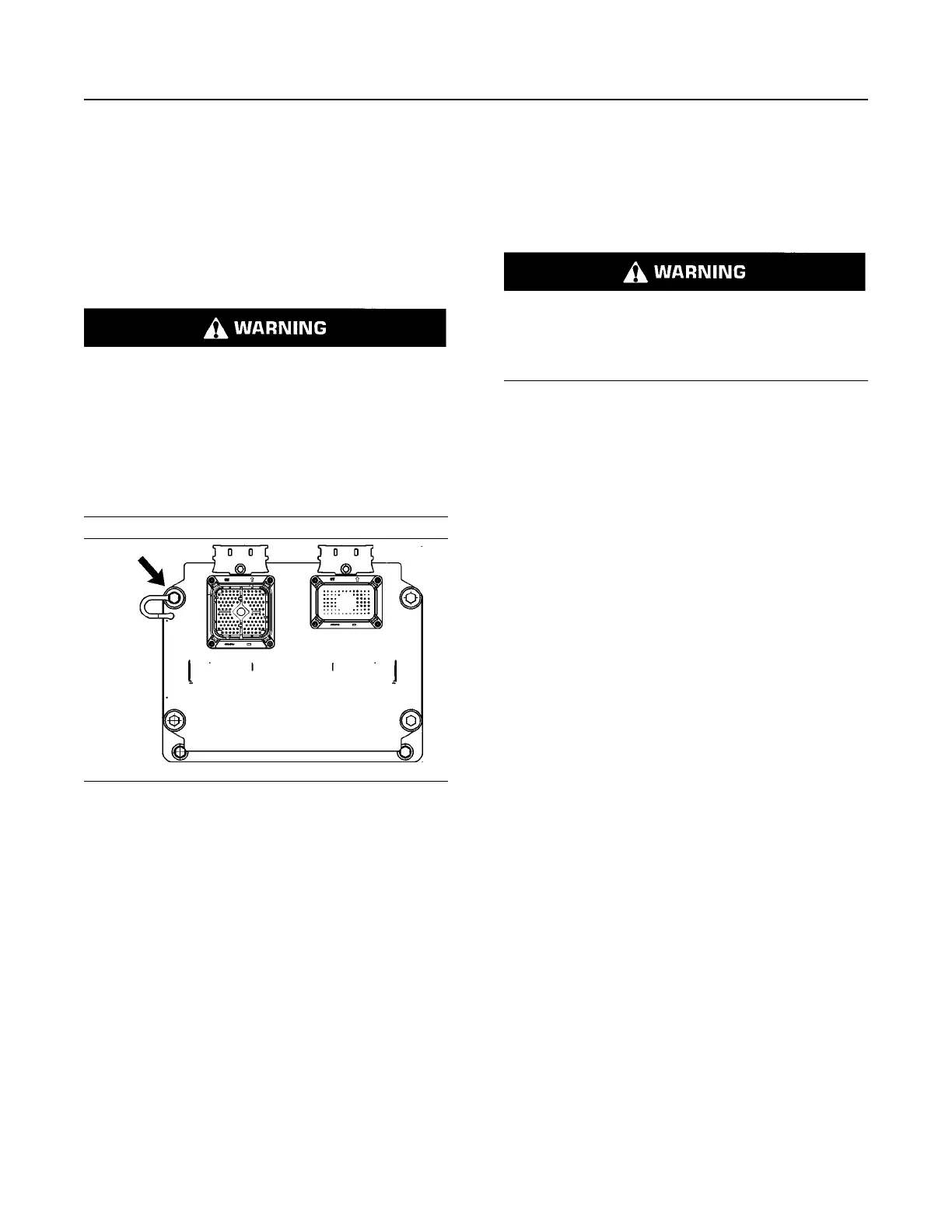
Illustration 94 g01376112
The electronics grounding stud is located on the
upper left corner of the engine control module.
Inspect the OEM harness for good connections.
Inspect the condition of the OEM harness.
The electronics grounding stud must have a wire
ground to the battery. Tighten the electronics
grounding stud at every oil change. Ground wires
and straps should be combined at engine grounds.
All grounds should be tight and free of corrosion.
• Clean the electronics grounding stud and the
terminals for the ground strap with a clean cloth.
• If the connections are corroded, clean the
connections with a solution of baking soda and
water.
• Keep the electronics grounding stud and the strap
clean and coated with MPGM grease or petroleum
jelly.
i06103230
Hoses and Clamps - Inspect/
Replace
Contact with high pressure fuel may cause fluid
penetration and burn hazards. High pressure fuel
spray may cause a fire hazard. Failure to follow
these inspection, maintenance and service in-
structions may cause personal injury or death.
If you inspect the engine in operation, always use the
proper inspection procedure in order to avoid a fluid
penetration hazard. Refer to Operation and
Maintenance Manual, “General hazard Information”.
Inspect all hoses for leaks that are caused by the
following conditions:
• Cracking
• Softness
• Loose clamps
Replace hoses that are cracked or soft. Tighten any
loose clamps.
Check for the following conditions:
• End fittings that are damaged or leaking
• Outer covering that is chafed or cut
• Exposed wire that is used for reinforcement
• Outer covering that is ballooning locally
• Flexible part of the hose that is kinked or crushed
• Armoring that is embedded in the outer covering
A constant torque hose clamp can be used in place
of any standard hose clamp. Ensure that the constant
torque hose clamp is the same size as the standard
clamp.
Due to extreme temperature changes, the hose will
harden. Hardening of the hoses will cause hose
clamps to loosen. This hardening can result in leaks.
A constant torque hose clamp will help to prevent
loose hose clamps.
Each installation application can be different. The
differences depend on the following factors:
• Type of hose
• Type of fitting material
• Anticipated expansion and contraction of the hose
114
SEBU9071-06
Maintenance Section
Grounding Stud - Inspect/Clean/Tighten


 To Next Page