EasyManua.ls Logo

Philips 231E1HSB/00 - Safety Check Process

Philips 231E1HSB/00
69 pages
Print Icon
To Next Page IconTo Next Page
To Previous Page IconTo Previous Page
Loading...
231E1
LCD
68
Safety
Check
Process
(safety)
Safety
Checks
After
the
original
service
problem
has
been
corrected,
a
complete
safety
check should
be
made.
Be
sure
to
check
over
the
entire
set,
not
just
the
areas
where
you
have
worked.
Some
previous
service
may
have
left
an
unsafe
condition,
which
could
be
unknowingly
passed
on
to
your
customer.
Be
sure
to
check
all of
the
following:
Fire
and
Shock
Hazard
1.
Be
sure
all
components
are
positioned
in
such
a
way
as
to
avoid
the
possibility
of
adjacent
component
shorts.
This
is
especially
important
on
those
chassis
which
are
transported
to
and
form
the
service
shop.
2.
Never
release
a
repaired
unit
unless
all
protective
devices
such
as
insulators,
barries,
covers,
strain
reliefs,
and
other
hardware
have
been
installed
in
accordance
with
the
original
design.
3.
Soldering
and
wiring
must
be
inspected
to
locate
possible
cold
solder
joints,
solder
splashes,
sharp
solder
points,
frayed
leads,
pinched
leads,
or
damaged
insulation(including
the
accord).
Be
certain
to
remove
loose
solder
balls
and
all
other
loose
foreign
particles.
4.
Check
across-the-line
components
and
other
components
for
physical
evidence
of
damage
or
deteriortion
and
replace
if
necessary
.
Follow
original
layout,
lead
length
and
dress.
5.
No
lead
or
component
should
touch
a
receiving
tube
or
a
resistor
rated
at
1watt
or
more.
Lead
tension
around
protruding
metal
surfaces
or
edges
must
be
avoided.
6.
Critical
components
having
special
safety
characteristics
are
identified
with
ans
bythe
Ref.No
in
the
parts
list
and
enclosed
within
a
broken
line
*(
Where
several
critical
components
are
grouped
in
one
area)
along
with
the
safety symbols
on
the
schematic
diagrams
and/or
exploded
views.
7.When
servicing
any
unit,
always
use
a
separate
isolation
transformer
for
the
chassis
failure
to
use
a
separate
isolation
transformer
may
expose
you
to
possible
shock
hazard,
and
may
cause
damage
to
servicing
instruments.
8.
Many
electronic
products
use
a
polarized
ac
line
cord(one
wide
pin
on
the
plug).
Defeating
this
safety
feature
may
create
a
potential
hazard
to
the
service
and
the
user
.
Extension
cords
which
do
not
incorporate
the
polarizing
feature
should
never
be
used.
9.
After
reassembly
of
the
unit,
always
perform
an
leakage
test
or
resistance test
from
the
line
cord
to
all
exposed
metal
parts
of
the
cabinets.
Also
check
all
metal
control
shafts(with
knobs
removed),
antenna
terminals,
handles,
screws, etc.
To
be
sure
the
unit
may
be
safety
operated
without
danger
of
electrical
shock.
Broken
line
Implosion
1.
All
picture
tubes
used
in
current
model
receivers
are
equipped
with
an
intergral
implosion
system
care
should
always
be
used,
and
safety
glasses
worn,
whenever
handling
any
picture
tube.
Av
o
i
d
scratching
or
other
wise
damaging
the
picture
tube
during
installation.
2.
Use
only
replacement
tubes
specified
by
the
manufacturer.
X-radiation
1.
Be
sure
procedures
and
instructions
to
all
your
service
personal
cover
the
subject
of
X-radiation.
Potential
sources
of
X-rays
in
TV
receivers
are
the
picture
tube
and
the
high
voltage
circuits.
The
basic
precaution
which
must
be
exercised
is
to
keep
the
high
voltage
at
the
factory
recommended
level.
2.
To
avoid
possible
exposure
to
X-radiation
and
electrical
shock,
only
the
manufacturer
s
s
p
ecified
anode
connectors
must
be
used.
3.
It
is
essential
that
the
service
technician
has
an
accurate
HV
meter
available
at
all
times.
The
calibration
of
this
meter
should
be
checked
periodically
against
a
reference
standard.
4.
When
the
HV
circuitry
isoperating
properly
there
is
no
possibility
of
an
X-
radiation
problem.
High
voltage
should
always
be
kept
at
the
manufacture,
rated
value-no
higher-
for
optimum
performance.
Every
time
a
color
set
is
serviced,
the
brightness
should
be
run
up
and
while
monitoring
the
HV
with
a
meter
to
be
certain
that
the
HV
is
requation
correctly
and
does
not
exceed
the
specified
value.
We
s
uggest
that
you
and
your
technicians
review
test
procedures
so
that
HV
requation
are
always
checked
as
a
standard
servicing
procedure,
and
the
reason
for
this
prudent
routine
is
cleanly
understood
by
everyone.
It
is
important
ot
use
an
accurate
and
reliable
HV
meter.
It
is
recommended
that
the
HV
recorded
on
each
customer
s
i
nvoice,
which
will
demonstrate
a
proper
concern
for
the
customer
s
s
a
fety
.
5.
When
troubleshooting
and
making
test
measurements
in
a
receiver
with
a
problem
of
excessive
high
voltage,
reduce
the
line
voltage
by
means
of
a
variac to
bring
the
HV
into
acceptable
limits
while
troubleshooting.
Do
not
operate
the
chassis
loner
than
necessary
to
locate
the
cause
of
the
excessive
HV
.
6.
New
picture
tubes
are
specifically
designed
to
withstand
higher
operating
voltages
without
creating
undesirable
X-radiation.
It
is
strongly
recommended that
any
shop
test
fixture
which
is
to
be
used
with
the
new
higher
voltage
chassis
be
equipped
with
one
of
the
new
type
tubes
designed
for
this
service.
Addition
of
a
permanently
connected
HV
meter
to
the
shop
test
fixture
is
advisable.
The
CR
T
ty
p
e
s
used
in
these
new
sets
should
never
be
replaced
with
any
other
types,
as
this
may
result
in
excessive
X-radiation.
7.
It
is
essential
to
use
the
specified
picture
tube
to
avoid
a
possible
X-radiation
problem.
8.
Most
TV
receivers
contain
come
types
of
emergency”
Hold
Down
circuit
to
prevent
HV
from
rising
to
excessive
levels
in
the
presence
of
a
failure
mode.
These
various
circuits
should
be
understood
by
all
technicians
servicing
them,
especially
since
many
hold
down
circuits
are
inoperative
as
long
as
the
receiver
performs
normally
.
Leakage
Current
Cold
Check
1.
Unplug
the
ac
line
cord
and
connect
a
jumper
between
the
two
prongs
of
the
plug.
2.
Tu
r
n
on
the
power
switch.
3.
Measure
the
resistance
value
between
the
jumpered
ac
plug
and
all
exposed
cabinet
parts
of
the
receiver,
such
as
screw
heads,
antennas,
and
control
shafts.
When
the
exposed
metallic
part
has
a
return
path
to
the
chassis,
the
reading
should
be
between
1
megohm
and
5.2
megohms.
When
the
exposed
metal
does
not
have
a
return
path
to
the
chassis,
the
reading
must
be
infinity
. Remove
the
jumper
from
the
ac
line
cord.
To
INSTRUMEN
TS
EXPOSE
D
METAL
PA
RTS
1500
ohm
,
10
W
0.15
uF
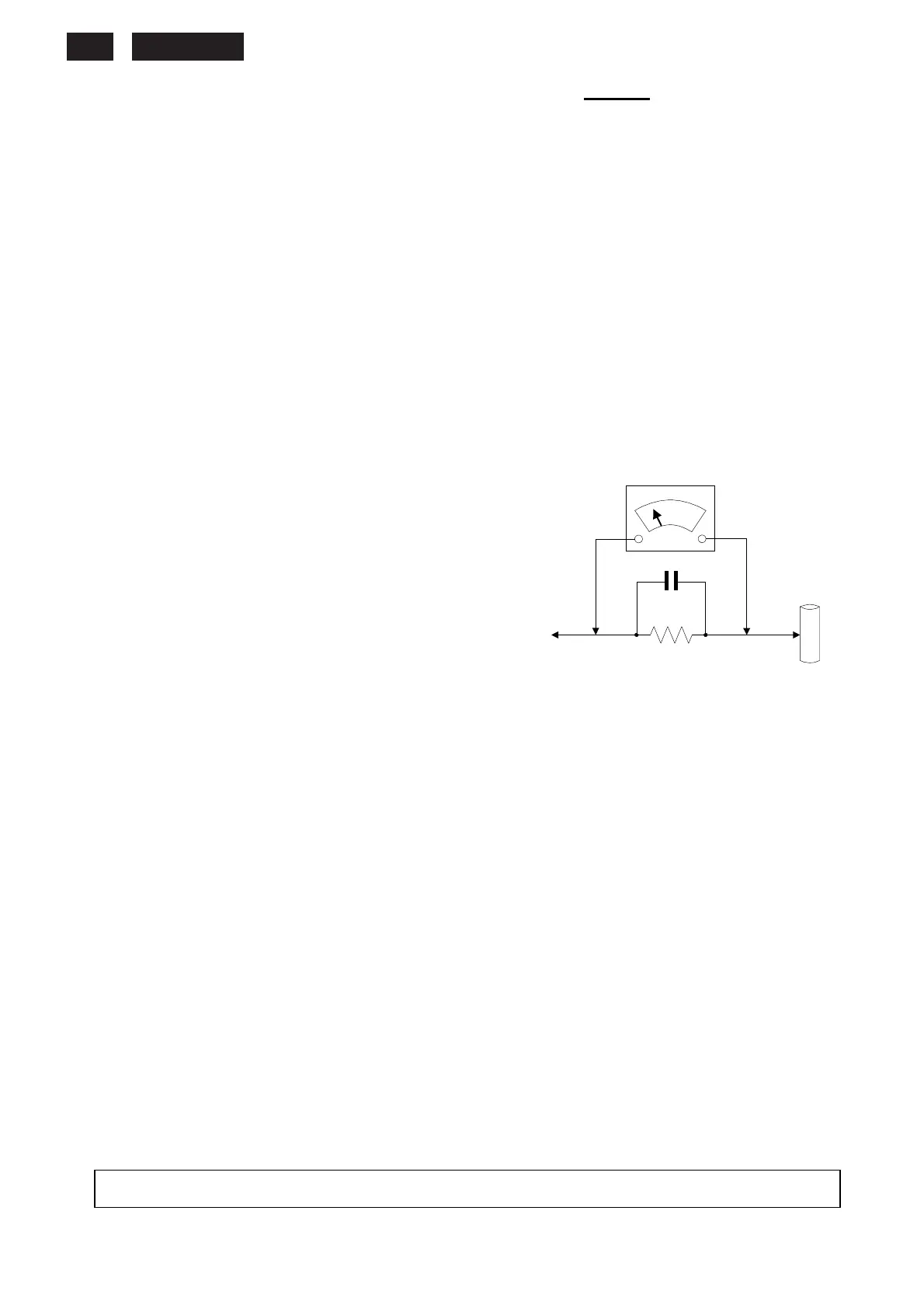
Leakage Current Hot Check
1.
Do
not
use
an
isolation
transformer
for
this
test.
Plug
the
completely
reassembled
receiver
directly
into
the
ac
outlet.
2.
Connect
a
1.5k,
10w
resistor
paralleled
by
a
0.15uf
capacitor
between
each
exposed
metallic
cabinet
part
and
a
good
earth
ground
such
as
a
water
pipe,
as
shown
above.
3.
Use
an
ac
voltmeter
with
at
least
5000
ohms
volt
sensitivity
to
measure
the
potential
across
the
resistor.
4.
The
potential
at
any
point
should
not
exceed
0.75
volts.
A
leakage
current
tester
may
be
used
to
make
this
test;
leakage
current
must
not
exceed
a
possibility
of
shock
hazard.
The
receiver
should
be
repaired
and
rechecked
before
returning
it
to
the
customer.
5.
Repeat
the
above
procedure
with
the
ac
plug
reversed.(note:
an
ac
adapter
is
necessary
when
a
polarized
plug
is
used.
Do
not
defeat
the
polarizing
feature
of
the
plug.)
Picture Tube Replacement
The
primary
source
of
X-radiation
in
this
television
receiver
is
the
picture
tube. The
picture
tube
utilized
in
this
chassis
is
specially
constructed
to
limit
X-
radiation
emissions.
For
continued
X-radiation
protection,
the
replacement
tube
must
be
the
same
types
as
the
original,
including
suf
f
i
x
letter
,
or
a
Philips
approved
tube.
Parts
Replacement
Many
electrical
and
mechanical
parts
in
Philips
television
sets
have
specialsafety
related
characteristics.
These
characteristics
are
often
not
evident
from
visual
inspection
nor
can
the
protection
af
f
orded
by
them
necessarily
be
obtained
by
using
replacement
components
r=ated
for
higher
voltage,
wattage,
etc.
The
use
of
a
substitute
part
which
does
not
have
the
same
safety
characteristics
as
the
Philips
recommended
replacement
part
should
in
this
service
manual
may
create
shock,
fire,
or
other
hazards
W
A
RNING:
Before
removing
the
back
cover
,
turn
the
unit
OFF
and
short
the
HIGH
VOL
T
AGE
to
the
ground.
WATER
PIPE
EARTH
GROUND

Related product manuals