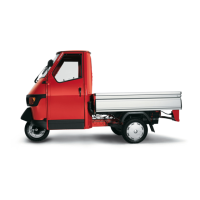
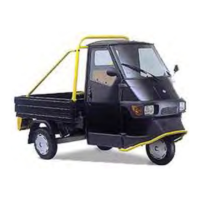
The overall equipment design and manufacture, meets the requirements set forth in
section 1.1 of the Technical Appendix to the Standards, in addition to the above men-
tioned CUNA norms.
Controls and control devices.
All controls comply with the applicable Directives regarding the type and operational
specifications of the equipment and its use. Operator position: this is the vehicle driv-
er's position. Control position: on the dashboard, to the left of the driving position (for
left-hand drive vehicles) or in the opposite position for right-hand drive vehicles.
Controls to be used by operator:
•
there is a single control for lifting or lowering the load bed.
•
a device fitted with an emergency system. This control is a pushbutton loca-
ted in the electrical circuit that connects the battery to the hydraulic control
unit. This protected circuit is derived from the vehicle's circuit and has two
sections:
••
one section supplies the electrical motor connected to the pump.
•
the other one activates the control distributor by-pass.
The control has two properly labelled positions:
•
upward arrow indicating lifting.
•
downward arrow indicating lowering.
In the resting position the electrical circuits of both sections remain open: the engine
is not powered and the by-pass remains closed.
Pushing the switch upwards (as shown by the arrow) closes the load bed supply sys-
tem. The switch has a latching function. Releasing the switch stops the load bed.
Moving the switch downwards (as shown by the arrow) opens the load bed distribution
by-pass and starts (or continues) the load bed lowering operation.
The switch has a latching function. Releasing the switch stops the load bed. There
are red-light indicators (located on control pushbutton and marked with a symbol in-
dicating lifted load bed) and buzzers that can be heard even from inside the cabin.
128


 To Next Page