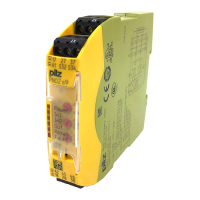
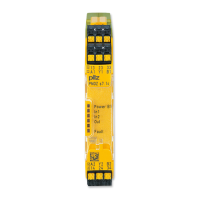
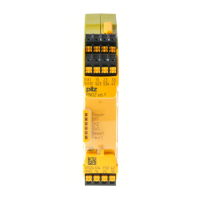
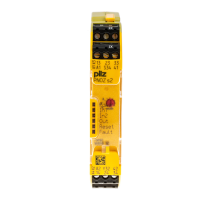
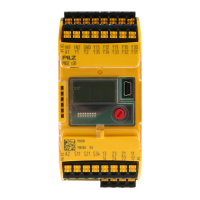
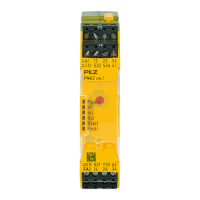
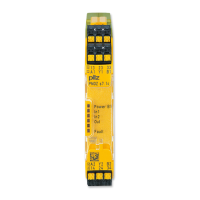
The PNOZ s3 safety relay provides a safety-related interruption of a safety circuit and meets the requirements of EN 60947-5-1, EN 60204-1, and VDE 0113-1. It is suitable for applications involving E-STOP pushbuttons, safety gates, and light beam devices.
Function Description
The safety relay offers various operating modes, which can be configured via a rotary switch. These modes determine how the input circuits are monitored and how the unit starts operation.
- Single-channel operation (In2+): In this mode, there is no redundancy in the input circuit. The unit detects earth faults in both the start and input circuits.
- Dual-channel operation without detection of shorts across contacts: This mode provides a redundant input circuit. It detects earth faults in the start and input circuits, as well as short circuits within the input circuit. If a monitored start is configured, it also detects short circuits in the start circuit.
- Dual-channel operation with detection of shorts across contacts (In2-): This is a redundant input circuit mode that offers comprehensive fault detection. It identifies earth faults in the start and input circuits, short circuits within the input circuit (and in the start circuit if monitored), and importantly, shorts between contacts in the input circuit.
- Automatic start (A): The unit becomes active as soon as the input circuit is closed.
- Manual start: The unit becomes active after the input circuit is closed, followed by the closing of the start circuit.
- Monitored start with falling edge: The unit activates when the input circuit is closed, and then the start circuit is closed and opened again. Alternatively, it activates when the start circuit is closed and opened again after the input circuit has been closed.
- Monitored start with rising edge: The unit activates once the input circuit is closed and the start circuit is closed after a specified waiting period has elapsed.
- Start with start-up test: Upon applying supply voltage, the unit performs a check to ensure that any closed safety gates are opened and then closed again.
The device incorporates robust safety features. Its circuit is redundant and includes built-in self-monitoring to ensure the safety function remains effective even in the event of a component failure. The correct opening and closing of the safety function relays are automatically tested during each on-off cycle. An electronic fuse is also integrated for additional protection.
Usage Features
The PNOZ s3 safety relay is designed for ease of use and flexibility in various safety applications.
- Positive-guided relay outputs: It features two instantaneous safety contacts (N/O) and one semiconductor output.
- Connection options: The unit can be connected to a variety of safety devices, including E-STOP pushbuttons, safety gate limit switches, start buttons, light beam devices, and PSEN sensors.
- Expandability: A connector allows for the easy integration of one PNOZsigma contact expansion module, increasing the number of available instantaneous safety contacts. This also enables the connection of external contactors or relays to further expand the system.
- Operating mode selection: Operating modes are set via a rotary switch located under the front cover of the unit, providing clear and straightforward configuration.
- LED indicators: The unit includes LED indicators for various statuses:
- Supply voltage (Power)
- Input status for channel 1 (In1)
- Input status for channel 2 (In2)
- Switch status for channel 1/2 (Out)
- Start circuit (Reset)
- Error (Fault)
- Connection terminals: The unit is available with plug-in connection terminals, offering a choice between spring-loaded terminals or screw terminals for convenient wiring.
- Installation: The safety relay is designed for installation in a control cabinet with a minimum protection type of IP54. It can be easily mounted on a 35 mm DIN rail using the notch on the rear. For vertical installations, a fixing element (such as a retaining bracket or end angle) should be used to secure the unit.
- Wiring considerations: The outputs 13-14 and 23-24 are designated as safety contacts. The semiconductor output Y32 should not be used for safety circuits. To prevent contact welding, a fuse should be connected before the output contacts. Proper cable length calculations and the use of copper wire that can withstand appropriate temperatures are essential. When connecting magnetically operated reed proximity switches, it's important to ensure that the maximum peak inrush current does not overload the switch.
Maintenance Features
The PNOZ s3 safety relay provides clear diagnostic indicators to assist with troubleshooting and maintenance.
- Status indicators:
- Power (LED on): Indicates that supply voltage is present.
- In1 (LED on): Shows that the input circuit at S12 is closed.
- In2 (LED on): Shows that the input circuit at S22 is closed.
- Out (LED on): Indicates that safety contacts are closed and semiconductor output Y32 carries a high signal.
- Reset (LED on): Shows that 24 V DC is present at S34.
- Error indicators: The unit uses LED patterns (on, flashing, or off) to signal various errors, helping to quickly identify the cause of a malfunction.
- All LEDs off: Diagnostics indicate a short across contacts or an earth fault, leading to the unit switching off. The remedy involves rectifying the short/earth fault and cycling the supply voltage.
- Fault (LED flashing): If the plug terminator is not connected, the "Fault" LED will flash. The solution is to insert the plug terminator and cycle the supply voltage.
- Fault (LED flashing): An internal error or defective unit will also cause the "Fault" LED to flash. The remedy is to cycle the supply voltage and, if necessary, replace the unit.
- Power (LED flashing): Indicates that the supply voltage is too low. The remedy is to check the supply voltage.
- In1, In2 alternately flashing: Signals a short detected between S12 and S22. The remedy involves rectifying the short and cycling the supply voltage.
- In1 (LED flashing): Indicates a power-up blocked due to a short-term interruption at S12 or input circuits not operated simultaneously. The remedy is to open both input circuits (S12 and S22) simultaneously and then close them again.
- In2 (LED flashing): Similar to In1, but for S22. Indicates a power-up blocked due to a short-term interruption at S22 or input circuits not operated simultaneously. The remedy is to open both input circuits (S12 and S22) simultaneously and then close them again.
- Reset (LED flashing): Indicates that the position of the rotary switch is not permitted or was adjusted during operation. The remedy is to cycle the supply voltage and set the correct operating mode.
- Power, In1, In2, Out, Reset, Fault (all flashing): This pattern indicates that the operating mode selector switch "mode" is in its start position (vertical position). The remedy is to switch off the supply voltage and set the required operating mode.
- Contact malfunctions: In the event of welded contacts, reactivation will not be possible after the input circuit has opened, serving as a clear indication of a critical fault requiring attention.
- Service life graphs: The manual provides service life graphs to estimate the number of cycles before wear-related failures can be expected, primarily due to electrical load. This information is crucial for planning preventive maintenance and ensuring the longevity of the device. To extend service life, sufficient spark suppression should be provided on all output contacts, and freewheel diodes should be used for contactors with capacitive loads.

 Need help?
 General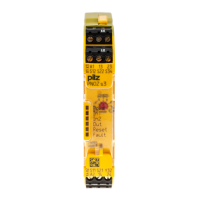

 To Next Page