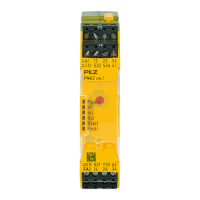
- 3 -
Montage
Grundgerät ohne Kontakterweiterungs-
block montieren:
` Stellen Sie sicher, dass der Abschlussstek-
ker seitlich am Gerät gesteckt ist.
Grundgerät und Kontakterweiterungsblock
PNOZsigma verbinden:
` Entfernen Sie den Abschlussstecker seitlich
am Grundgerät und am Kontakterweite-
rungsblock.
` Verbinden Sie das Grundgerät und den Kon-
takterweiterungsblock mit dem mitgeliefer-
ten Verbindungsstecker bevor Sie die Geräte
auf der Normschiene montieren.
Montage im Schaltschrank
` Montieren Sie das Sicherheitsschaltgerät in
einen Schaltschrank mit einer Schutzart von
mindestens IP54.
` Befestigen Sie das Gerät mit Hilfe des Rast-
elements auf der Rückseite auf einer Norm-
schiene.
` Sichern Sie das Gerät auf einer senkrechten
Normschiene (35 mm) durch ein Halte-
element (z. B. Endhalter oder Endwinkel).
` Vor dem Abheben von der Normschiene das
Gerät nach oben oder unten schieben.
Installation
Install base unit without contact expander
module:
` Ensure that the plug terminator is inserted at
the side of the unit.
Connect base unit and PNOZsigma contact
expander module:
` Remove the plug terminator at the side of the
base unit and at the contact expander mod-
ule.
` Connect the base unit and the contact ex-
pander module to the supplied connector
before mounting the units to the DIN rail.
Installation in control cabinet
` The safety relay should be installed in a con-
trol cabinet with a protection type of at least
IP54.
` Use the notch on the rear of the unit to attach
it to a DIN rail.
` Ensure the unit is mounted securely on a ver-
tical DIN rail (35 mm) by using a fixing ele-
ment (e.g. retaining bracket or an end angle).
` Push the unit upwards or downwards before
lifting it from the DIN rail.
Montage
Installer l'appareil de base sans bloc d'ex-
tension de contacts :
` Assurez-vous que la fiche de terminaison est
insérée sur le côté de l'appareil.
Raccorder l'appareil de base et le bloc d'ex-
tension de contacts PNOZsigma
` Retirez la fiche de terminaison sur le côté de
l'appareil de base et sur le bloc d'extension
de contacts.
` Avant de monter les appareils sur le rail DIN,
reliez l'appareil de base et le bloc d'exten-
sion de contacts à l'aide du connecteur four-
ni.
Montage dans une armoire
` Montez le bloc logique de sécurité dans une
armoire électrique ayant un indice de protec-
tion d'au moins IP54.
` Montez l'appareil sur un rail DIN à l'aide du
système de fixation situé sur la face arrière.
` Fixez l'appareil monté sur un rail DIN vertical
(35 mm) à l'aide d'un élément de maintien
(par exemple : un support terminal ou une
équerre terminale).
` Avant de retirer l'appareil du rail DIN, pous-
sez l'appareil vers le haut ou vers le bas.
Verdrahtung
Beachten Sie:
` Angaben im Abschnitt „Technische Daten“
unbedingt einhalten.
` Die Ausgänge 13-14, 23-24, 33-34 sind Si-
cherheitskontakte, der Ausgang 41-42 ist ein
Hilfskontakt (z. B. für Anzeige).
` Vor die Ausgangskontakte eine Sicherung
(s. techn. Daten) schalten, um das Ver-
schweißen der Kontakte zu verhindern.
` Berechnung der max. Leitungslänge I
max
im
Eingangskreis:
R
lmax
= max. Gesamtleitungswiderstand
(s. techn. Daten)
R
l
/ km = Leitungswiderstand/km
` Leitungsmaterial aus Kupferdraht mit einer
Temperaturbeständigkeit von 60/75 °C ver-
wenden.
` Sorgen Sie an allen Ausgangskontakten bei
kapazitiven und induktiven Lasten für eine
ausreichende Schutzbeschaltung.
Wiring
Please note:
` Information given in the “Technical details”
must be followed.
` Outputs 13-14, 23-24, 33-34 are safety con-
tacts, output 41-42 is an auxiliary contact
(e.g. for display).
` To prevent contact welding, a fuse should be
connected before the output contacts (see
technical details).
` Calculation of the max. cable runs l
max
in the
input circuit:
R
lmax
= max. overall cable resistance (see
technical details)
R
l
/km = cable resistance/km
` Use copper wire that can withstand 60/75
°C.
` Sufficient fuse protection must be provided
on all output contacts with capacitive and in-
ductive loads.
Raccordement
Important :
` Respectez impérativement les données indi-
quées dans la partie "Caractéristiques tech-
niques".
` Les sorties 13-14, 23-24, 33-34 sont des
contacts de sécurité, la sortie 41-42 est un
contact d'information (par exemple pour l'af-
fichage).
` Protection des contacts de sortie par des fu-
sibles (voir les caractéristiques techniques)
pour éviter leur soudage.
` Calcul de la longueur de câble max. I
max
sur
le circuit d'entrée :
R
lmax
= résistance max. de l'ensemble du
câblage (voir les caractéristiques techni-
ques)
R
l
/km = résistance du câblage/km
` Utilisez uniquement des fils de câblage en
cuivre résistant à des températures de 60/
75 °C.
` Assurez-vous du pouvoir de coupure des
contacts de sortie en cas de charges capaci-
tives ou inductives.
Betriebsbereitschaft herstellen Preparing for operation Mettre l'appareil en mode de marche
Anschluss Connection Connexion
` Versorgungsspannung ` Supply voltage ` Tension d'alimentation
Versorgungsspannung/power supply/tension
d'alimentation
AC DC
` Eingangskreis ` Input circuit ` Circuit d'entrée
Eingangskreis/input circuit/circuit d'entrée Einkanalig/single-channel /monocanal Zweikanalig/dual-channel/à deux canaux
Zweihandtaster
mit Querschlusserkennung/
two-hand button
with detection of shorts across contacts/
poussoir de commande bimanuelle
avec détection des courts-circuits entre les
canaux
R
lmax
R
l
/ km
I
max
=
R
lmax
R
l
/ km
I
max
=
R
lmax
R
l
/ km
I
max
=
A1
L
A2
N
S22
A1
L+
A2
L-
S12(+)
S11
S21
S22(-)
S1
S2


 To Next Page
 Loading...