Need help?
Do you have a question about the Poly VVX 410 and is the answer not in the manual?
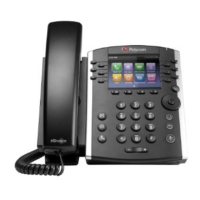
Displays icons for accessing phone functions like New Call, Messages, and Directories.
Shows phone lines, favorites, and soft keys; allows access to the Dialer when idle.
Displays active, incoming, and held calls; allows interaction via soft keys.
Details methods for initiating calls using the handset, speakerphone, headset, or from Home/Lines view.
Covers answering calls using speakerphone, handset, or headset, including answering while on an active call.
Provides instructions on ending active or held calls by replacing the handset or using soft keys.
Explains how to place calls on hold, resume them, and transfer calls to another party.
Details enabling and disabling call forwarding, including per-call forwarding.
Guides on initiating and managing conference calls, including holding and splitting participants.
Instructions for viewing, adding, and dialing favorite contacts.
Explains how to access and navigate through placed, received, and missed calls.
Covers viewing, adding, updating, deleting, and searching contacts in the directory.
Guides on accessing voicemail messages and connecting to the message center.
Explains how to mute the microphone during calls and enable/disable Do Not Disturb mode.
Details how to change call and ringer volumes, and update incoming call ringtones.
This document serves as a quick start guide for the Poly VVX 410 phone, providing users with essential information on its functions, usage, and basic maintenance. The guide is structured to help users navigate the phone's interface and utilize its various communication features effectively.
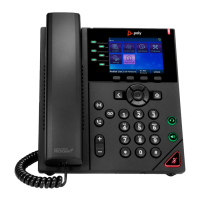
The Poly VVX 410 phone offers three primary views: Home, Calls, and Lines. The Lines view is the default, displaying phone lines, favorite contacts, and soft keys. From the Lines view, if the phone is idle, users can press a Line key to access the Dialer for making calls. The Home view displays a grid of icons, allowing users to access various phone functions. This view can be accessed from any menu by pressing the Home button. Navigation within the Home view is done using the up, down, left, and right arrow keys to scroll through and select icons. The Calls view becomes accessible when the phone has one or more active or held calls. This view provides a centralized place to manage ongoing conversations. Users can switch between Home and Lines views by pressing the Home button. To switch between Lines and Calls views, users can press "More" followed by "Lines" or "Calls" respectively.
Call status is visually indicated by color: dark green for an active call, bright blue for an incoming call, and dark blue for a held call. In the Calls view, users can use the up and down arrow keys to highlight a specific call, and the soft keys will then control the highlighted call.
When entering information using the dialpad, users can press the Backspace button to correct errors. To type characters, a key is pressed repeatedly to cycle through character options, stopping on the desired character. For other characters, "Encoding" or "Mode" can be used. The 1, *, 0, and # keys are also available for data entry.
Placing Calls: To initiate a call, users can pick up the handset, press the speakerphone button, or the headset button. After entering the phone number, "Send" is pressed. Alternatively, the number can be entered first, followed by "Dial," and then picking up the handset or pressing the speakerphone or headset button. From the Lines view, pressing a phone Line key, entering the number, and pressing "Send" will place a call. From the Home view, "New Call" is selected using the arrow keys, the number is entered, and "Send" is pressed. For quick calling, users can select a recent call, a favorite contact, or a contact from the Contact Directory.
Answering Calls: Incoming calls can be answered by pressing the speakerphone button or tapping "Answer." To answer with the handset, simply pick it up. For headset users, pressing the headset button will answer the call. If a new call comes in while another call is active, pressing "Answer" will answer the new call and place the current call on hold.
Ending Calls: An active call can be ended by replacing the handset, pressing the speakerphone button, or the headset button. Alternatively, the "End Call" soft key can be pressed. To end a held call, users navigate to the Calls view, highlight the held call, press "Resume," and then "End Call."
Holding Calls: From the Calls view, a call can be placed on hold by pressing "Hold" or the hold button. To resume a held call, "Resume" or the hold button is pressed again. It's important to highlight the call first before attempting to resume it.
Transferring Calls: To transfer a call, from the Calls view, users press "Transfer" or the transfer button, and then dial the other party. Once the ringback tone is heard, or after speaking with the other party, "Transfer" or the transfer button is pressed again. For a blind transfer, "Blind" can be pressed to complete the transfer without waiting for the ringback tone.
Forwarding Calls: Call forwarding can be enabled by pressing "Forward" from the Home or Lines view, selecting the forwarding type, entering a forwarding number, and pressing "Enable." To disable it, the same steps are followed, but "Disable" is selected. For per-call forwarding, while the phone is ringing, "Forward" is pressed, the forwarding number is entered, and "Forward" is pressed again.
Placing Conference Calls: To set up a conference call, the first party is called. Once connected, "More" is pressed, followed by "Confrnc." Then, the second party is dialed and connected, and "Confrnc" is pressed again. During a conference call, users can "Hold" all participants, "End Call" to remove themselves while keeping others connected, "Manage" participants (if available), or "Split" to end the conference and hold all participants. If an active and held call exists, "Join" can be pressed to set up a conference.
Favorites: Favorites are frequently called contacts. The Favorites list displays all favorites, with a smaller selection appearing in the Lines view. To view the full Favorites list, from Home view, users press the Home button and select "Directories" > "Favorites." To add a contact to Favorites, navigate to the Contact Directory, select the contact, press "Info," "More," and then "Add to Favorites." Confirmation is done by pressing "Yes." To dial a Favorite, users can press the Favorite from Home or Lines view, or from their Favorites list.
Viewing Recent Calls: From the Lines view, users can press the Home button, select "Directories," and then "Recent Calls" to view their call history. The right arrow key shows recent Placed Calls, the left arrow key shows recent Received Calls, the down arrow key shows recent Missed Calls, and the up arrow key shows Favorites. Within the Recent Calls list, "Sort" can be used to order calls, "Type" to display specific call types, or a call record can be selected to call the person.
Contact Directory: To select a contact from the Contact Directory, users press the Directory button. To view the Directory, "Directories" is selected from Home view, and then "Contact Directory" on the Directory screen. To add a contact, users navigate to the Contact Directory, press "Add," enter the contact's information, and press "Save." A Favorite Index number can be entered to make the contact a Favorite. To update contact information, users navigate to the Contact Directory, select the contact, press "Info," "Edit," update the information, and press "Save." To delete a contact, users navigate to the Contact Directory, select the contact, press "Info," "Delete," and press "Yes" to confirm. To search for a contact, users navigate to the Contact Directory, press "Search," enter search criteria, and press "Search." To dial a contact from the Directory, users navigate to the Contact Directory, select the contact, and from the contact's information screen, select the contact's phone number. A star icon next to a contact indicates it is a Favorite.
Listening to Voicemail: An envelope icon next to a Line key indicates new voicemail. Users select "Messages" from Home view or press the Messages button, then select "Message Center." "Connect" is pressed, and the prompts are followed.
Muting the Microphone: During a call, pressing the Mute button will prevent other parties from hearing the user. To disable mute, the Mute button is pressed again. This function applies to calls using the handset, headset, and speakerphone.
Using Do Not Disturb (DND): To enable or disable ringing, users press "DND" from Home or Lines view. When DND is enabled, the DND icon appears in the status bar and beside the appropriate Line key.
Adjusting Volume: During a call, the call volume can be adjusted by pressing the volume up or down buttons. To change the ringer volume, the volume up or down buttons are pressed when the phone is idle or ringing.
Updating Ringtones: To change the incoming call ringtone, users select "Settings" from Home view, then "Basic" > "Ring Type." The desired ringtone is then selected. To set a ringtone for a specific contact, users navigate to their Contact Directory, select the contact, press "Edit," update the contact's ring type, and press "Save."
 General
| Lines | 12 |
|---|---|
| Ethernet Ports | 2 |
| Power over Ethernet | Yes |
| Bluetooth | No |
| Wi-Fi | No |
| Speakerphone | Yes |
| HD Voice | Yes |
| Protocols | SIP |
| Wall Mountable | Yes |
| Display Color | Color |
| Display | 3.5" color LCD |
| Resolution | 320 x 240 |
| Audio Codec | G.711, G.722, G.729 |
| Headset Port | Yes |
| Dimensions | 19 x 15 x 18 cm |

 To Next Page