ENGLISH
3
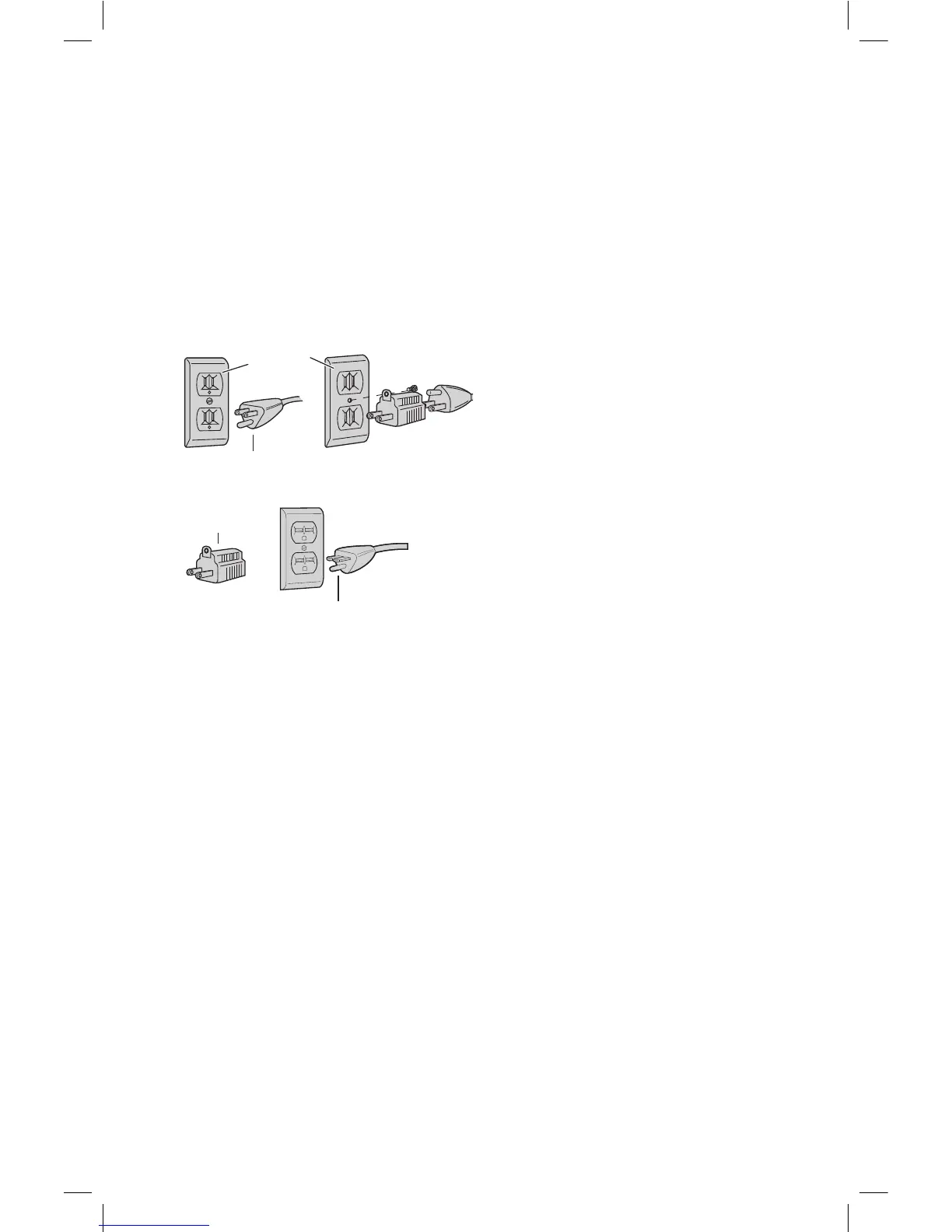
3-conductor cord and 3-prong grounding type plug to fit
the proper grounding type receptacle. The green (or green
and yellow) conductor in the cord is the grounding wire.
Never connect the green (or green and yellow) wire to a live
terminal. If your unit is intended for use on less than 150 V,
it has a plug that looks like that shown in sketch A. If it is for
use on 150 to 250 V, it has a plug that looks like that shown
in sketch D. An adapter, sketches B and C, is available for
connecting sketch A type plugs to 2-prong receptacles. The
green-colored rigid ear, lug, or the like, extending from the
adapter must be connected to a permanent ground, such as
a properly grounded outlet box. No adapter is available for a
plug as shown in sketch D. ADAPTER SHOWN IN SKETCHES B
and C ARE NOT FOR USE INCANADA.
Fig. B
A B
GROUNDING PIN
GROUNDED
OUTLET
BOX
C D
GROUNDING
MEANS
GROUNDING PIN
ADAPTER
WARNING: To reduce the risk of electrocution, keep all
connections dry and off the ground. Do not touch the
plug with wethands.
WARNING: The saw must be plugged into a GFCI
protectedreceptacle.
WARNING: Never use saw with salt water or a
conductivefluid.
Additional Safety Rules for Wet Tile Saw
CAUTION: Wear appropriate hearing protection
during use. Under some conditions and duration
of use, noise from this product may contribute to
hearingloss.
CAUTION: Do not connect unit to electrical
power source until complete instructions are read
andunderstood.
• Use safety equipment. Always wear eye protection.
Dust mask, non-skid safety shoes, hard hat, or hearing
protection must be used for appropriateconditions.
• Keep hands out of path of saw blade. NEVER CUT A
PIECE WHERE HAND WOULD BE 3" (76mm) OR LESS
FROMBLADE.
• Do not perform any operation freehand, that is without
holding the workpiece firmly against the fence or
edgeguide.
• Never reach in back of theblade.
• DON’T - Cut dry. If blade is not cooled with water, serious
damage will occur. Dry cutting will increase exposure to
harmful airbornedust.
• Turn off the tool and wait for blade to stop before moving
the workpiece or changingsettings.
• To reduce risk of injury, return the cart to the full rear
position after eachcut.
• DO - Make certain the blade rotates in the correct direction
as indicated by the arrow on theblade.
• DO - Always use the splashhood.
• DO - Be sure all clamp handles and knobs are tight before
starting anyoperation.
• DO - Be sure all blade and clamp washers are clean and
recessed sides of collars are against blade. Tighten arbor
nutsecurely.
• DO - Keep the blade properlyaligned.
• DO - Keep the motor air slots free of chips anddirt.
• DO - Always empty water from the reservoir before
transporting. Water can splash into electricalcomponents.
• DO - Keep hands out of the path of the sawblade.
• DON’T - Attempt to operate on anything but designated
voltage. Incorrect voltage may result in shock, fire, or
unpredictableoperation.
• DON’T - Use blades larger or smaller than those which
arerecommended.
• DON’T - Force cutting action. Allow motor to reach full
speed before cutting. Stalling or partial stalling of motor
can cause majordamage.
• DON’T - Use metal cutting abrasive wheels. The excessive heat
and abrasive particles generated by them will damage thesaw.
• DO - Use continuous rim wheels only, no serrated edges or
toothedblades.
• DON’T - Allow anyone to stand behindsaw.
• DON’T - Place either hand in the blade area when the saw is
connected to the powersource.
• DON’T - Use blades rated less than 5000 R.P.M.
• DON’T - Place hands closer than 3" (76 mm) from the
sawblade.
• DON’T - Reach behind or underneath the saw unless it is
turned off andunplugged.
• DON’T - Move either hand from saw or workpiece until the
blade hasstopped.
Additional Safety Information
WARNING: ALWAYS use safety glasses. Everyday
eyeglasses are NOT safety glasses. Also use face or
dust mask if cutting operation is dusty. ALWAYS WEAR
CERTIFIED SAFETYEQUIPMENT:
• ANSI Z87.1 eye protection (CAN/CSA Z94.3),
• ANSI S12.6 (S3.19) hearing protection,
• NIOSH/OSHA/MSHA respiratoryprotection.
WARNING: Some dust created by power sanding,
sawing, grinding, drilling, and other construction
activities contains chemicals known to the State
of California to cause cancer, birth defects or





 To Next Page