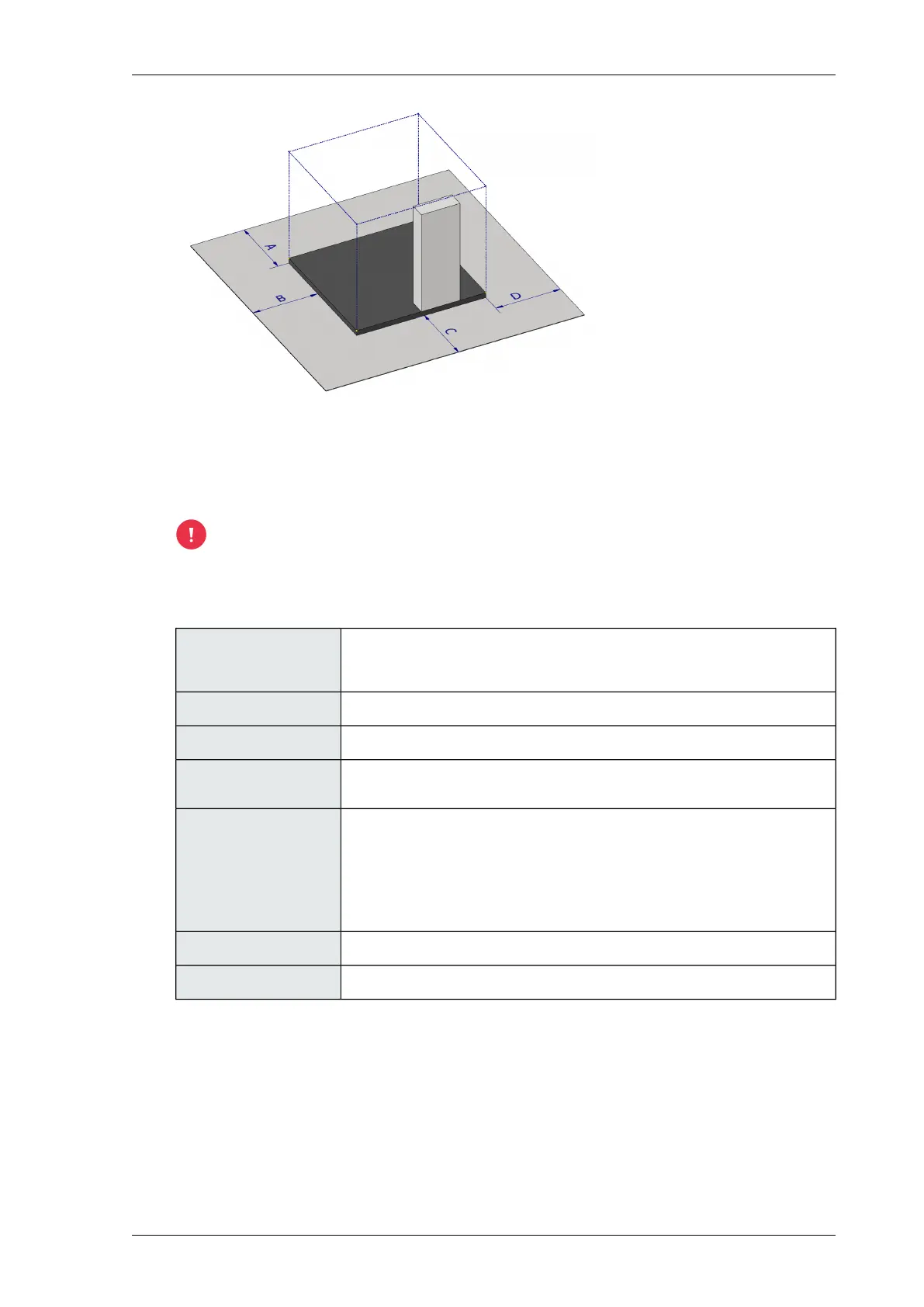
Required minimum space around unit
A = minimum 50 cm
B, C, D = minimum 110 cm
Environmental requirements
The unit must not be in direct sunlight. Due to bright sunlight the temperature will become
too high, causing plastic parts to deform, creating malfunctions in electrical components
and shortening the service life of electrical components.
Always keep any cabinet ventilation grilles free and open, allowing the electrical components
to be cooled.
Position the unit in an indoor, well-ventilated room, free from drips and splashes, with
a stable temperature (no rapid temperature changes).
Select a location where the unit cannot easily be damaged (e.g. by mobile equipment).
The surface on which the unit will stand should be hard, flat and level.
General
0 – 35 °C
As long as the unit contains water (residue) it must be kept frost-free.
Ambient temperature when
not operating
5 – 30 °CAmbient temperature during
operation
5 – 30°C (the unit can still work at a maximum temperature of 30°C. However, with
regard to the water quality and/or the operation of the unit, such a high water
temperature is generally unacceptable.)
Supply water temperature
< 85% (this is lower than the maximum relative air humidity during transport because
of the presence of chemical substances.)
Condensation will form on the pipe-work, particularly when relatively cold supply water
is used. This is very corrosive when combined with the vapours from the chemical
substances. Hose clamps and other metal parts must therefore be of corrosion-resistant
types of metals or must be well coated (and remain so).
The cabinet contains sensitive electronic circuits and must definitely remain
condensation-free.
Relative air humidity
1000 m above sea level (Cavitation may occur in the system pump when the ambient
pressure is too low.)
Maximum installation height
maximum 2 (normal, non-conducting pollution)Pollution factor (NEN-EN-IEC
61010-1)
Operating software
Refer to the relevant process computer software manual.
21NutriJet - user - 00.002
Operation



 To Next Page