8619470 145A MULTI-PROCESS MIG-ARC-TIG WELDER V1.0
22 For technical questions call 1-800-665-8685
STICK OUT
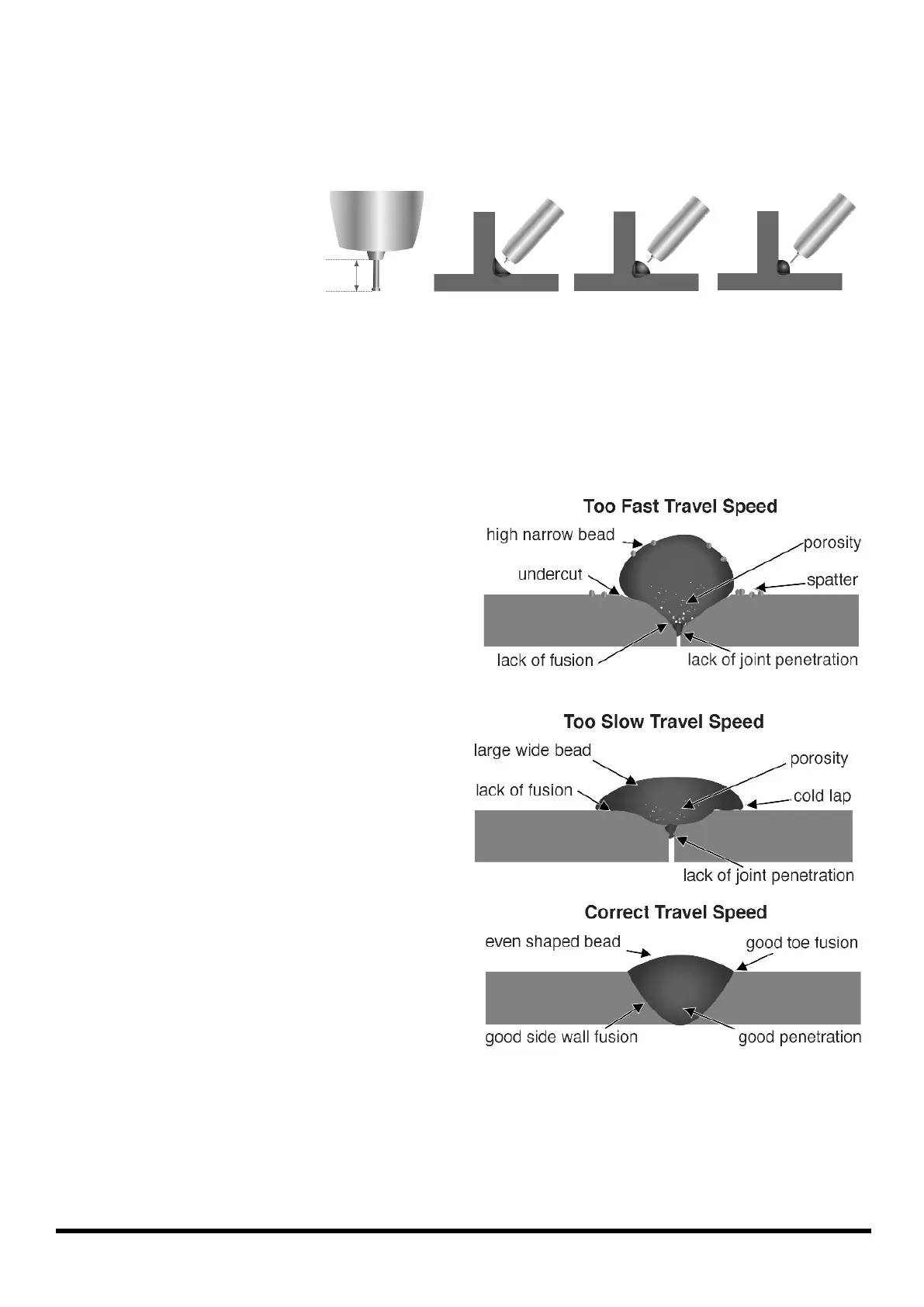
Stick out is the length of the unmelted wire protruding from the end of the contact tip.
A constant even stick out of 1/8 to 1/4 in. (Fig. 39) will produce a stable arc and an even current
flow providing good penetration and even fusion (Fig. 40). A stick out that is too short will cause
an unstable weld pool,
produce spatter and over heat
the contact tip (Fig. 41). A
stick out too long will cause
an unstable arc, lack of
penetration, lack of fusion and
increase spatter (Fig. 42).
TRAVEL SPEED
Travel speed is the rate that the gun is moved along the weld joint and is usually measured in mm
per minute. Travel speeds can vary depending on conditions and the welder’s skill and is limited to
the welder’s ability to control the weld pool. Push technique allows faster travel speeds than Drag
technique. Gas flow must also correspond with the travel speed, increasing with faster travel speed
and decreasing with slower speed. Travel speed needs to match the amperage and will decrease as
the material thickness and amperage increase.
TOO FAST TRAVEL SPEED
A too fast travel speed produces too little heat
per inch of travel resulting in less penetration and
reduced weld fusion, the weld bead solidifies very
quickly trapping gases inside the weld metal
causing porosity. Undercutting of the base metal
can also occur and an unfilled groove in the base
metal is created when the travel speed is too fast
to allow molten metal to flow into the weld crater
created by the arc heat (Fig. 43).
TOO SLOW TRAVEL SPEED
A too slow travel speed produces a large
weld with lack of penetration and fusion. The
energy from the arc dwells on top of the
weld pool rather than penetrating the base
metal. This produces a wider weld bead with
more deposited weld metal per mm than is
required resulting in a weld deposit of poor
quality (Fig. 44).
CORRECT TRAVEL SPEED
The correct travel speed keeps the arc at the
leading edge of the weld pool allowing the
base metal to melt sufficiently to create good
penetration, fusion and wetting out of the
weld pool, producing a weld deposit of good
quality (Fig. 45).


 To Next Page