CONDITIONING GUIDELINES
The following guidelines will help you to plan your
exercise program. Remember that proper nutrition
and adequate rest are essential for successful results.
EXERCISE INTENSITY
Whether your goal is to burn fat or to strengthen your
cardiovascular system, the key to achieving the
desired results is to exercise with the proper intensity.
The proper intensity level can be found by using your
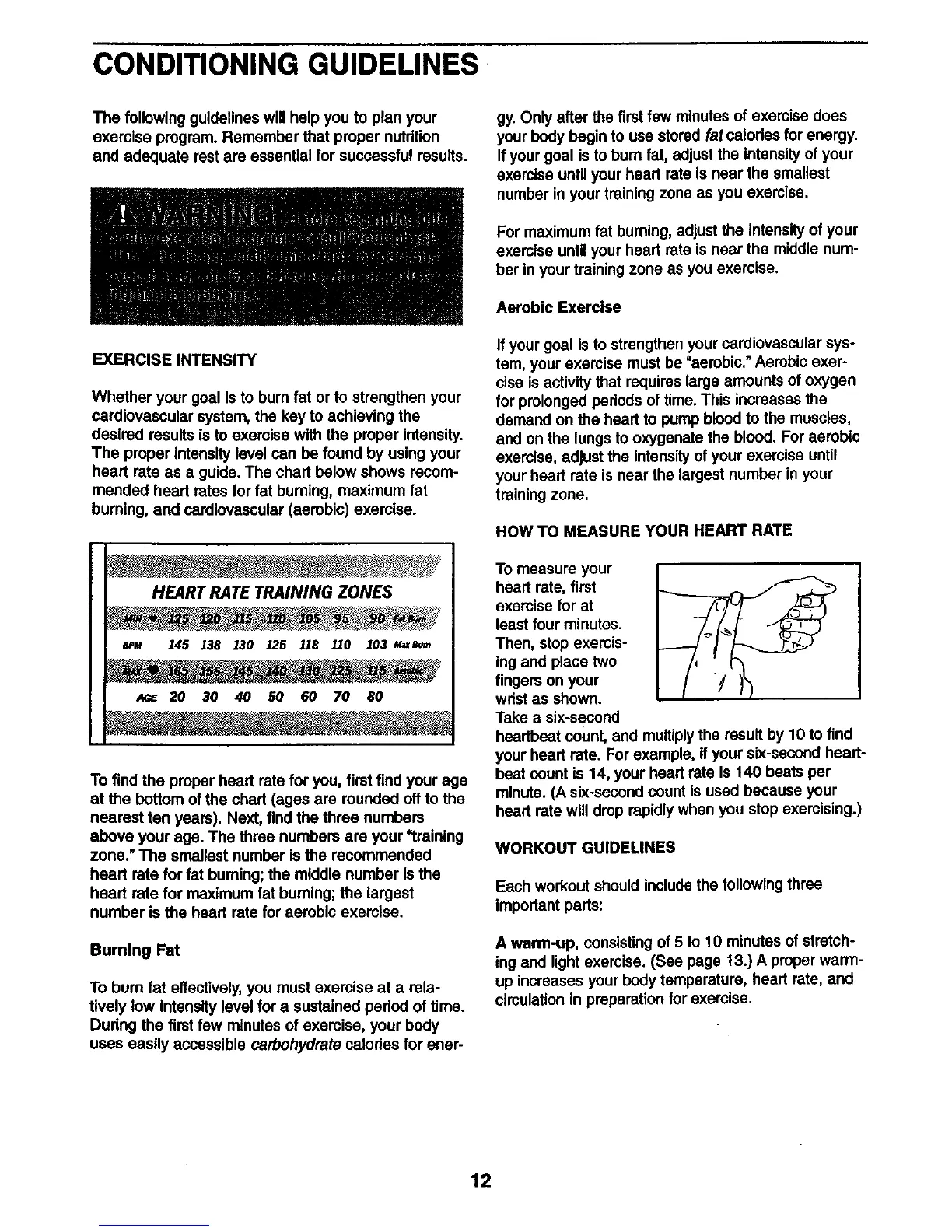
heart rate as a guide. The chart below shows recom-
mended heart rates for fat burning, maximum fat
buming, and cardiovascular (aerobic) exemise.
HEART RATETRAINING ZONES
To find the proper heart rate for you, first find your age
at the bottom of the chart (ages are rounded off to the
nearest ten years). Next, find the three numbers
above your age. The three numbers are your "training
zone." The smallest number is the recommended
heart rate for fat burning;the middle number is the
heart rate for maximum fat burning; the largest
number is the heart rate for aerobic exemise.
Burning Fat
To bum fat effectively,you must exemise at a rela-
tively low intensity level for a sustained period of time.
Dudng the first few minutes of exemise, your body
uses easily accessible carbohydrate calodes for ener-
gy. Only after the firstfew minutesof exercise does
yourbody begin to use stored fatcalodes for energy.
If your goal is to bum fat, adjust the intensityof your
exercise until your heart rate Is near the smallest
number in your training zone as you exemise.
For maximum fat burning, adjust the intensityof your
exercise untilyour heart rate is near the middle num-
ber In yourtraining zone as you exemise.
Aerobic Exercise
Ifyour goal is to strengthen your cardiovascular sys-
tem, your exemise must be =aerobic." Aerobic exer-
cise Is activity that requires large amounts of oxygen
for prolonged pedods of time. This increases the
demand on the heart to pump blond to the muscles,
and on the lungs to oxygenate the blood. For aerobic
exercise, adjust the Intensity of your exercise until
your heart rate is near the largest number in your
training zone.
HOW TO MEASURE YOUR HEART RATE
To measure your
heart rate, first
exemise for at
least four minutes.
Then, stop exercis-
ing and place two
fingers on your
wdst as shown.
Take a six-second
heartbeat count, and multiplythe result by 10 to find
your heart rate. For example, ifyour six-second head-
beat count is 14, your heart rate is 140 beats per
minute. (A six-second count is used because your
heart rate will drop rapidly when you stop exercising.)
WORKOUT GUIDELINES
Each workout should include the following three
important pads:
A warm-up, consisting of 5 to 10 minutes of stretch-
ing and light exercise. (See page 13.) A proper warm-
up increases your body temperature, heart rate, and
cimulation in preparation for exercise.
12





 To Next Page