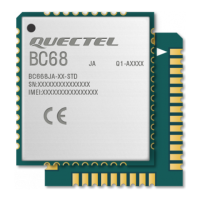
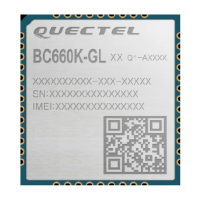
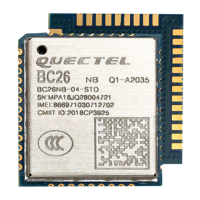
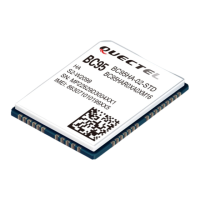
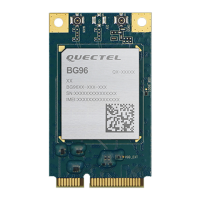
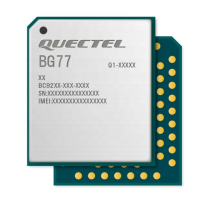
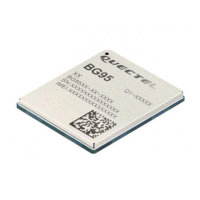
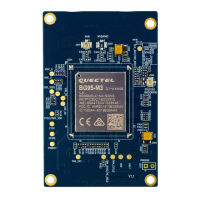
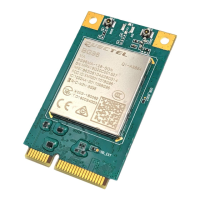
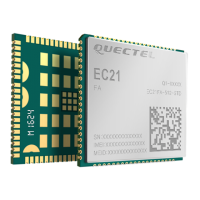
The Quectel BC65 is an NB-IoT module designed for various applications requiring low-power, long-range wireless communication. This document, the BC65 Hardware Design, provides comprehensive details on its interfaces, electrical and mechanical characteristics, and usage guidelines.
Function Description
The BC65 module is a high-performance NB-IoT module with extremely low power consumption. It is designed to communicate with infrastructures of mobile network operators through NB-IoT radio protocols (3GPP Rel-13 and 3GPP Rel-14). The module supports a certain range of frequency bands and is an SMD type module with an LCC package, featuring an ultra-compact profile of 17.7 mm × 15.8 mm × 2.2 mm. It provides abundant external interfaces such as UART, ADC, and protocol stacks (UDP/TCP/MQTT, etc.), which offer great convenience for customers' applications. The module is suitable for smart metering, bike sharing, smart wearables, smart parking, smart city, home appliances, security and asset tracking, agricultural and environmental monitoring, and other IoT applications requiring complete range of SMS* and data transmission services.
Important Technical Specifications
Power Supply:
- Supply voltage range: 3.2–4.2 V
- Typical supply voltage: 3.8 V
- Typical power consumption: 4 µA (in Deep Sleep mode)
- Power Supply Pins: VBAT (pins 42, 43) for module power, GND (pins 1, 10, 27, 34, 36, 37, 40, 41) for ground.
- Recommended Power Supply Design: Use a low quiescent current LDO with an output current capacity of 0.8 A. A Li-MnO2/2S alkaline battery can also be used. It is recommended to place a 100 µF tantalum capacitor (ESR = 0.7 Ω) and three ceramic capacitors (100 nF, 100 pF, and 22 pF) near the VBAT pins. A TVS diode on the VBAT trace is also recommended to improve surge withstand capability.
Frequency Bands:
- H-FDD: B1*, B3, B5, B8, B20, B28
- Receiving Frequencies: B1* (2110–2170 MHz), B3 (1805–1880 MHz), B5 (869–894 MHz), B8 (925–960 MHz), B20 (791–821 MHz), B28 (758–803 MHz)
- Transmitting Frequencies: B1* (1920–1980 MHz), B3 (1710–1785 MHz), B5 (824–849 MHz), B8 (880–915 MHz), B20 (832–862 MHz), B28 (703–748 MHz)
Transmitting Power: 23 dBm ±2 dB
USIM Interface:
- Supports 1.8/3.0 V USIM card.
- Pins: USIM_VDD (14), USIM_CLK (13), USIM_DATA (11), USIM_RST (12).
- Voltage accuracy: 1.8/3.0 V.
- Reference Circuit: Includes a 100 nF capacitor on USIM_VDD, 22 Ω resistors on USIM_VDD, USIM_RST, USIM_CLK, and USIM_DATA, and a 10 kΩ pull-up resistor on USIM_DATA. ESD protection with a TVS diode is recommended.
UART Interfaces:
- Main UART: Used for AT command communication and data transmission. Supports baud rates of 4800 bps, 9600 bps (default), and 57600 bps.
- Pins: MAIN_RXD (18), MAIN_TXD (17).
- Power domain: 1.8 V.
- Debug UART: Used for firmware debugging and upgrading. Supports 921600 bps baud rate.
- Pins: DBG_RXD (38), DBG_TXD (39).
- Power domain: 1.8 V.
- Auxiliary UART:* Used for AT command communication and data transmission. Supports baud rates of 4800 bps, 9600 bps (default), and 57600 bps.
- Pins: AUX_RXD (28), AUX_TXD (29).
- Power domain: 1.8 V.
- UART Application: For 3.3 V UART interfaces, a level translator (e.g., TXS0108EPWR) is recommended.
Network Protocols: Supports UDP/TCP/SNTP/MQTT/CoAP*/PPP/TLS*/DTLS*/HTTP* protocols.
SMS:* Text/PDU Mode.
Data Transmission Rate:
- Cat NB1 (Max): Single-tone: 25.5 kbps (DL)/16.7 kbps (UL); Multi-tone: 25.5 kbps (DL)/62.5 kbps (UL).
- Cat NB2 (Max): 127 kbps (DL)/158.5 kbps (UL).
AT Commands: 3GPP TS 27.005/3GPP TS 27.007 AT commands (3GPP Rel-13/Rel-14), Quectel Enhanced AT commands.
Firmware Update: DFOTA, Debug UART.
Physical Characteristics:
- Size: (17.7 ±0.15) mm × (15.8 ±0.15) mm × (2.2 ±0.2) mm
- Weight: approx. 1.0 ± 0.1 g
- Pin Count: 58 pins (44 LCC pins and 14 LGA pins).
Temperature Ranges:
- Operating Temperature Range: -25 °C to +75 °C (meets 3GPP specifications).
- Extended Temperature Range: -40 °C to +85 °C (maintains basic functions, but Pout may reduce).
- Storage Temperature Range: -40 °C to +90 °C.
Antenna Interface:
- Pin: ANT_RF (35).
- Characteristic impedance: 50 Ω.
- Antenna Requirements: Cable insertion loss < 1 dB (703–960 MHz), < 1.5 dB (1710–2170 MHz). VSWR ≤ 2, Efficiency > 30 %, Max input power (W) 50, Input impedance (Ω) 50.
- RF Layout: Coplanar waveguide design on a 2-layer or 4-layer PCB is recommended. The RF trace should be controlled to 50 Ω impedance.
Electrostatic Discharge (ESD):
- VBAT, GND: Contact Discharge ±5 kV, Air Discharge ±10 kV.
- Antenna interface: Contact Discharge ±5 kV, Air Discharge ±10 kV.
- Other interfaces: Contact Discharge ±0.5 kV, Air Discharge ±1 kV.
Usage Features
Operating Modes:
- Normal Mode: AP handles tasks, such as AT command communication.
- Idle Mode: All tasks suspended, AP enters idle mode.
- Connected Mode: Network connected, module supports data transmission. Can switch to PSM or DRX/eDRX.
- DRX/eDRX Mode: Modem in idle mode, downlink data can be received during PTW. Can switch to PSM or connected mode.
- PSM (Power Saving Mode): Modem disconnected from network, cannot receive downlink data. Can switch to connected mode.
- Light Sleep Mode: UART interface active, module can be woken up via main UART.
- Deep Sleep Mode: CPU powered off, only 32 kHz RTC clock working. Current consumption reduced to minimum (typically 4 µA). UART interface inactive. Module enters Deep Sleep when AP is in idle mode and modem is in PSM.
Turn On/Off and Reset:
- Turn On: Drive PWRKEY (pin 7) to a low-level voltage for at least 1000 ms. PWRKEY can be connected to GND for automatic turn-on if not needed.
- Turn Off:
- AT command AT+QPOWD=1.
- Disconnecting VBAT power supply in emergency.
- Automatically turns off when VBAT drops below 3.2 V.
- Reset: Drive RESET_N (pin 15) to a low-level voltage for at least 1000 ms. Recommended to retain MCU control of RESET_N for abnormal booting.
PSM_EINT Interface:
- Pin: PSM_EINT (19).
- Dedicated external interrupt pin used to wake up the module from Deep Sleep. Valid on the falling edge.
ADC Interface:
- Pin: ADC (9).
- General-purpose ADC interface with a voltage range of 0–1.8 V. Available in active and idle modes.
RI Behaviors:
- Pin: RI (20).
- Ring indication signal. Driven low for at least 120 ms when a URC (Unsolicited Result Code) is received.
Network Status Indication:
- Pin: NETLIGHT (16).
- Indicates module status. Always Low (LED Off) when the module is not working or the modem is in idle/PSM mode.
- 64 ms High (LED On)/800 ms Low (LED OFF) for network searching.
- 64 ms High (LED On)/2000 ms Low (LED OFF) for network connected.
- Reference Circuit: Includes a 4.7K resistor from NETLIGHT to VBAT, and a transistor circuit with 2.2K and 47K resistors.
Maintenance Features
Storage:
- Packaging: Vacuum-sealed, ESD protected. MSL rated as 3.
- Recommended Storage Condition: 23 ±5 °C and 35–60% relative humidity.
- Storage Life: 12 months in vacuum-sealed packaging under recommended conditions.
- Floor Life: 168 hours in a plant (23 ±5 °C, <60% relative humidity) after vacuum-sealed packaging is removed. Must be processed in reflow soldering or other high-temperature operations within 168 hours. Otherwise, store in an environment with <10% relative humidity.
Manufacturing and Soldering:
- Pre-baking: Required to avoid blistering, cracks, and inner-layer separation if:
- Module not stored in recommended conditions.
- Floor life requirement violated.
- Vacuum-sealed packaging is broken or removed for over 24 hours.
- Before module repairing.
- Pre-baking Requirements: 8 hours at 120 ±5 °C. Modules must be soldered to PCB within 24 hours after baking, or stored in a dry environment.
- Reflow Soldering:
- Max slope (Soak Zone): 1 to 3 °C/s.
- Soak time (between 150 °C and 200 °C): 70–120 s.
- Max slope (Reflow Zone): 2 to 3 °C/s.
- Reflow time (over 220 °C): 45–70 s.
- Max temperature: 238 °C to 246 °C.
- Cooling down slope: -1.5 to -3 °C/s.
- Max reflow cycle: 1.
- Cleaning: NEVER wipe the module's shielding can with organic solvents (acetone, ethyl alcohol, isopropyl alcohol, trichloroethylene, etc.) as it may cause rusting.
- Conformal Coating: DO NOT use coating material that may chemically react with the PCB or shielding cover, and prevent coating material from flowing into the module.
Packaging:
- Reel Dimensions: 330 mm diameter.
- Modules per reel: 250.
General Notes:
- Quectel provides information as a service to its customers, based on customer requirements, and makes efforts to ensure quality. However, no warranty is given, and no liability is accepted for injury, loss, or damage incurred from use or reliance on the information. All information is subject to change without prior notice.
- Disclaimer: While efforts are made to ensure error-free functions and features, inaccuracies may exist. Quectel makes no warranties regarding the use of features and functions under development, and excludes liability for any loss or damage.
- Confidentiality: All documentation and information provided by Quectel is confidential. The Receiving Party shall not access or use it for any purpose other than expressly provided, nor disclose it to third parties without prior written consent. Unauthorized use may result in legal action.

 Need help?
 General

 To Next Page