Need help?
Do you have a question about the Record DFA 70 and is the answer not in the manual?
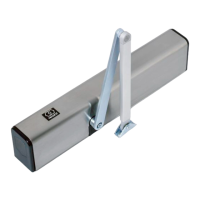
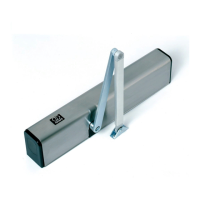
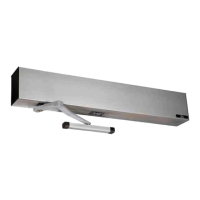
The record DFA 70 is a compact, self-monitoring, microprocessor-controlled swing door operator designed for a wide application spectrum. It is suitable for various door movement control scenarios, including automatic, continuously open, and manual operation. The operator continuously evaluates the current door position, speed, and the target position at every instant to precisely calculate the optimum motion. This ensures smooth and efficient door operation, preventing abrupt stops and excessive speeds. Depending on the door width, the corresponding spring range must be selected in the range of EN 4 to EN 6 (according to European standard EN 1154), which also allows for increased use of a redundant force limitation for safety.
The DFA 70 has dimensions of 900 x 70 x 127 mm (W x H x D). It operates on a voltage of 110 – 240 VAC, 50/60 Hz, with a power consumption of 13 W (nominal) and 67 W (maximum). The maximum torque is 65 Nm, and the maximum mass inertia of the door leaf is 65 kgm². The opening angle is adjustable from 70° to 115°. The hold-open time is adjustable from 0 to 60 seconds (in 40 steps), the opening speed from 3 to 20 seconds (in 40 steps), and the closing speed from 5 to 20 seconds (in 40 steps). The noise level is less than 45 dB, and the protection class is IP20. It operates within a temperature range of -15 to +50°C and a humidity range of up to 85% relative humidity, non-condensing. The maximum door leaf weight is 65 kgm².
The DFA 70 offers various operating modes, including:
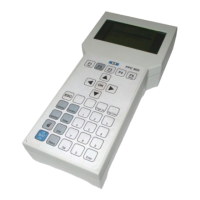
The operator can be configured using the electronic controller BDE-D, which provides an intuitive operation and navigation through its operator-friendly menu. The LCD with backlight shows data and information about the door status with symbols and text messages. The system also supports a mechanical BDI (toggle switch) with three selectable operating modes: Locked, One-Way, Continuously Open, Manual, and Automatic. The priority and code of the following table apply, where BDE1 (S1) and BDE2 (S2) represent the two STG input terminals (J7/1 + J7/2, print BDE-M) for the mechanical BDE:
The system includes a reset button, which, when pressed for at least 5 seconds, generates a control unit reset. Status indication is provided, with a fault indicated if no fault is present, and blinks if a fault is present (see chapter Status and fault signals BDE-D).
Regular maintenance and servicing are crucial for the safe and reliable operation of the DFA 70. Specific checks and maintenance may only be carried out by a specialist or a person trained for this purpose. The authorization of these persons is carried out exclusively by the manufacturer. The scope, result, and time of the periodic inspections and maintenance must be recorded in an inspection book and a checklist. These documents must be kept by the operator.
Testing:
Servicing:
Door care: The entire system, including the sensors and safety devices, can be cleaned with a moist cloth and standard commercial cleaners (non-scouring, do not use any solvents). First test the cleaners on a hidden (not easily visible) place. Keep all guides free of dirt.
Maintenance and regular inspection: A safety inspection must be carried out before initial start-up and as required, as well as in accordance with the applicable regulations – but at least twice a year. We recommend having maintenance carried out at the same time. A safety-related inspection must be performed by a competent service technician or an authorized partner. Maintenance due is displayed on the BDE-D operating unit if this function has been activated. The interval for the output of the message is defined by the number of opening cycles and/or after a certain operating time has elapsed. Regular inspection and maintenance of the equipment by trained personnel, authorized by the manufacturer, provides the best guarantee for a long service life and trouble-free safe operation. We recommend concluding a service agreement with the service center responsible for your area.
Logbook: The logbook serves only as a template. According to local regulations, such a logbook must be attached to the door installation, and all interventions and recurrent controls must be recorded in it.
Spare parts and wearing parts: The design of the system, not all spare parts and wearing parts are listed.
Decommissioning and dismantling: When shutting down or taking out of service, the system is disconnected from the mains supply and any existing battery is unplugged. After each temporary shutdown, a new commissioning must be carried out. All machine parts must be sorted by type of material and disposed of according to local regulations and guidelines. The door systems can be completely disassembled in reverse order.
Materials:
 General
| Brand | Record |
|---|---|
| Model | DFA 70 |
| Category | Door Opening System |
| Language | English |


 To Next Page