43
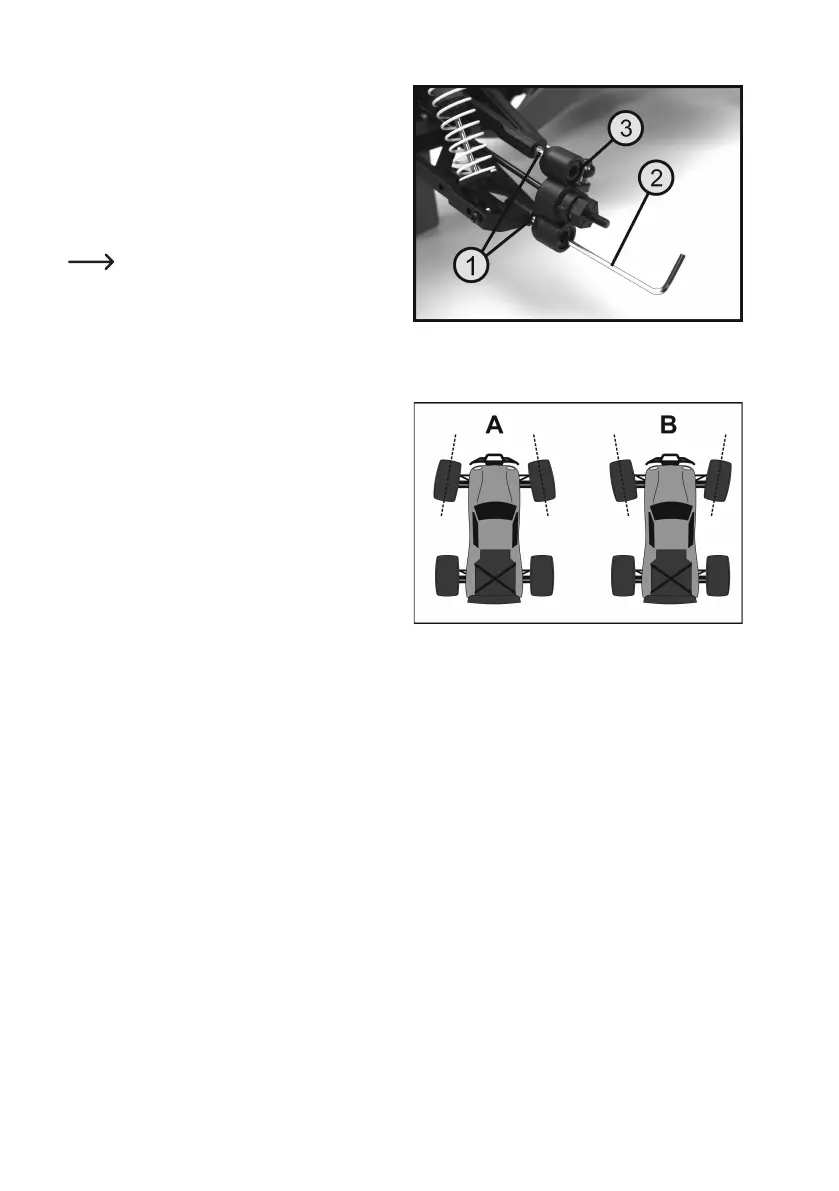
Adjustthefrontaxlebyturningtheupper/lowerpivotball
screws(1).Todothis,usea2.5mmHexkey(2).Make
sure that at least two-thirds of the threads of the pivot ball
screws remain in the suspension arm.
Be sure to also check the play in the pivot ball screws
whilst adjusting. If necessary, adjust the plastic inserts (3)
witha5mmHexkeyifthepivotballscrewsaretoostiffor
ifthereisexcessiveplayinthebearing.
The pivot ball screws can be accessed through
the wheel rim using a long Hex key. In this
case,youcancheckthemodiedconguration
very quickly.
b) Conguring the tyre track
Whenconguringthetyretrack,thepositionofthewheel
plane is adjusted to the direction of travel.
In this case, two distinctions are made:
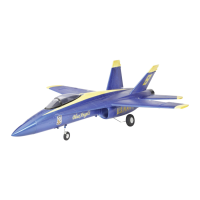
A toe-in means that the front wheels are facing slightly
inwards (see Figure 5A).
A toe-out means that the front wheels are facing slightly
outwards (see Figure 5B).
Theconguration ofthefrontwheelsinthetwo illustra-
tionsshownaboveisexaggeratedtoclearlyshowthedif-
ferencebetweenatoe-inandatoe-out.Extremesettings
mustbeavoidedwhenconguringthemodelvehicle!
A toe-in contributes to a better lateral guidance of the tyre
and therefore to a more direct steering response. It also
effectively supports directional stability.
Ifdesired,asmoothersteeringresponsecanbeachievedbyconguringatoe-outaccordingly.
Atoeangleof0°onthefrontaxleensuresthebestdriveabilityonalmostanysurface.Atoe-inortoe-outangleofmore
than 3° leads to problems in handling and reduced speed.
Before you adjust the tie rods. Check the position of the steering or the steering linkage (see Figure 31 in the assembly
instructions). When the servo lever is at 90° to the servo, both wheels should be aligned identically. If the wheels have
aslightleftorrightsteeringdeection,rstadjustthesteeringlinkage.Ifnecessary,mountthesteeringlinkageonthe
servo and adjust to the required length.
Figure 4
Figure 5



 To Next Page