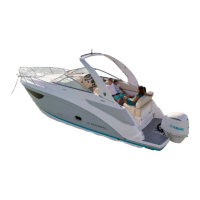
STERN DRIVE MANEUVERING
Inboard/outboard, I/O, or sometimes called stern drive boats do not
feature conventional rudders. The boat uses a steering system that
directs the propeller thrust by turning the stern drive unit where the
propeller is mounted.
Directing propeller energy (thrust) makes slower speed maneuvering
easier. The propeller discharge current is turned from one side to the
other which results in turning forces. Rudder boats need water to
fl ow by the rudder to be effi cient. Stern drive units are designed to
have reduced shaft angle, so the propeller does not produce as much
unequal blade thrust and resistance as does a propeller on a rudder
equipped boat. Large horsepower stern drive boats do produce more
thrust and steering torque but Regal boats have the advantage of
power steering.
Boats do not handle like automobiles do. Where a car would turn
about its front wheels, a boat turns about its center of gravity. This
effect is most pronounced when on plane where friction is particularly
reduced. There is no substitute for hands on experience practicing
steering both at low and high speeds in a variety of current, wind,
and weather conditions. But below is some basic information on how
single stern drive boats handle in normal conditions.
Prop Walk_____________________________________
The factory equipped propeller on your Regal is right handed and
rotates clockwise as viewed from the stern when in forward gear. So
as it turns, because of its screw like shape, not only is it pushing water
backward, but also to the port side. Blades in shallower water provide
less propulsion force than blades in deeper water. This uneven
propulsion is known as prop walk, as it tends to push your stern in an
5-10
Chapter 5


 To Next Page