37
Systems
(AC) ALTERNATING CURRENT-GENERAL INFORMATION
OVERVIEW
Alternating current sometimes called AC current is
brought on board through the use of a dockside shore-
power) cord, reel system or produced on board through
the generator. Just as a residential home uses 120/240
volts to run various household appliances and equipment
the same holds true on your yacht.
With AC current electrons “cycle” in one direction a
short distance and reverse themselves traveling in the op-
posite direction. This is how AC became known as alter-
nating current. The rate that the current reverses itself is
referred to as frequency. In the United States the alternat-
ing current frequency is 60 cycles per second. Overseas
a 50 cycle frequency per second is standard. Component
specifi cations must match the country’s frequency.
BASIC ELECTRICAL TERMS
Voltage is a measurement of the electrical potential that an
electrical power source contains for doing some type of
work for us. Think of it as electrical pressure. An example
might be your yacht’s battery.
Amperage is a particular amount of electricity fl owing
through some part of a circuit. Think of it as the rate of
electrical fl ow through your yacht’s wiring.
Resistance is measured in ohms and inhibits the electrical
fl ow through a circuit. An example would possibly be an
incandescent light bulb. The resistance in the light bulb
element allows it to glow and brighten the cabin along
with giving off heat.
It is important that you understand and respect the al-
ternating current system used on board. Be sure to read
and follow any danger, warning, or caution labels in
reference to the yacht’s electrical system or individu-
al equipment components. Most of all, use common
sense!
Since several of the electrical components on select
yacht have changed, earlier and the later systems of
AC current will be presented. Included are drawings
that describe the system components for both the earlier
and later versions. You will be able to quickly tell which
system is installed on your boat by visually spotting the
components on the deck or in the bilge (sump) and by
reviewing the system drawings.
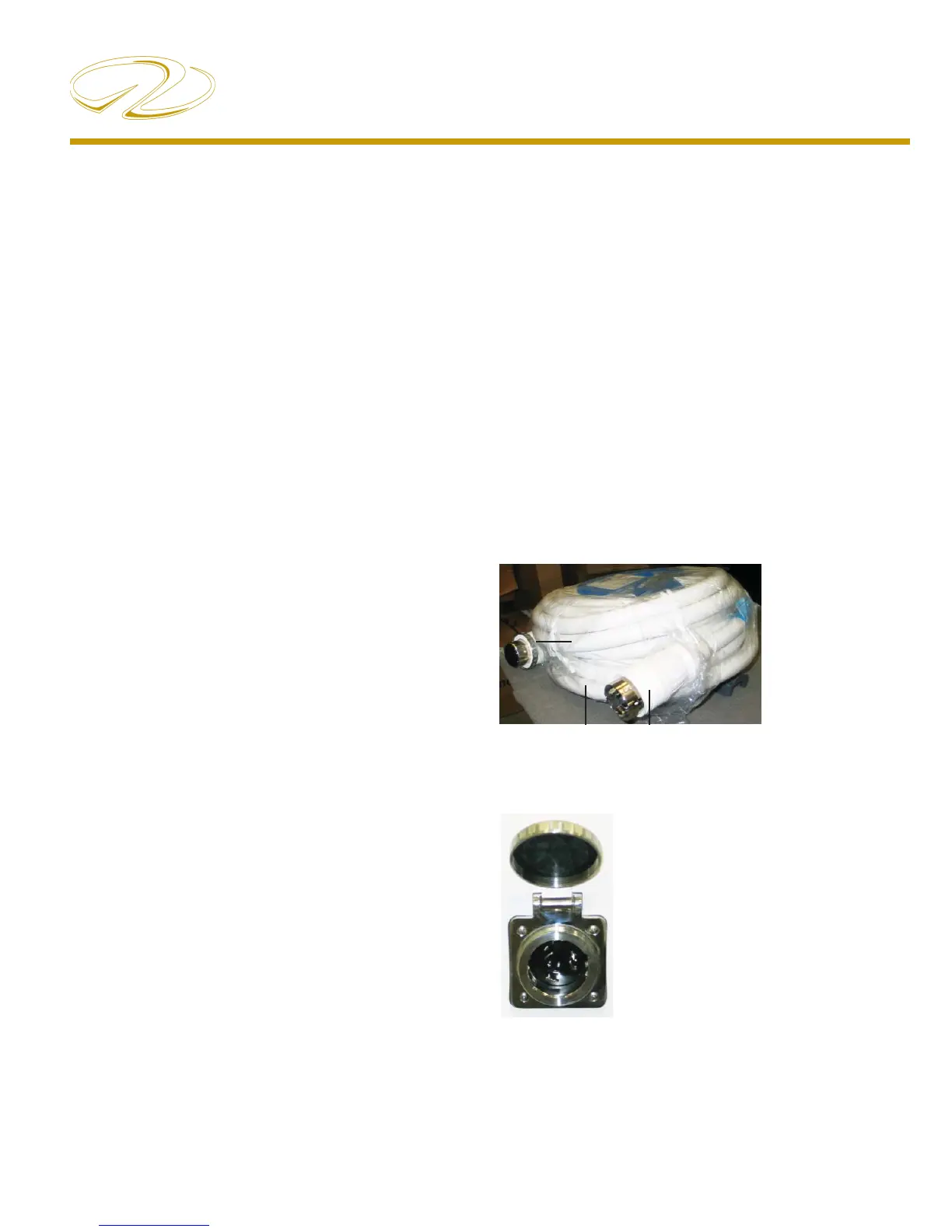
Used in both earlier and later systems the dockside cord
is the basic component used to deliver up to 50 amps of
electricity from the marina dock power box to the yacht
itself.
Before plugging in
the dockside power
cord check to see
that all yacht AC
breakers are off. This
includes the incoming
as well as both the
main and equipment
breakers at the AC
ship’s control panel.
See the AC panel illustration later in this
chapter.
When connecting the shore power
cord be sure to twist the cord into
the yacht inlet plug fi rst. The inlet
plug is located on the aft deck. The
cord installs one way only. Align the
2 pins with the 90 degree shape, (or
use the imprinted arrows and detentes
located on the stainless steel part of
the inlet), insert the cord end straight
into the inlet plug and twist in a clockwise direction to lock
in place. Screw the threaded sealing ring into the shore
power inlet until tight. This protects the inlet and cord
pins from moisture.
DOCKSIDE (SHORE POWER) CORD SYSTEM
MARINA PLUG
IN END
YACHT INLET
PLUG IN END
50 FT. 50 AMP
CORD
YACHT INLET



 To Next Page