driving recommendations ..........................
(current page)
fuel consumption .......................................
(current page)
2.36
ENG_UD79887_5
Conseils de conduite, éco conduite (HJB - Renault)
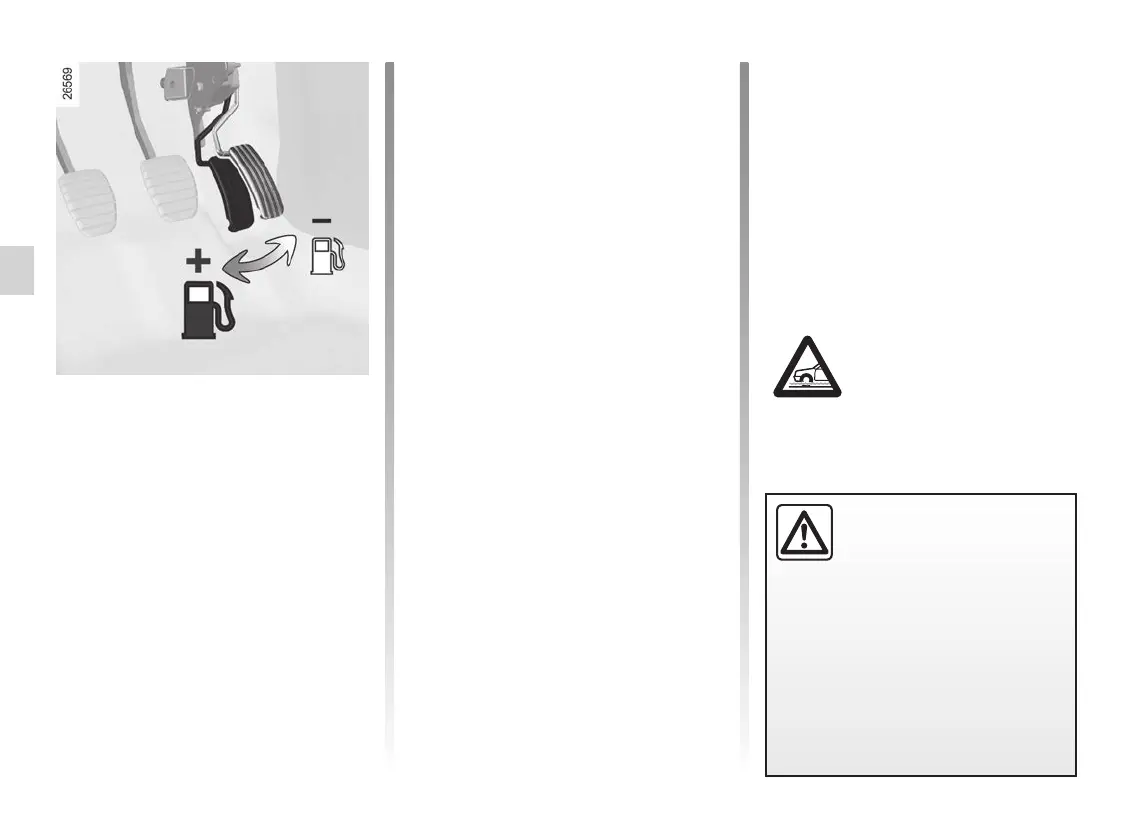
– Do not try to maintain the same
speed up a hill, accelerate no more
than you would on flat ground. Keep
your foot in the same position on the
accelerator pedal.
– Double declutching and accelerating
before switching off are unnecessary
in modern vehicles.
– Bad weather, flooded roads:
Do not drive through
floods if the water is
above the lower edge of
the wheel rims.
DRIVING ADVICE, ECO DRIVING (7/8)
Driving advice and ECO
driving
Heating levels
It is normal to notice an increase in the
vehicle’s fuel consumption when using
the heating (particularly when the out-
side temperature drops below zero) or
air conditioning.
Behaviour
– Drive carefully for the first few miles
until the engine reaches its normal
operating temperature, rather than
let it warm up while the vehicle is sta-
tionary.
– High speeds significantly affect the
vehicle’s fuel consumption.
Examples (at a steady speed):
– reducing the speed from 80 mph
(130 km/h) to 68 mph (110 km/h)
approximately saves up to 20% of
fuel approximately;
– reducing the speed from 56 mph
(90 km/h) to 50 mph (80 km/h) ap-
proximately saves up to 10% of
fuel approximately.
– Dynamic driving involving heavy and
frequent acceleration and braking is
expensive on fuel in comparison to
the time saved.
– Do not over rev the engine in the in-
termediate gears. You should always
use the highest gear possible.
– Avoid sudden acceleration.
– Brake as little as possible. If you an-
ticipate an obstacle or bend in ad-
vance, you may then simply release
the accelerator pedal.
Obstructions to the driver
On the driver’s side, only
use mats suitable for the
vehicle, attached with the
pre-fitted components, and check
the fitting regularly. Do not lay one
mat on top of another.
There is a risk of wedging the
pedals.






 To Next Page