6
5. Features
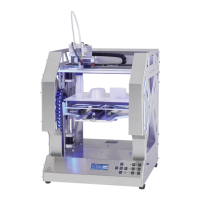
• Large printing space of approx. 245 x 230 x 200 mm
• Play-free profile rail guides and ball-threaded drives for maximum precision
• Automatic printing plate measurement
• Ceramics heating plate with structural surface
• Highly precise extruder with replaceable printing nozzle
• Integrated long-lived industrial mains unit
• Display and key pad for the device operation right at the device
• Control via a computer (USB) or stand-alone operation (with SD or SDHC card) possible
• Manual control of the printing parameters possible even during operation
• Extremely stable by aluminium/steel mechanics
• Suitable for all common standard roll filament types
• Breaking and abrasion-free cable guides across energy guide chains
• Future-proof with optional accessories
6. Working Principle of the 3D Printer
For 3D print, first a file is needed that contains the three-dimensional data of the object to be printed (a common format of such a
file is, e.g., a .stl-file).
This file can be produced with the corresponding software or with a 3D-scanner. There are also many printing files already online
that can be downloaded to print an object as quickly as possible.
The actual printer software has the task to render the above three-dimensional file into a file that the printer can print. This is a
file in which the individual print layers, the print temperatures for printing head and heating bed, etc. are specified. The file has
the extension “.gcode”.
This GCODE printing file is sent to the 3D printer either via the USB interface by the computer, or an SD card with the printing file
is put into the card reader and the 3D printer is used in standalone operation.
The 3D printer then prints the print file layer for layer according to the FFF (Fused Filament Fabrication) / FDM (Fused Deposition
Modelling) procedure.
At the actual print, the filament material is transported from the filament roll to the print head (extruder).
In the extruder, the filament material is melted and then applied to the heating plate via a fine extruder nozzle layer by layer.
The heating plate moves in the Y and Z directions, the extruder moves in the X-direction. Thus, all prerequisites to produce a three-
dimensional object by horizontal application of the present layers are created.
A 3D printer is a highly complex device in which many parameters must be set depending on the printer, printed object
and filament material used.
Additionally, the adhesion of the printed object on the printing plate is influenced by printing plate temperature, fila
-
ment material, shape of the printed object and surface properties of the printing plate.
Ambience influences such as drafts, grease on the printing plate, etc. also play a role in the quality and adhesion of the
printed object.
For the above reasons, it is not possible to achieve high-quality print results at once and without previous experi
-
ments.
Change the adjustable parameters in small steps to achieve the best printing results for your application. The printing
examples enclosed on the SD-card provide references, but must be refined for perfect results depending on the above
parameters.


 To Next Page