UG-OPUS® 5-80R
OPUS® 5-80R Pre-packed Chromatography Columns
2. If column storage solution is alcohol based, run equilibration buffer at low flow rate (i.e. 50
cm/hr) for 2-3 column volumes. Because Ethanol solution is more viscous than water, the
flow rate of this step should be chosen such that the pressure drop on the column does not
exceed the maximum operating pressure.
3. After the storage solution has been removed, condition the column with the equilibration
buffer for 1-2 column volumes at column qualification testing flow rate.
4. Proceed to testing the column:
4.1. Note: refer to your column’s CoA or CoQ for the test “Mobile Phase” and “Testing Flow
Rate” used by Repligen.
5. Conduct a pulse injection with 1-2% CV of the Injection Solution.
5.1. Note: refer to your column’s CoA or CoQ for the “Injection Solution” and “Injection
Volume” used by Repligen.
6. Elute with mobile phase for 1-2 CV at the same test flow rate while monitoring UV or
conductivity depending on the Injection Solution.
6.1. Salt injection solutions are typically analyzed with a conductivity meter while acetone
injection solutions are analyzed with an UV meter.
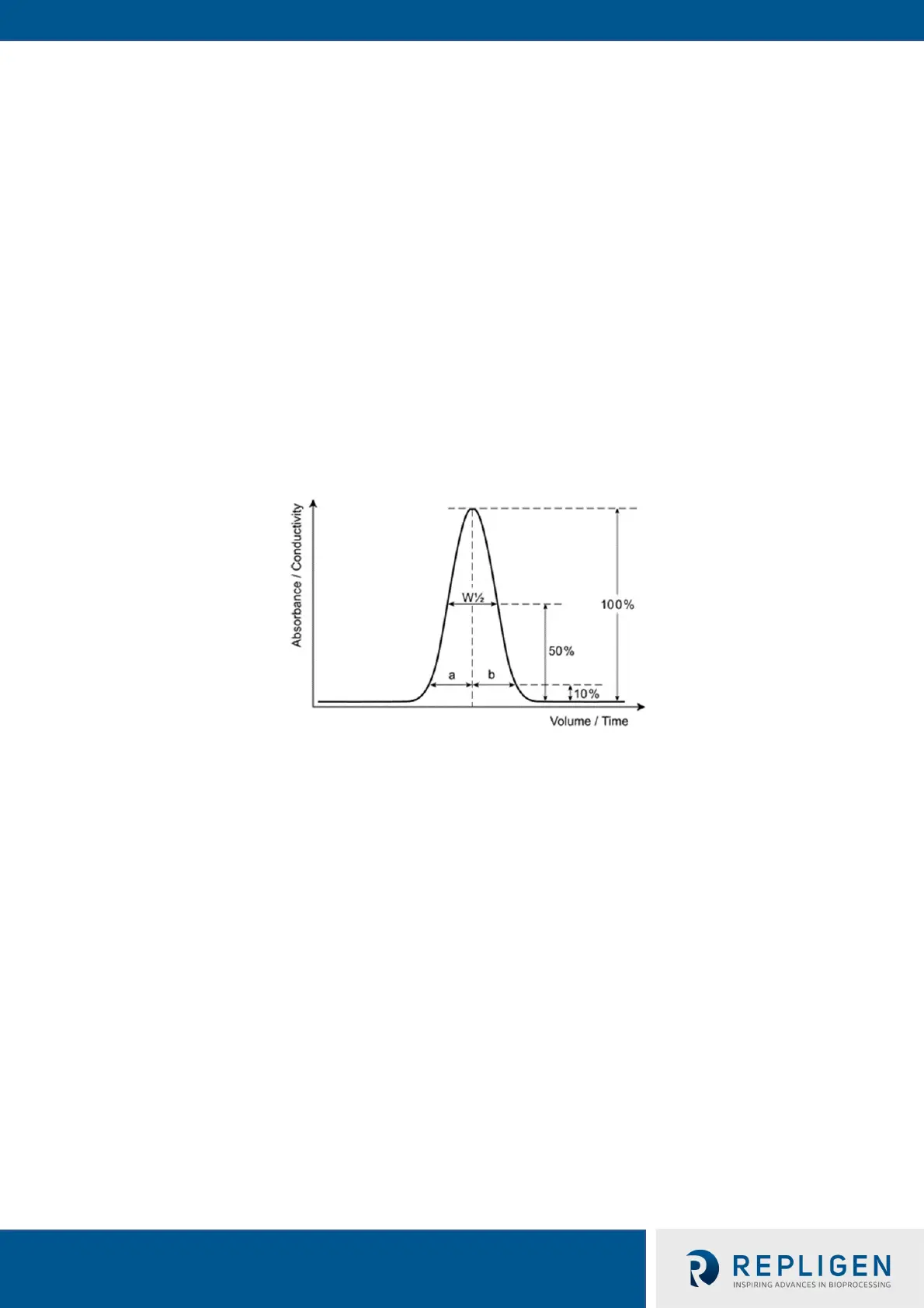
6.2. Calculate number of theoretical plates and asymmetry of the eluted peak:
Figure 8. Absorbance / Conductivity Graph
Theoretical Plate
Count: N= 5.54 x (V
R
/W
1/2
)
2
, assuming a Gaussian peak
Where:
N = number of theoretical plates
V
R
= peak retention (elution) volume
W
1/2
= peak width at half height
Asymmetry: As = b/a
Where:
a = partial peak width at 10% of the peak height for the leading part of the peak
b = partial peak width at 10% of the peak height for the tailing part of the peak
If the plate count and asymmetry measurements are within defined acceptance limits (reference the
column’s CoA or CoQ “QC Release Data”) then the column should be considered fit for purpose.


 To Next Page