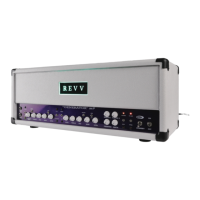
REVV | D25
15
TORPEDO REMOTE &
REACTIVE LOAD
REACTIVE LOAD
40
The D25 is equipped with a Two-notes reactive load to
allow you to play & record without needing a microphone
all while retaining perfect tone & feel. The Speaker
Load push button on the front of the amplifier selects
between internal load (in) & speaker load (out). You
can switch freely between the two modes as needed.
You do not need to unplug the D25’s combo speaker
to play silently - selecting Speaker Load on the front
panel will disable output to the D25’s speaker. Of
course, by leaving the speaker active - you may use
both the speaker & direct XLR output simultaneously.
For example, using D25 for stage volume, & sending
an XLR to front of house.
BALANCED DIRECT-XLR-OUT
41
The balanced Direct-XLR-Out jack on the rear of the
amplifier is a direct output from the Two-notes Torpedo-
embedded. The purpose of this output is to be used
with audio interfaces to exclude the use of an actual
microphone, using virtual cabinets instead.
To connect D25 to an audio interface, use an XLR
cable and set the amplifier up how you intend to play
(EQ, volume, etc.) Adjust the Output Level control until
the Clip Warning LED illuminates, and then back it o
slightly until you get no further clipping. For further
instructions specific to your circumstances, consult
your interface’s manual.
Note: The reverb or other eects that Two-notes Torpedo-
embedded provides will only be available through the
output of the headphone or XLR jacks and not the
cabinet itself. The speaker output will always behave
normally & independently of your Two-notes settings.
As a bonus, some users will find this useful for “wet/dry”
setups in which they send a signal that utilizes reverb
to front of house, while playing through a dry cabinet.
TORPEDO REMOTE
42
The D25 can be connected to Two-notes Remote
software via the rear USB port for the organization of
presets & deep-editing of their settings.
You can find the Remote Software for the D25 here:
http://www.two-notes.com/downloads.
Once you connect the D25 to your computer using
the provided USB cable, your computer will recognize
the D25. This may take a few minutes. Once complete,
open the Remote Software, and the D25 will connect.
Once connected, you can tweak all available Torpedo-
embedded DynIR settings to your preferences!
Note: If you are new to studio practices such as mic
placement, the dierence in tonalities between speakers,
and more - Two-notes has a wealth of resources
available throughout their channels to get you started.
Of course, the presets are the best start in this situation!



 To Next Page