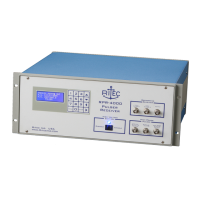
RPR-4000
Operations manual
REV 8-21 20
6. View the broadband receiver output on the oscilloscope. You should see the
signal from your signal generator amplified to 1 V peak to peak.
7. Please note that the receiver has a blanking function which will not be coherent
with your signal. Because of this seen you may see a randomly appearing or
moving blank space in your signal on the oscilloscope. This is normal.
Setting up a pulse-echo measurement
Operating the RPR-4000 Pulser/Receiver in the two standard modes of operation (Pulse-
Echo and Through Transmission) is very straight forward.
For Pulse-Echo operation, proceed as follows:
1. Connect a short coaxial cable from “Diplexer Output to Receiver” to Receiver
“Input Number 1”.
2. If using a piezo-electric transducer, connect coax cables from “High Power RF
Pulse Output” to an RT-150 (150 ohm high power load) and then to an
appropriate transducer.
3. If a low impedance transducer (e.g., an electromagnetic acoustic transducer) is
used, then 150 ohm load is not required.
4
4. Connect a coaxial cable from “Trigger Out” on the rear panel of the RPR-4000 to
the external trigger input on the oscilloscope.
5. Connect a coaxial cable from receiver “Output” to a 50 ohm vertical input on the
scope. Set scope vertical sensitivity to 0.5 V per division.
6. Connect a coaxial cable from “RF Pulse Monitor” to a 50 Ω terminated input on
the oscilloscope. Set the vertical sensitivity to 1 V per division.
(Because the monitor output is down 40 dB [100:1] this vertical sensitivity then
corresponds to 100 V at the pulser output per division).
7. Using the keypad on the front panel set the various operating parameters as
follows:
Page 1 – Pulser settings 1/2
Frequency: Transducer center frequency
Pulse Width: 5 cycles
4
The 150 Ω termination on the output serves two functions: 1.) Cleans up the base line
during the RF pulse and 2.) Allows the control algorithm for output level to function with
higher resolution.


 To Next Page