Need help?
Do you have a question about the Robe Robin BMFL Blade and is the answer not in the manual?
Caution about high voltage and risk of electric shock when touching wires.
Warning about hot housing and cooling period before handling.
Instruction to disconnect power via cable, check cord for damage.
Requirement for qualified personnel for electrical connections and servicing.
Caution against looking directly into the light source.
Specifies professional-only use and advises against extreme heat, moisture, or dust.
Procedure for safe fixture shutdown and lamp handling.
Guidelines for installation spots and mandatory safety rope use.
Warning regarding lamp ignition with open covers.
Specifies the maximum allowable ambient temperature limit of 45°C.
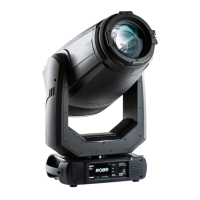
Identifies external components of the fixture head.
Lists and identifies connectors on the rear panel.
Lists and identifies controls on the front panel.
Mandates installation by a qualified electrician following local codes.
Essential safety instruction for earthing the fixture to prevent electric shock.
Details power cable core colours and their corresponding connections.
Warning against connecting the fixture to a dimmer system.
Critical safety warning for lamp installation with power off and unplugged.
Detailed instructions for inserting a new lamp.
Prohibits operation with the lamp cover open.
Steps for adjusting the lamp's position and focus for optimal light performance.
Safety instruction for filter replacement with power off.
Explanation of how dichroic filters are attached to the colour wheel via magnets.
Safety instruction for gobo replacement and handling bare fingers.
Critical instruction for correct gobo holder reinsertion orientation.
Procedure for installing handles for Follow Spot Mode.
Safety instruction for light frost module replacement with power off.
Safety warning for lamp replacement, emphasizing protection and cooling.
Requirement for certified structures and adherence to installation codes.
Mandates safety wire with 10x weight capacity for overhead rigging.
Prohibition of personnel presence below the fixture during rigging/servicing.
Fire hazard warning: keep flammable materials at least 1m away.
Procedure for truss mounting using clamps and safety wires.
Specification for suitable shielded twisted-pair DMX cabling and connectors.
Method for connecting fixtures in a serial DMX chain.
Instruction for terminating the last fixture in a DMX chain.
Describes ArtNet protocol for Ethernet connection.
Explanation of IP addresses in networking.
Connecting fixtures to Ethernet network and setting IP/Universe.
Configuring "Ethernet To DMX" mode for the first fixture.
Reminder to terminate the DMX chain at the last fixture.
Details of the lamp and its power settings.
Explanation of cold restrike lamp behavior.
Description of Colour Wheel 1 contents and features.
Description of Colour Wheel 2 contents and features.
Functionality of the effect wheel.
Description of static and rotating gobo wheels.
Details about the prism system.
Description of the frost module's capabilities.
Features of the motorized iris.
Specifications of the motorized zoom unit.
Capabilities of the motorized focus.
Function of the shutter unit for strobe effects.
Operation of the mechanical dimmer unit.
Description of fast pan/tilt movement with motion stabilizer.
Specifies the operational ranges for tilt and pan movements.
Overview of the framing system and its shutters.
DMX Address setting and DMX Preset selection.
Ethernet Mode configuration and IP/Net Mask settings.
Fixture times, temperatures, software versions, and error logs.
Menu item to select user profiles (A or B).
Menu item to select DMX signal input mode.
Menu item to set pan/tilt movement behaviour.
Menu item to configure blackout conditions.
Menu item to change touch screen settings.
Menu item to change temperature unit (°C to °F).
Menu item to set fan mode (Auto or High).
Selects the dimmer curve (Linear or Square Law).
Menu to reset fixture modules or all modules.
Runs test/demo sequences and uses all functions for introduction.
For projections without pan/tilt, and sound control activation.
Selects programs to loop and starts test sequences or user programs.
Creates or edits desired programs.
Sets effects to desired positions before fine calibration.
Opens light output for fine lamp adjustment.
Fine adjustment for various effects like Pan, Tilt, and Colour Wheels.
Calibration for framing shutters and prisms.
Menu item to update software via PC.
Description of the QVGA touch screen with battery backup.
Identifies the physical control buttons and their functions.
Navigation, action, and function icons used in the menu.
Initial screen display and explanation of the battery status indicator.
Setting the DMX start address.
Selecting the DMX channel mode.
Configuration menu for Ethernet operation.
Ethernet to DMX conversion and protocol settings.
Setting the IP address and Net Mask.
Setting parameters for MANet and sACN operations.
Resettable hours, remaining lamp hours, and resettable strikes.
Importance of air filter cleaning for performance and life.
Viewing internal fixture temperatures (Head, Base, Ambient).
Reading DMX values of received channels.
Reading wireless operation status.
Reading software versions of fixture modules.
Menu for reading MAC Address, RDM UID, and RDM Label.
Menu to read fixture error messages.
Error messages for gobo, focus, zoom, and base overheating.
Recalls two user settings (User A and User B).
Selects DMX mode and input type (Wired/Wireless).
Pan/Tilt Reverse and Feedback settings.
Sets pan/tilt movement mode (Time or Speed).
Active Blackout Triggers and Timeout Blackout Function.
Display Intensity, Screen Saver, Touchscreen Lock/Calibration.
Changes display orientation and temperature unit (°C to °F).
Sets fan mode and selects dimmer curve.
Sets date and time for fixture log system.
Resets all fixture parameters to factory defaults.
Menu to reset fixture modules or all modules.
Controls fixture channels via the control panel.
Runs test/demo sequences and uses all functions for introduction.
For projections without pan/tilt, and sound control activation.
Selects programs to loop and starts test sequences or user programs.
Creates or edits desired programs.
Adjusting program length using Start/End Step.
Sets effects to desired positions before fine calibration.
Opens light output for fine lamp adjustment.
Fine adjustment for various effects like Pan, Tilt, and Colour Wheels.
Calibration for framing shutters and prisms.
Steps for calibrating effects via the control board.
Performing calibration using a DMX controller.
Lists effects and their corresponding DMX channels for calibration.
Loads default factory calibration values.
Calibrates the pan/tilt electronic motion stabilizer.
Menu item to update software via PC.
Switches the lamp on/off and configures lamp behavior.
Offers two lamp power levels and Quiet mode.
Sets time delay for ignition and configures light sensor.
Sets rules for automatic lamp switching based on DMX presence.
Overview of RDM support and its bi-directional communication protocol.
Lists available RDM commands for the fixture.
Identifies parameters for RDM commands.
Details on the wireless DMX module and its operation.
Activating wireless DMX via the DMX Input menu.
Procedure for linking fixture with DMX transmitter.
Procedure for unlinking the fixture from the receiver.
Air filter cleaning and lamp time remaining icons.
Active lamp timer, lamp errors, and overheating messages.
Messages for sensor communication failure and internal errors.
Error messages for colour wheel and individual colour flags.
Error messages for prism and zoom module positioning.
Error messages for focus module positioning.
Messages indicating power supply or battery failure.
Diagram showing the location of various fans within the fixture.
Power supply, voltage, and consumption details.
Details of the Osram Lok-it! HTI 1700/PS lamp.
Reflector and zoom range specifications.
CMY + CTO mixing module features.
Rotating and static gobo wheel features.
Touch screen, sensor, protocols, and DMX modes.
Details on the wireless DMX module and its features.
Number and rotation range of framing blades.
Pan/Tilt movement ranges, resolution, control, and locking.
Maximum ambient and housing temperature limits.
Minimum distance from flammable surfaces and objects.
DMX, ArtNet, and AC power connection types.
Total heat dissipation and net weight of the fixture.
Visual representation of fixture dimensions.
Part numbers for standard accessories.
Part numbers for optional accessories.
1700W, 1500W, and Quiet mode data at minimum zoom.
Critical safety warning for maintenance procedures.
Front lens, interior, filters, gobos, and wheels cleaning frequency.
Importance of periodic air filter checks and cleaning.
Steps for replacing the fuse safely.
Records changes and versions of the user manual.
 General
| Pan Range | 540° |
|---|---|
| Tilt Range | 270° |
| Input Voltage | 100-240 V AC, 50/60 Hz |
| Frost | Variable frost |
| Voltage | 100-240 V AC, 50/60 Hz |
| Dimming | 0 - 100% |
| Control Protocol | DMX, RDM, Art-Net |
| Gobo Wheel 1 | Rotating gobo wheel with replaceable gobos + open |
| Framing Shutters | 4 independently controllable framing shutters |
| Cooling | Forced air cooling |
| Control | DMX |

 To Next Page