EasyManua.ls Logo

Saab 96 - Driving Safety and Economy Tips

Saab 96
68 pages
Print Icon
To Next Page IconTo Next Page
To Previous Page IconTo Previous Page
Loading...
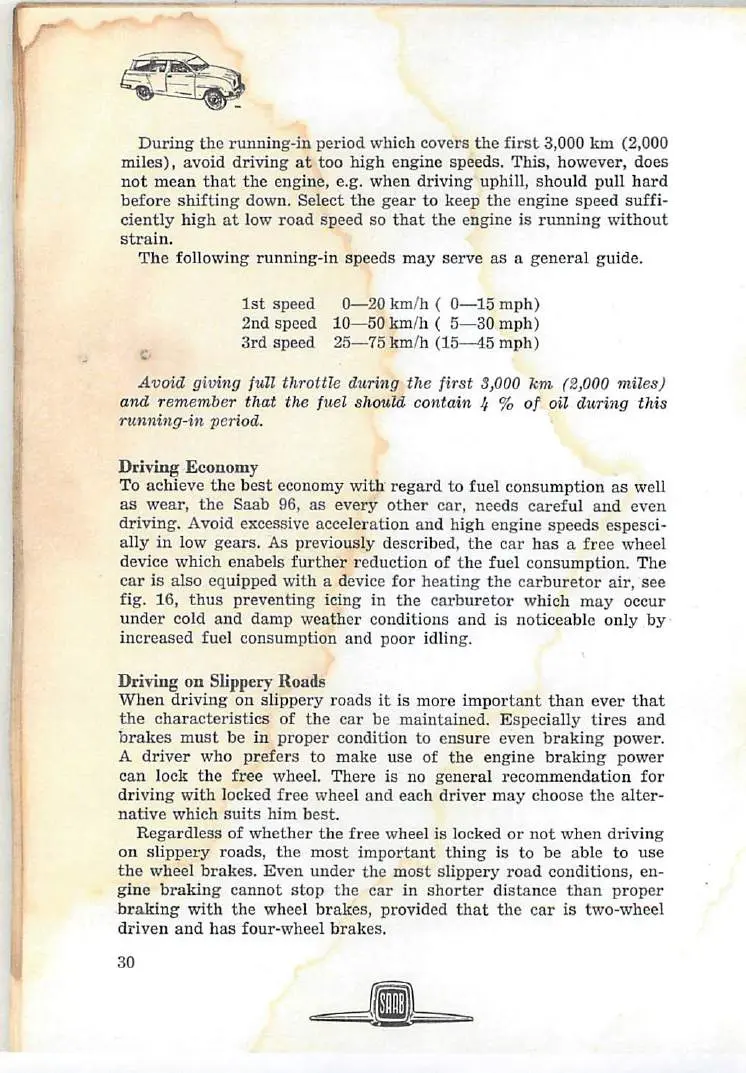
During
the
running-in
period
which
covers
the
first
3,000
km
(2,000
miles),
avoid
driving
at
too
high
engine
speeds.
This,
however,
does
not
mean
that
the
engine,
e.g.
when
driving
uphill,
should
pull
hard
before
shifting
down.
Select
the
gear
to
keep
the
engine
speed
suffi
ciently
high
at
low
road
speed
so
that
the
engine
is
running
without
strain.
The
following
running-in
speeds
may
serve
as
a
general
guide.
1st
speed
0—20
km/h
(
0—15
mph)
2nd
speed
10—50
km/h
(
5—30
mph)
3rd
speed
25—75
km/h
(15—45
mph)
Avoid
giving
full
throttle
during
the
first
3,000
km
(2,000
miles)
and
remember
that
the
fuel
should
contain
Jf
%
of
oil
during
this
running-in
period.
Driving
Economy
To
achieve
the
best
economy
with
regard
to
fuel
consumption
as
well
as
wear,
the
Saab
96,
as
every
other
car,
needs
careful
and
even
driving.
Avoid excessive
acceleration
and
high
engine speeds espesci-
ally
in
low
gears.
As
previously
described,
the
car
has
a
free
wheel
device which enabels
further
reduction
of
the
fuel consumption.
The
car
is
also
equipped
with
a device
for
heating
the
carburetor
air,
see
fig. 16,
thus
preventing icing in
the
carburetor
which
may
occur
under
cold
and
damp
weather
conditions
and
is
noticeable
only
by
increased
fuel
consumption
and
poor
idling.
i
Driving on Slippery Roads
When
driving
on
slippery
roads
it is
more
important
than
ever
that
the
characteristics
of
the
car
be
maintained.
Especially
tires
and
brakes
must
be
in
proper
condition
to
ensure
even
braking
power.
A
driver
who
prefers
to
make
use
of
the
engine
braking
power
can
lock
the
free
wheel.
There
is no
general
recommendation
for
driving
with
locked
free
wheel
and
each
driver
may
choose
the
alter
native
which
suits
him
best.
Regardless
of
whether
the
free
wheel
is
locked
or
not
when
driving
on
slippery
roads,
the
most
important
thing
is
to
be
able
to
use
the
wheel
brakes.
Even
under
the
most
slippery
road
conditions,
en
gine
braking
cannot
stop
the
car
in
shorter
distance
than
proper
braking
with
the
wheel
brakes,
provided
that
the
car
is
two-wheel
driven
and
has
four-wheel
brakes.
30

Table of Contents

Related product manuals